
To prevent a dangerous runaway condition, a muffle furnace employs a critical, independent safety mechanism that automatically cuts all power to its heating elements. This function is typically handled by an open circuit safety trigger, which acts as a definitive fail-safe. It is designed to activate if the primary temperature control system fails, ensuring the furnace cannot heat uncontrollably.
A muffle furnace's protection against thermal runaway is not a single feature, but a layered system. While an independent safety circuit provides the ultimate failsafe, the furnace's fundamental design—from its precise digital controller to its insulated inner chamber—is engineered to maintain thermal stability from the start.
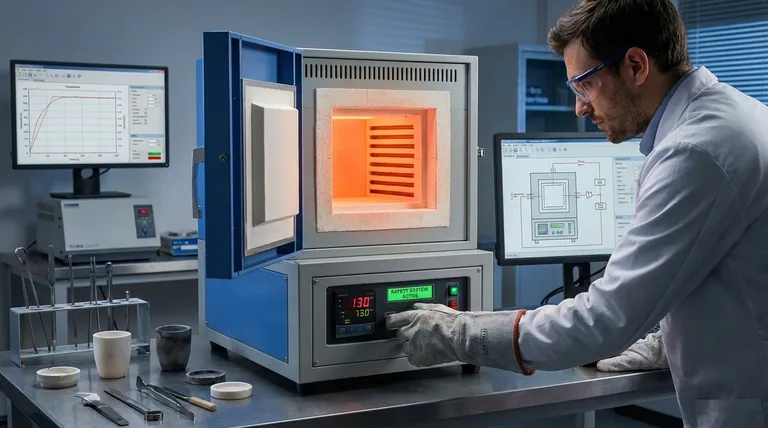
The Core Safety Mechanism: The Open Circuit Trigger
The primary defense against a runaway condition is a system designed to fail safely. This is the role of the open circuit trigger or a similar over-temperature protection circuit.
How it Works
An open circuit safety trigger constantly monitors the furnace's temperature, independent of the main controller. If it detects a temperature that exceeds a preset safety limit, it physically interrupts the electrical circuit.
This action is decisive, removing all power to the heating elements. The furnace cannot get hotter because the source of energy has been completely disconnected.
Why it's a "Fail-Safe"
This system is engineered so that its default state in the event of a fault is "off." If the sensor that provides feedback to the main controller breaks or detaches, the safety circuit will detect the resulting overheating and shut the system down.
This prevents the most common cause of runaway: a faulty sensor telling the controller the furnace is cold, causing it to send maximum power to the heaters indefinitely.
A System Designed for Stability
While the safety trigger is the final line of defense, the furnace's normal operating components are all designed to ensure precise and stable temperature, making a runaway event unlikely in the first place.
The Role of the Temperature Controller
The digital controller is the brain of the operation. It continuously compares the user's desired temperature (the setpoint) with the actual temperature measured by a thermocouple inside the chamber.
Based on this comparison, it precisely modulates the power sent to the heating elements, making thousands of tiny adjustments to maintain a consistent temperature.
The Function of the Muffle Chamber
The "muffle" itself—a separate inner chamber, often ceramic—plays a key role in thermal stability. It shields the sample from direct radiation from the heating elements.
This creates a more uniform, gentle heating environment and adds thermal mass, which helps to dampen any rapid temperature fluctuations and prevent overshoot.
The Importance of High-Efficiency Insulation
Modern muffle furnaces use advanced insulation. Its primary job is to keep heat inside for energy efficiency, but it also contributes to stability.
By minimizing heat loss to the outside environment, the insulation allows the controller to maintain a set temperature with less effort and power fluctuation, leading to a more predictable and stable system.
Understanding the Primary Failure Point
Despite robust designs, the most critical vulnerability in any high-temperature system is sensor failure. Understanding this risk clarifies why the safety circuit is so essential.
The Risk of a Detached Thermocouple
The thermocouple is the furnace's only way of knowing its internal temperature. If it becomes dislodged or breaks, it may begin reading the cooler ambient room temperature instead of the hot chamber.
The controller, believing the furnace is cold, will then command the heating elements to run at 100% power continuously. This is the classic runaway scenario that the independent open circuit protection is built to prevent.
Controller Malfunction
While far less common, the primary temperature controller itself could theoretically fail in a state that leaves the power to the heaters "on." An independent safety circuit that bypasses the main controller entirely is the only reliable protection against this type of hardware failure.
Making the Right Choice for Your Goal
By understanding these integrated systems, you can ensure your processes are both safe and accurate.
- If your primary focus is safety: Regularly verify that the over-temperature protection system is functional and that the thermocouple is securely mounted and in good condition.
- If your primary focus is process accuracy: Periodically calibrate your temperature controller and thermocouple to ensure the temperature you set is the true temperature your sample experiences.
- If your primary focus is equipment longevity: Operate the furnace within its specified temperature limits and avoid unnecessarily rapid heating cycles that can stress components over time.
By trusting its layered safety and control systems, you can operate your muffle furnace with full confidence in its precision and reliability.
Summary Table:
| Component | Role in Preventing Runaway | Key Feature |
|---|---|---|
| Open Circuit Trigger | Cuts power if temperature exceeds limit | Independent safety mechanism |
| Temperature Controller | Maintains stable temperature via feedback | Digital precision control |
| Muffle Chamber | Shields samples and adds thermal mass | Uniform heating environment |
| Insulation | Reduces heat loss and stabilizes system | High-efficiency material |
| Thermocouple | Monitors temperature for controller input | Critical for accurate readings |
Ensure your lab's safety and precision with KINTEK's advanced high-temperature furnaces. Leveraging exceptional R&D and in-house manufacturing, we provide diverse laboratories with reliable solutions like Muffle, Tube, Rotary Furnaces, Vacuum & Atmosphere Furnaces, and CVD/PECVD Systems. Our strong deep customization capability precisely meets your unique experimental needs. Contact us today to discuss how our furnaces can enhance your operations and prevent risks like thermal runaway!
Visual Guide

Related Products
- 1400℃ Muffle Oven Furnace for Laboratory
- 1700℃ High Temperature Muffle Oven Furnace for Laboratory
- 1800℃ High Temperature Muffle Oven Furnace for Laboratory
- 1200℃ Muffle Oven Furnace for Laboratory
- High Temperature Muffle Oven Furnace for Laboratory Debinding and Pre Sintering
People Also Ask
- How does a high-temperature laboratory muffle furnace affect material properties? Transform Anodic Oxide Films Fast
- What is the primary function of a high-temperature laboratory muffle furnace in chemical synthesis? Achieve Precision.
- What is the muffle furnace function in ilmenite oxidative roasting? Enhance Phase Change & Magnetic Separation
- What are the primary objectives of using a muffle furnace in zirconia synthesis? Achieve precision phase control.
- How is a laboratory high-temperature muffle furnace utilized in g-C3N4 synthesis? Optimize Your Thermal Polycondensation



















