
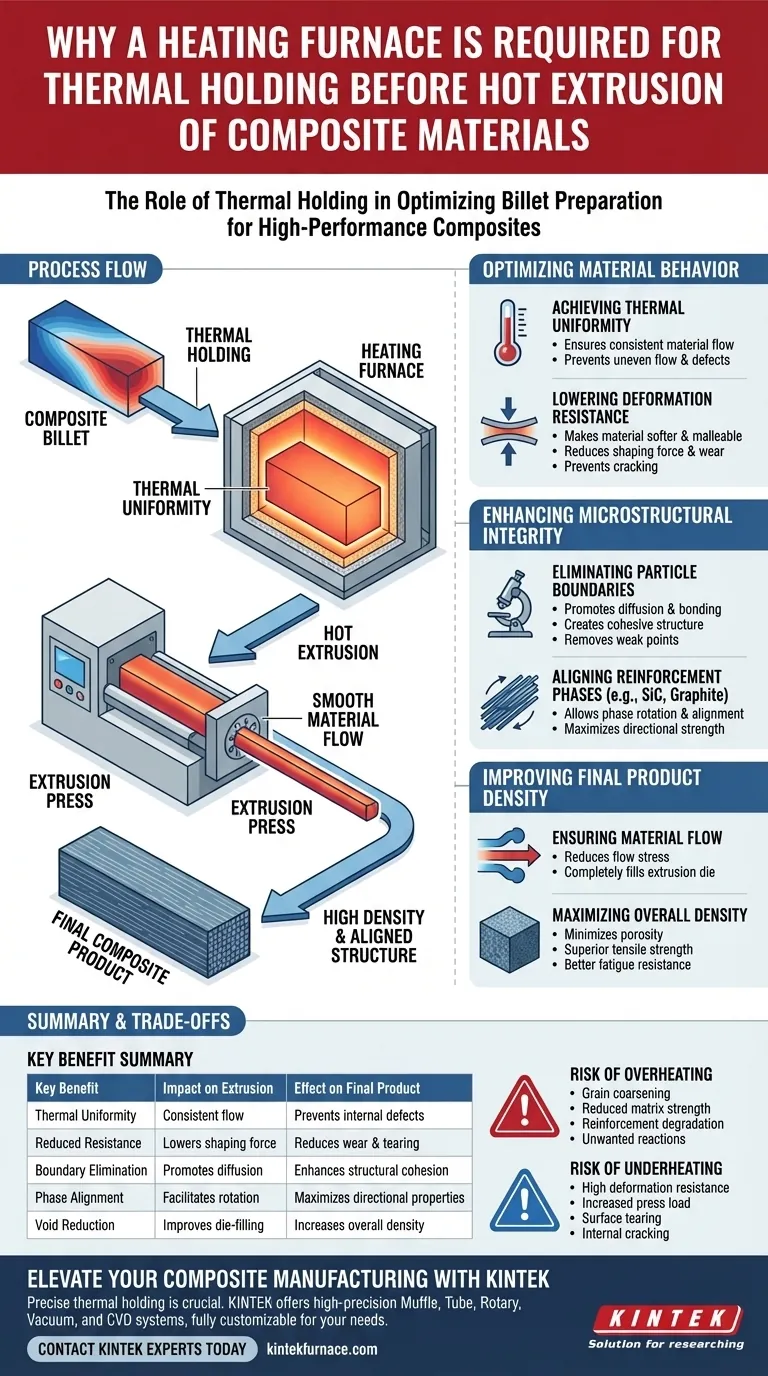
Thermal holding plays a pivotal role in preparing composite billets for the intense physical stress of hot extrusion. By utilizing a heating furnace to maintain a specific temperature, you ensure the material achieves thermal uniformity, which significantly lowers its resistance to deformation and guarantees smooth flow during the extrusion process.
The primary purpose of thermal holding is to homogenize the material's temperature, thereby reducing deformation resistance and optimizing microstructural alignment. This pre-processing step is essential for achieving high density and eliminating particle boundaries in the final composite product.
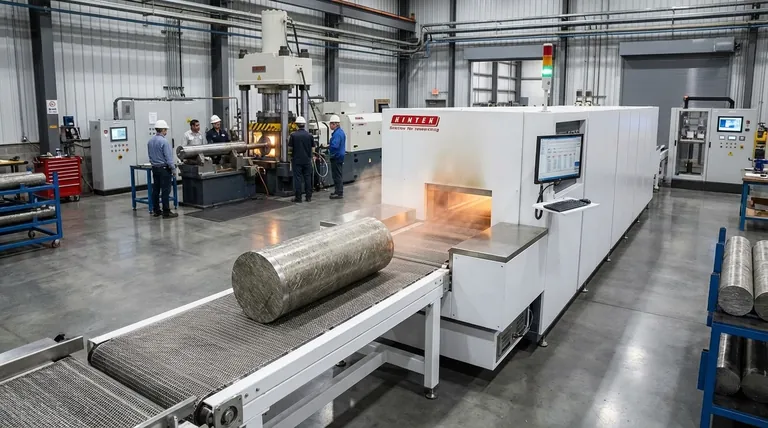
Optimizing Material Behavior
Achieving Thermal Uniformity
The core function of the heating furnace is to bring the entire billet to a consistent, specific temperature.
Without this uniformity, temperature gradients within the material would lead to uneven flow, causing defects in the final product.
Lowering Deformation Resistance
When the composite is held at the correct elevated temperature, the material becomes softer and more malleable.
This lowers the force required to shape the material, reducing wear on the extrusion equipment and preventing the billet from cracking under pressure.
Enhancing Microstructural Integrity
Eliminating Particle Boundaries
Thermal holding promotes diffusion and bonding between the constituent particles of the composite.
This process helps eliminate distinct particle boundaries, which are often the weakest points in a composite material. Removing these boundaries creates a more cohesive and continuous structure.
Aligning Reinforcement Phases
The combination of heat and the subsequent extrusion flow has a specific effect on reinforcements, such as Silicon Carbide (SiC) and graphite.
Proper thermal holding allows these phases to rotate and align along the extrusion direction. This directional alignment is critical for maximizing the mechanical strength of the composite along the axis of use.
Improving Final Product Density
Ensuring Material Flow
The reduction in flow stress allows the material to fill the extrusion die completely.
This ensures that internal voids are closed and that the material consolidates effectively during the process.
Maximizing Overall Density
By combining uniform heat with the pressure of extrusion, the porosity of the material is minimized.
A higher overall density directly correlates to superior mechanical properties, such as tensile strength and fatigue resistance.
Understanding the Trade-offs
The Risk of Overheating
While heating is essential, exceeding the optimal temperature or holding the material for too long can be detrimental.
Excessive heat may cause grain coarsening, which reduces the strength of the matrix material. It can also degrade certain reinforcement phases or cause unwanted chemical reactions at the interface between the matrix and the reinforcement.
The Risk of Underheating
Conversely, failing to reach the target temperature results in high deformation resistance.
This increases the load on the extrusion press and raises the likelihood of surface tearing or internal cracking due to poor material flow.
Ensuring Extrusion Success
To maximize the quality of your composite materials, you must tailor the thermal holding parameters to your specific performance targets.
- If your primary focus is Structural Integrity: Prioritize a holding time that ensures complete thermal saturation to fully eliminate particle boundaries.
- If your primary focus is Directional Strength: precise temperature control is vital to facilitate the flow required to align reinforcements like SiC and graphite without degrading them.
By strictly controlling the thermal holding environment, you transform a raw billet into a high-performance composite ready for demanding applications.
Summary Table:
| Key Benefit | Impact on Extrusion Process | Effect on Final Product |
|---|---|---|
| Thermal Uniformity | Ensures consistent material flow | Prevents internal defects and cracks |
| Reduced Resistance | Lowers the force required for shaping | Reduces equipment wear and surface tearing |
| Boundary Elimination | Promotes particle diffusion/bonding | Enhances structural cohesion and strength |
| Phase Alignment | Facilitates rotation of reinforcements | Maximizes directional mechanical properties |
| Void Reduction | Improves die-filling capability | Increases overall density and fatigue resistance |
Elevate Your Composite Manufacturing with KINTEK
Precise thermal holding is the difference between a failed extrusion and a high-performance composite. Backed by expert R&D and manufacturing, KINTEK offers high-precision Muffle, Tube, Rotary, Vacuum, and CVD systems, along with other specialized lab high-temp furnaces—all fully customizable to meet your unique material parameters.
Don't let temperature gradients compromise your material's integrity. Ensure perfect thermal saturation and microstructural alignment with our industry-leading heating solutions.
Contact KINTEK Experts Today to Discuss Your Custom Furnace Needs
Visual Guide
Related Products
- Multi Heating Zones CVD Tube Furnace Machine for Chemical Vapor Deposition Equipment
- Laboratory Quartz Tube Furnace RTP Heating Tubular Furnace
- Split Multi Heating Zone Rotary Tube Furnace Rotating Tube Furnace
- Vacuum Heat Treat Sintering Furnace with Pressure for Vacuum Sintering
- 2200 ℃ Graphite Vacuum Heat Treat Furnace
People Also Ask
- What is the function of a multi-zone tube furnace in CVD synthesis? Master 2D In2Se3 Nanosheet Precision
- Why are multi zone tube furnaces particularly useful for nanomaterial research? Unlock Precise Thermal Control for Advanced Synthesis
- What environmental protection applications utilize multi zone tube furnaces? Unlock Precision in Waste Treatment and Green Tech
- What temperature-related capabilities make multi zone tube furnaces valuable for research? Unlock Precision Thermal Control
- What role do multi zone tube furnaces play in new energy research? Unlock Precise Thermal Control for Innovation



















