
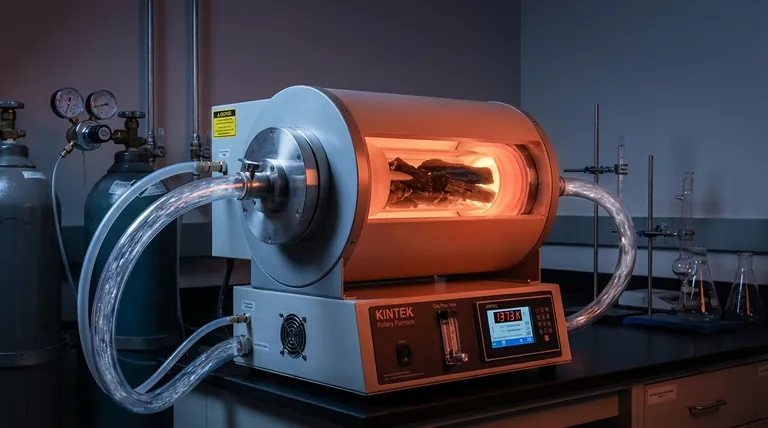
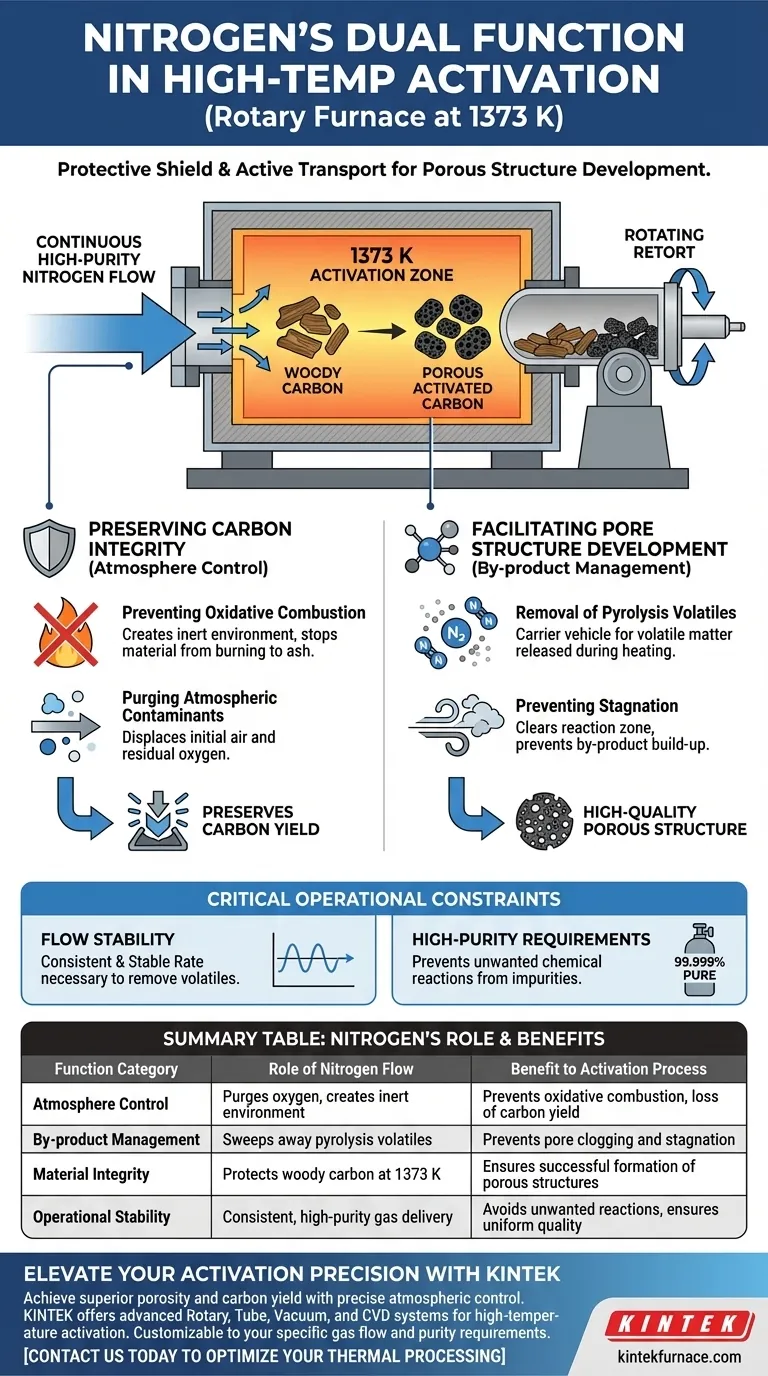
The primary function of continuous high-purity nitrogen gas in a rotary furnace at 1373 K is to act as both a protective shield and an active transport mechanism. It creates an inert environment that prevents the woody carbon source from burning to ash through oxidative combustion while simultaneously sweeping away volatile by-products to ensure the successful development of a porous structure.
By purging oxygen and removing exhaust gases, the nitrogen flow preserves the carbon yield and clears the microscopic pathways necessary for high-quality activation.
Preserving the Carbon Integrity
The first critical role of the nitrogen flow is to strictly control the chemical environment inside the reactor. At temperatures as high as 1373 K, the presence of oxygen is destructive to the activation process.
Preventing Oxidative Combustion
The nitrogen stream maintains an inert atmosphere around the carbon source. Without this protection, the woody material would undergo rapid oxidation (burning) before it could ever reach the activation temperature.
Purging Atmospheric Contaminants
Before the process fully begins, the gas flow serves to purge initial air from the rotary furnace. This displacement ensures that no residual oxygen remains trapped within the reactor to compromise the material.
Facilitating Pore Structure Development
Beyond protection, the physical movement of the gas is essential for the activation mechanics. The flow must be continuous and stable to manage the by-products of the reaction.
Removal of Pyrolysis Volatiles
As the material heats, it undergoes pyrolysis, releasing volatile matter. The nitrogen flow acts as a carrier vehicle, promptly transporting these compounds away from the solid carbon.
Preventing Stagnation
If gaseous by-products are allowed to linger, they can inhibit the reaction. The continuous flow clears the reaction zone, ensuring the process continues effectively toward the formation of a highly porous structure.
Critical Operational Constraints
While nitrogen is essential, the parameters of its delivery determine the success of the activation.
The Necessity of Flow Stability
The flow rate must be consistent and stable throughout the process. An unstable flow may fail to remove volatiles fast enough, potentially allowing them to re-deposit or interfere with pore formation.
High-Purity Requirements
The gas utilized must be high-purity. Impurities in the gas stream could introduce unwanted chemical reactions at 1373 K, defeating the purpose of the inert atmosphere.
Optimizing Your Activation Process
To maximize the efficacy of your rotary furnace operations, align your gas flow strategy with your specific production metrics.
- If your primary focus is maximizing carbon yield: Ensure the nitrogen purge is thorough and the system is completely sealed against air leaks to prevent oxidative loss.
- If your primary focus is maximizing surface area (porosity): Prioritize a stable, sufficient flow rate that aggressively removes volatiles to prevent pore clogging.
The correct nitrogen flow is the invisible backbone of the process, protecting the raw material while actively sculpting the final product's internal architecture.
Summary Table:
| Function Category | Role of Nitrogen Flow | Benefit to Activation Process |
|---|---|---|
| Atmosphere Control | Purges oxygen and creates inert environment | Prevents oxidative combustion and loss of carbon yield |
| By-product Management | Sweeps away pyrolysis volatiles | Prevents pore clogging and stagnation of the reaction |
| Material Integrity | Protects woody carbon sources at 1373 K | Ensures successful formation of high-quality porous structures |
| Operational Stability | Consistent, high-purity gas delivery | Avoids unwanted chemical reactions and ensures uniform quality |
Elevate Your Activation Precision with KINTEK
Achieving superior porosity and carbon yield requires more than just high temperatures—it demands precise atmospheric control. Backed by expert R&D and world-class manufacturing, KINTEK offers advanced Rotary, Tube, Vacuum, and CVD systems designed to handle the rigors of high-temperature activation.
Whether you are processing woody biomass or specialty carbons, our lab high-temperature furnaces are fully customizable to meet your specific gas flow and purity requirements. Contact us today to optimize your thermal processing and see how KINTEK can provide the specialized tools your research or production demands.
Visual Guide
References
- W. F. Spencer, Aleksandar N. Nikoloski. Sustainable Production of Activated Carbon from Waste Wood Using Goethite Iron Ore. DOI: 10.3390/su17020681
This article is also based on technical information from Kintek Furnace Knowledge Base .
Related Products
- Vacuum Sealed Continuous Working Rotary Tube Furnace Rotating Tube Furnace
- Electric Rotary Kiln Small Rotary Furnace Biomass Pyrolysis Plant Rotating Furnace
- Electric Rotary Kiln Continuous Working Small Rotary Furnace Kiln for Pyrolysis Plant Heating
- Electric Rotary Kiln Small Rotary Furnace for Activated Carbon Regeneration
- Laboratory Vacuum Tilt Rotary Tube Furnace Rotating Tube Furnace
People Also Ask
- What is the purpose of rotary tube furnaces? Achieve Uniform Heat Treatment for Powders and Granules
- What are the key advantages of using a rotary tube furnace? Achieve Dynamic, Uniform Heating for Powders
- What are the advantages of rotary tube furnaces in fuel compatibility? Boost Efficiency and Cut Costs
- How does the amount of material processed vary between batch and continuous rotary tube furnaces? Scale Your Production Efficiently
- What is the temperature range of some rotary tube furnaces? Achieve Uniform Heating Up to 1200°C



















