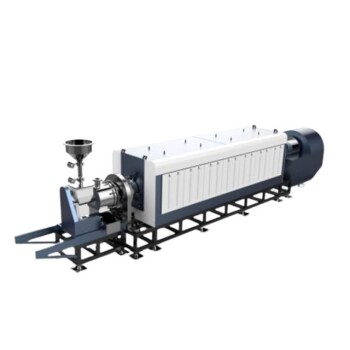
The decisive process advantage of an industrial-scale Rotary Drum Kiln lies in its ability to deliver superior material mixing and uniform heat distribution through continuous rotation. Unlike static laboratory furnaces, the kiln’s dynamic motion ensures that biomass maintains consistent contact with the thermal environment, resulting in a significantly more homogeneous product.
While laboratory furnaces provide basic thermal data, they often fail to replicate the physics of mass production. The Rotary Drum Kiln bridges this gap by delivering output properties that accurately represent large-scale industrial standards.
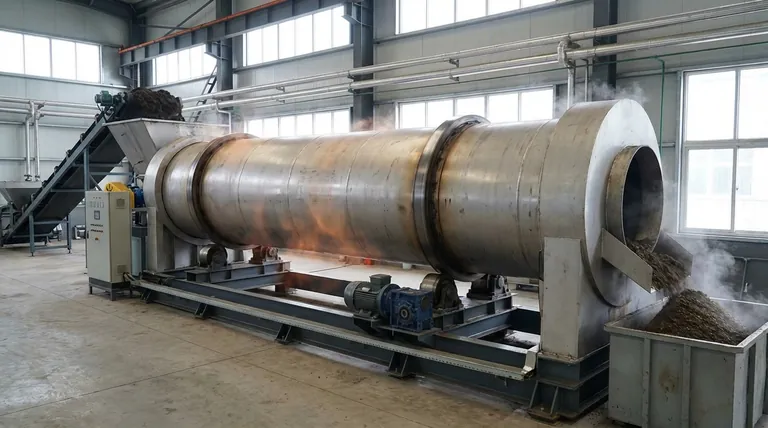
The Power of Dynamic Heating
Superior Material Mixing
The core mechanism of a Rotary Drum Kiln is the continuous rotation of the cylinder. This movement actively tumbles the biomass, preventing the material stratification often seen in static environments.
Uniform Heat Distribution
In a static laboratory furnace, heat transfer can be inconsistent, leading to "hot spots" or uneven torrefaction. The dynamic nature of the rotary kiln ensures that every particle of biomass receives equal exposure to the heat source.
Consistent Thermal Contact
The rotation facilitates a process where the material is constantly turned over. This maintains consistent contact between the biomass and the thermal environment, ensuring that the heat penetrates the material evenly throughout the process.
Achieving Industrial Fidelity
Homogeneity of the Final Product
Because the heating environment is uniform, the resulting bio-reductant is highly homogeneous. This consistency is difficult to achieve in smaller, static equipment where the outer layers of a sample may process differently than the core.
Representative Chemical Properties
For semi-industrial production, the goal is to predict full-scale outcomes. The rotary kiln produces bio-reductants with volatile matter and fixed carbon content that closely mirror what will be achieved in a full industrial plant.
Validating Scalability
Data derived from laboratory furnaces often requires significant extrapolation to be useful for industry. The rotary kiln produces physical and chemical properties that are representative of large-scale standards, reducing the risk during the scale-up phase.
Common Pitfalls in Process Scaling
The Risk of Static Data
A common mistake in bio-reductant development is assuming that data from static laboratory equipment will translate directly to industrial processes. Static heating cannot simulate the mass transfer and mixing dynamics of a production environment.
Misinterpreting Output Quality
Relying solely on lab-scale samples can lead to inaccurate predictions regarding the fixed carbon content of the final product. Without the dynamic mixing of a rotary kiln, lab samples may suggest a level of quality that is not reproducible at scale.
Making the Right Choice for Your Goal
To ensure your bio-reductant production meets your specific project needs, align your equipment choice with your production objectives.
- If your primary focus is initial material screening: Stick to laboratory furnaces for quick, small-scale tests where flow dynamics are not yet critical.
- If your primary focus is industrial process validation: Utilize an industrial-scale Rotary Drum Kiln to ensure your volatile matter and fixed carbon data are truly representative of mass production.
True scalability requires mimicking the physics of the final process, not just the temperature.
Summary Table:
| Feature | Laboratory Furnace (Static) | Rotary Drum Kiln (Dynamic) |
|---|---|---|
| Material Mixing | Static/Stratified | Continuous tumbling/Active mixing |
| Heat Distribution | Potential hot spots | Uniform exposure for every particle |
| Product Homogeneity | Low to Moderate | High (Highly consistent) |
| Scaling Accuracy | Requires high extrapolation | Representative of industrial standards |
| Process Simulation | Basic thermal data only | Mimics mass production physics |
Transition from Lab to Scale with KINTEK Precision
Don't let static lab data compromise your industrial scaling. KINTEK’s advanced thermal solutions bridge the gap between initial screening and mass production. Backed by expert R&D and manufacturing, we offer high-performance Rotary, Muffle, Tube, Vacuum, and CVD systems—all fully customizable to your specific torrefaction and carbonization needs.
Ensure your bio-reductant quality with equipment designed for industrial fidelity. Contact our technical experts today to find the perfect furnace for your unique process requirements!
Visual Guide

References
- Richard Deutsch, Gernot Krammer. Characteristics of High-Temperature Torrefied Wood Pellets for Use in a Blast Furnace Injection System. DOI: 10.3390/en18030458
This article is also based on technical information from Kintek Furnace Knowledge Base .
Related Products
- Electric Rotary Kiln Small Rotary Furnace Biomass Pyrolysis Plant Rotating Furnace
- Electric Rotary Kiln Small Rotary Furnace for Activated Carbon Regeneration
- Electric Rotary Kiln Continuous Working Small Rotary Furnace Kiln for Pyrolysis Plant Heating
- Electric Rotary Kiln Pyrolysis Furnace Plant Machine Small Rotary Kiln Calciner
- Vacuum Sealed Continuous Working Rotary Tube Furnace Rotating Tube Furnace
People Also Ask
- What are the main applications of a rotary kiln electric furnace? Achieve Uniform Heat Treatment for Powders
- What are the key components of a rotary kiln electric furnace? Unlock Efficient Thermal Processing
- What is the significance of the refractory lining in a rotary kiln electric furnace? Unlock Efficiency and Longevity
- What is the benefit of adjustable speed control in rotary kilns? Optimize Efficiency and Quality
- What are the main advantages of using rotary kilns for bulk solids processing? Achieve High-Volume, Uniform Thermal Processing