
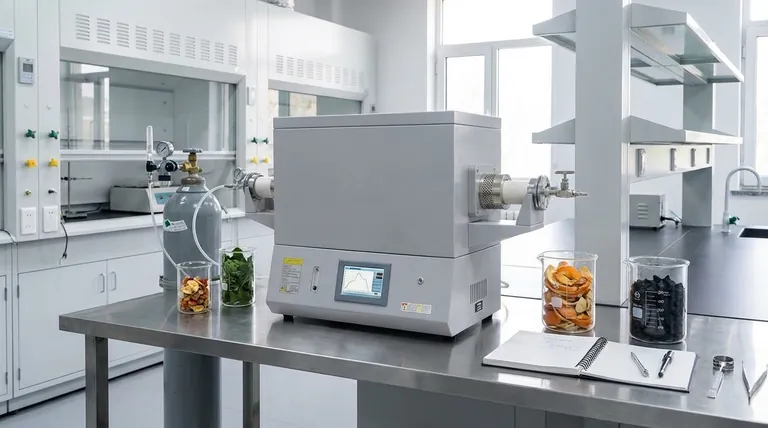
The laboratory tube furnace acts as the primary reaction vessel for converting fruit and vegetable waste into usable fuel. It provides the essential, oxygen-free (anaerobic) environment required for torrefaction, allowing for precise thermal regulation that alters the chemical structure of the biomass without burning it.
The core value of the tube furnace lies in its ability to strictly control heating rates and holding times under anaerobic conditions. This precision is what drives the increase in energy density and transforms raw food waste into stable, high-quality biochar.
The Mechanics of Transformation
Precision Thermal Regulation
The tube furnace is not simply a heater; it is a programmable instrument used to define specific heating rates and isothermal holding times.
By controlling how fast the temperature rises and how long it stays at the target level, the furnace ensures the biomass undergoes consistent thermochemical conversion.
This regulation directly impacts the final fuel characteristics, optimizing the material for future energy use.
Enabling Anaerobic Conditions
Torrefaction requires the absence of oxygen to prevent the biomass from combusting into ash.
The design of a laboratory tube furnace allows for a sealed environment where inert gases can flow, maintaining strictly anaerobic conditions.
This environment preserves the carbon content of the fruit and vegetable waste while driving off moisture and volatiles, resulting in increased energy density.
Understanding Equipment Distinctions
Production vs. Analysis
It is critical to distinguish between the equipment used for making the fuel and the equipment used for analyzing it.
While the tube furnace is used for the torrefaction process itself, a laboratory muffle furnace serves a different purpose.
Muffle furnaces are typically used for high-temperature ashing (often at 815 °C) to completely mineralize samples.
The Role of Ash Analysis
You should not use a tube furnace for ashing analysis, nor a muffle furnace for precision torrefaction.
The muffle furnace helps determine inorganic residue content, which is vital for evaluating risks like slagging and fouling in combustion equipment.
For high-ash biomass, such as pea shells, this analytical step is crucial to predict how the fuel produced in the tube furnace will behave in real-world applications.
Making the Right Choice for Your Goal
To ensure the success of your biomass conversion project, apply the equipment according to its specific function:
- If your primary focus is producing high-energy fuel: Utilize the laboratory tube furnace to optimize heating rates and holding times under anaerobic conditions.
- If your primary focus is evaluating equipment safety: Use a muffle furnace to determine the ash content and assess the risk of slagging or fouling.
Precise control over the reaction environment is the defining factor in successfully upgrading food waste into viable energy.
Summary Table:
| Feature | Laboratory Tube Furnace (Torrefaction) | Laboratory Muffle Furnace (Analysis) |
|---|---|---|
| Primary Function | Thermochemical conversion (Biochar production) | High-temperature ashing (Mineralization) |
| Atmosphere | Anaerobic/Inert gas flow (Oxygen-free) | Ambient air / Oxidizing |
| Key Outcome | Increased energy density and fuel stability | Determination of inorganic ash content |
| Critical Control | Heating rates and isothermal holding times | High-temperature stability (e.g., 815 °C) |
| Material Impact | Chemical restructuring without combustion | Complete removal of volatile organic matter |
Elevate Your Biomass Research with KINTEK Precision
Transforming fruit and vegetable waste into high-density biochar requires absolute control over your thermal environment. At KINTEK, we understand that the success of your torrefaction process depends on the precision of your equipment.
Backed by expert R&D and world-class manufacturing, we provide a comprehensive range of Muffle, Tube, Rotary, Vacuum, and CVD systems. Whether you are producing advanced fuels or performing critical ash analysis, our high-temp lab furnaces are fully customizable to meet your unique research requirements.
Ready to optimize your waste-to-energy conversion?
Contact KINTEK Experts Today to find the perfect furnace for your laboratory.
Visual Guide

References
- Andreja Škorjanc, Danijela Urbancl. Advancing Energy Recovery: Evaluating Torrefaction Temperature Effects on Food Waste Properties from Fruit and Vegetable Processing. DOI: 10.3390/pr13010208
This article is also based on technical information from Kintek Furnace Knowledge Base .
Related Products
- 1400℃ High Temperature Laboratory Tube Furnace with Alumina Tube
- Laboratory Quartz Tube Furnace RTP Heating Tubular Furnace
- Laboratory Vacuum Tilt Rotary Tube Furnace Rotating Tube Furnace
- 1700℃ High Temperature Laboratory Tube Furnace with Alumina Tube
- Vertical Laboratory Quartz Tube Furnace Tubular Furnace
People Also Ask
- How are high-temperature laboratory tube furnaces applied in long-term vacuum homogenization heat treatments for intermetallic samples?
- How do high-temperature laboratory tube furnaces ensure environmental stability? Precision Thermal Reduction Tips
- How are high-temp tube furnaces used to measure diffusion coefficients per Fick's law? Master Precision Annealing
- How are high-temperature tube furnaces applied in testing ceramic-supported alloy membranes? Insights
- What is the function of a furnace in CuAlMn alloy treatment? Achieve Perfect Microstructural Homogenization



















