
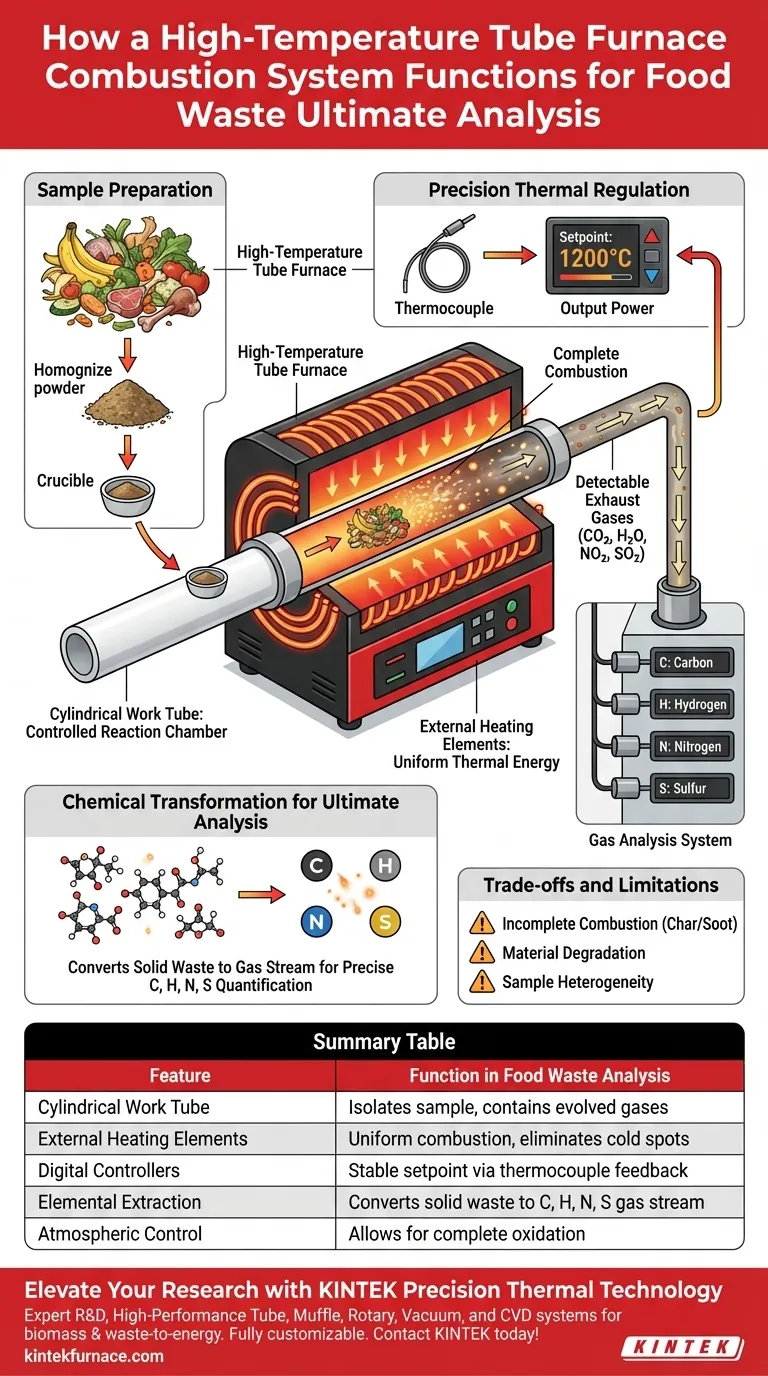
The high-temperature tube furnace combustion system functions by isolating food waste samples within a sealed environment and subjecting them to uniform, intense thermal energy. This process ensures the complete combustion of complex organic matter, converting solid waste into a stream of detectable exhaust gases. By analyzing these gases, researchers can determine the precise concentrations of carbon, hydrogen, nitrogen, and sulfur required for accurate ultimate analysis.
The core takeaway is that the tube furnace acts as a precision reactor that transforms heterogeneous food waste into a homogenous gas stream, providing the essential elemental data needed for carbon balance calculations and pyrolysis modeling.
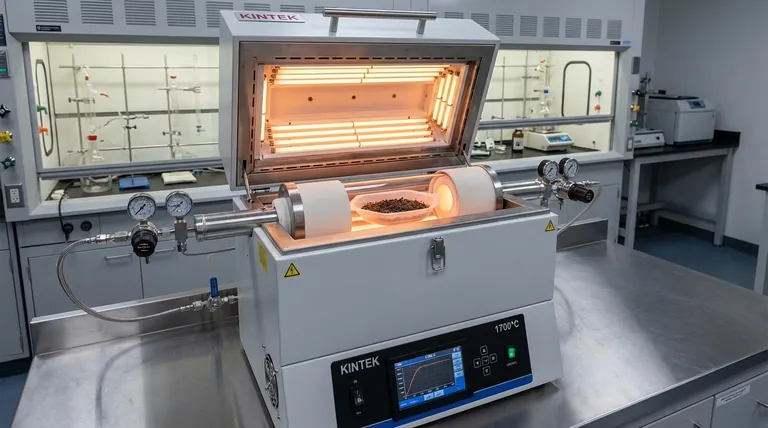
The Mechanical Architecture of the Combustion System
The Role of the Cylindrical Work Tube
The heart of the system is a cylindrical work tube where the food waste mixture is placed. This tube serves as a controlled reaction chamber, isolating the sample from external contaminants while containing the evolved gases for analysis.
External Heating Elements
Heating elements are strategically located outside the work tube, surrounding it to provide uniform heat along its entire length. This design ensures that the sample experiences a consistent temperature gradient, which is critical for achieving reproducible results in ultimate analysis.
Sample Loading and Containment
Samples are loaded into the tube before it is installed in the furnace and sealed. This containment allows for the precise manipulation of the internal atmosphere, ensuring that the combustion process occurs under specific, user-defined conditions.
Precision Thermal Regulation and Monitoring
Feedback via Thermocouple Sensors
The system utilizes thermocouples or temperature sensors to continuously monitor the internal thermal environment. These sensors provide real-time data to the system's controller, ensuring the furnace maintains the high temperatures required for complete elemental breakdown.
Digital Control Systems
A digital controller receives signals from the sensors and automatically adjusts the power output of the heating elements. This closed-loop system allows the user to set specific parameters, ensuring the furnace reaches and maintains the exact temperature setpoint needed for the food waste mixture.
Achieving Uniform Temperature Distribution
Because the heating elements surround the tube, the system achieves an even temperature distribution. This uniformity prevents "cold spots" that could lead to the incomplete combustion of the food waste, which would otherwise skew the final elemental data.
Chemical Transformation for Ultimate Analysis
Complete Combustion of Complex Waste
The primary function during ultimate analysis is to facilitate complete combustion. The high-temperature environment breaks down the complex chemical bonds in food waste, converting the solid matrix into its constituent elements in gaseous form.
Extraction of Elemental Data
The process specifically targets the determination of sulfur, carbon, hydrogen, and nitrogen content. These measurements serve as the baseline data for subsequent calculations, such as determining the pyrolysis carbon balance.
Creating a Gas Stream for Detection
As the sample combusts, it produces a stream of detectable exhaust gases. These gases are then analyzed to quantify the exact mass fraction of each element present in the original food waste mixture.
Understanding the Trade-offs and Limitations
The Risk of Incomplete Combustion
If the furnace temperature is not sufficiently high or the residence time is too short, the food waste may not fully oxidize. Incomplete combustion leads to the formation of char or soot, which traps carbon and sulfur, resulting in an underestimation of the sample's true elemental composition.
Material Degradation and Contamination
Operating at the high temperatures required for ultimate analysis can cause the work tube to degrade over time. This degradation can introduce impurities into the gas stream or lead to leaks, compromising the integrity of the atmospheric control and the accuracy of the sulfur measurements.
Sensitivity to Sample Heterogeneity
Food waste is notoriously non-uniform, and small sample sizes used in tube furnaces may not always be representative of the bulk material. This requires meticulous sample preparation and homogenization to ensure that the ultimate analysis reflects the true nature of the waste mixture.
How to Apply This to Your Project
When utilizing a high-temperature tube furnace for the ultimate analysis of food waste, your approach should vary based on your specific research goals.
- If your primary focus is sulfur quantification: Ensure the furnace is calibrated to the specific high-temperature range required to fully evolve sulfur dioxide without loss to the furnace walls.
- If your primary focus is pyrolysis carbon balance: Focus on the precision of the temperature control system to ensure every milligram of carbon is accounted for in the gaseous phase.
- If your primary focus is equipment longevity: Implement a gradual heating and cooling ramp in your digital controller to minimize thermal shock to the ceramic work tube.
By mastering the thermal and chemical dynamics of the tube furnace, you can transform volatile food waste into the high-fidelity data required for advanced bioenergy modeling.
Summary Table:
| Feature | Function in Food Waste Analysis |
|---|---|
| Cylindrical Work Tube | Isolates sample and contains evolved gases for elemental detection. |
| External Heating Elements | Surrounds the tube to ensure uniform combustion and eliminate cold spots. |
| Digital Controllers | Regulates power output via thermocouples for stable setpoint maintenance. |
| Elemental Extraction | Converts solid waste into a gas stream to quantify C, H, N, and S. |
| Atmospheric Control | Allows for specific oxygen or inert environments for complete oxidation. |
Elevate Your Research with Precision Thermal Technology
Maximize the accuracy of your ultimate analysis and pyrolysis modeling with KINTEK. Backed by expert R&D and world-class manufacturing, we provide high-performance Tube, Muffle, Rotary, Vacuum, and CVD systems tailored for complex applications like biomass and waste-to-energy research.
Whether you need custom dimensions or specific atmospheric controls, our lab high-temp furnaces are fully customizable to meet your unique needs. Contact KINTEK today to discuss your laboratory requirements and see how our expertise can streamline your data collection.
Visual Guide
References
- Zsolt Dobó, Gábor Nagy. Production of Biochar by Pyrolysis of Food Waste Blends for Negative Carbon Dioxide Emission. DOI: 10.3390/en18010144
This article is also based on technical information from Kintek Furnace Knowledge Base .
Related Products
- 1400℃ High Temperature Laboratory Tube Furnace with Alumina Tube
- 1700℃ High Temperature Laboratory Tube Furnace with Alumina Tube
- 1200℃ Split Tube Furnace Laboratory Quartz Tube Furnace with Quartz Tube
- Vertical Laboratory Quartz Tube Furnace Tubular Furnace
- 1700℃ High Temperature Muffle Oven Furnace for Laboratory
People Also Ask
- How does zone-melting in tube furnaces synthesize bismuth micro-wires? Master Single-Crystal Thermoelectric Growth
- How do high-temperature laboratory tube furnaces ensure environmental stability? Precision Thermal Reduction Tips
- How are high-temperature laboratory tube furnaces applied in long-term vacuum homogenization heat treatments for intermetallic samples?
- How are high-temp tube furnaces used to measure diffusion coefficients per Fick's law? Master Precision Annealing
- How are high-temperature tube furnaces applied in testing ceramic-supported alloy membranes? Insights



















