
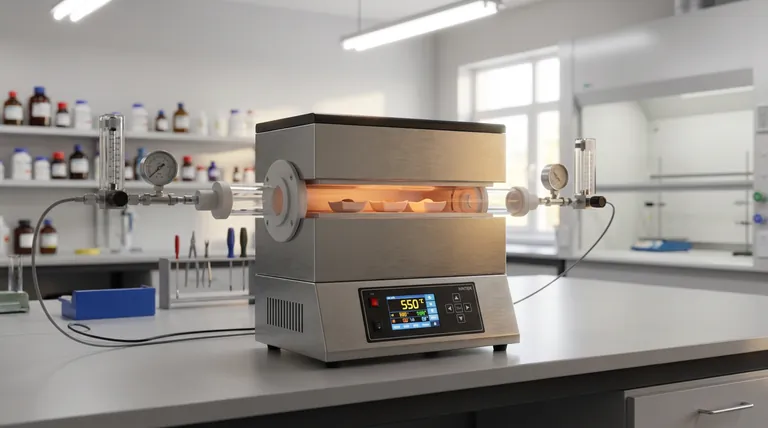
A high-temperature tube furnace serves as the critical annealing environment for Ir-TiO2 samples, driving essential chemical and structural transformations. Operating between 500 °C and 600 °C, this equipment is responsible for purifying the synthesized material and establishing its final crystalline phase.
The tube furnace does not merely dry the sample; it orchestrates a complex thermal evolution. By maintaining strict temperature profiles, it eliminates organic synthesis byproducts while simultaneously forcing both the titanium dioxide and iridium oxide components into their active, crystalline states.
Mechanisms of Material Transformation
Elimination of Organic Templates
During the synthesis of Ir-TiO2, organic agents such as Pluronic F-127 are often used as templates to define the material's structure.
The tube furnace effectively removes these organic residues through calcination. By raising the temperature to the 500 °C – 600 °C range, the furnace burns off the template, leaving behind the pure metal oxide framework.
Crystallization of Titanium Dioxide (TiO2)
Raw TiO2 often exists in an amorphous (disordered) state immediately after synthesis.
The thermal energy provided by the furnace facilitates a phase transition. Under these specific annealing conditions, the titanium dioxide rearranges its atomic structure to form the anatase phase, significantly enhancing the material's crystallinity.
Transformation of Iridium Oxide (IrO2)
The furnace plays a distinct role depending on the maximum temperature reached.
At an annealing temperature of 600 °C, the furnace provides sufficient energy to alter the state of the Iridium Oxide component. This specific thermal threshold drives IrO2 from an amorphous state into a stable crystalline state.
The Role of Precision Control
Controlled Heating Rates
The transformation of these materials requires a gradual introduction of heat rather than a sudden thermal shock.
The tube furnace enables precise ramp rates, such as 3 °C per minute. This controlled increase ensures that organic removal and crystallization occur uniformly without damaging the material's porous structure.
Uniform Thermal Distribution
A core advantage of the tube furnace design is its ability to deliver consistent heat along the length of the heating zone.
This minimizes temperature gradients, ensuring that every part of the Ir-TiO2 sample experiences the exact same conditions. This uniformity is vital for achieving consistent phase composition throughout the entire batch.
Understanding the Trade-offs
Temperature Selection and Phase Behavior
Selecting the correct temperature is a balance between purity and specific structural goals.
While 500 °C is sufficient for removing organic templates and crystallizing the TiO2 into anatase, it may not be enough to fully crystallize the IrO2. Conversely, strictly adhering to 600 °C is necessary if crystalline IrO2 is required for your specific application.
Atmosphere Limitations
While supplementary data suggests tube furnaces can support vacuums or reducing atmospheres (like ethanol for defect introduction), the standard post-treatment for Ir-TiO2 described here focuses on annealing.
Attempting to combine these processes without careful consideration could lead to unintended reduction of the oxides rather than the desired crystallization and purification.
Making the Right Choice for Your Goal
To maximize the effectiveness of the tube furnace for your specific Ir-TiO2 requirements, consider the following target outcomes:
- If your primary focus is basic purification and TiO2 structure: Set the furnace to at least 500 °C to ensure the complete removal of Pluronic F-127 and the formation of the anatase phase.
- If your primary focus is the crystallinity of the Iridium component: You must increase the annealing temperature to 600 °C to provide the energy required for the amorphous-to-crystalline transition of IrO2.
Precise thermal management is the difference between a raw, amorphous powder and a highly crystalline, functional catalyst.
Summary Table:
| Process Objective | Temperature Range | Structural Outcome |
|---|---|---|
| Organic Template Removal | 500°C - 600°C | Elimination of agents like Pluronic F-127 |
| TiO2 Phase Transition | ≥ 500°C | Formation of the active Anatase phase |
| IrO2 Crystallization | 600°C | Transition from amorphous to stable crystalline state |
| Structure Preservation | 3°C/min ramp rate | Uniform pore structure and uniform thermal distribution |
Precision is the difference between an amorphous powder and a high-performance catalyst. Backed by expert R&D and manufacturing, KINTEK offers advanced Muffle, Tube, Rotary, Vacuum, and CVD systems designed to provide the strict thermal profiles your Ir-TiO2 research demands. Whether you need uniform heating zones for consistent phase composition or customizable systems for unique atmospheres, our lab high-temp furnaces are built for your exact needs. Contact KINTEK today to optimize your annealing process and achieve superior material crystallinity.
References
- Harnessing Visible Light: Unraveling the Photocatalytic Water Splitting Activity of Ir–TiO<sub>2</sub>. DOI: 10.1021/acsaem.5c01776
This article is also based on technical information from Kintek Furnace Knowledge Base .
Related Products
- 1400℃ High Temperature Laboratory Tube Furnace with Alumina Tube
- 1700℃ High Temperature Laboratory Tube Furnace with Alumina Tube
- 1200℃ Split Tube Furnace Laboratory Quartz Tube Furnace with Quartz Tube
- Vertical Laboratory Quartz Tube Furnace Tubular Furnace
- 1700℃ High Temperature Muffle Oven Furnace for Laboratory
People Also Ask
- How are high-temperature laboratory tube furnaces applied in long-term vacuum homogenization heat treatments for intermetallic samples?
- How do high-temperature laboratory tube furnaces ensure environmental stability? Precision Thermal Reduction Tips
- How are high-temp tube furnaces used to measure diffusion coefficients per Fick's law? Master Precision Annealing
- How are high-temperature tube furnaces applied in testing ceramic-supported alloy membranes? Insights
- What is the function of a furnace in CuAlMn alloy treatment? Achieve Perfect Microstructural Homogenization



















