
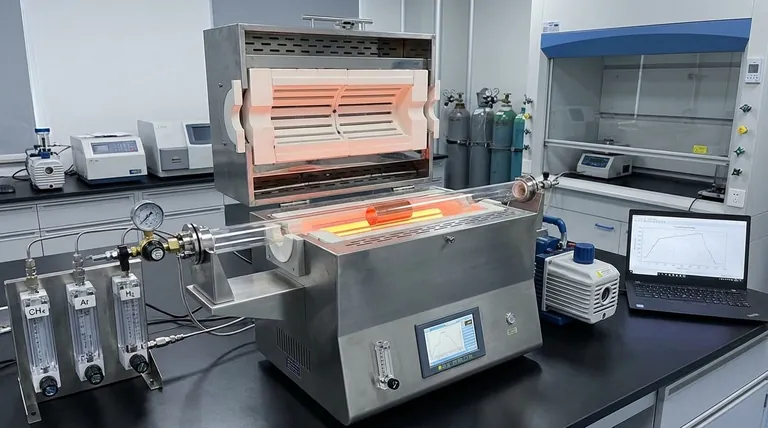
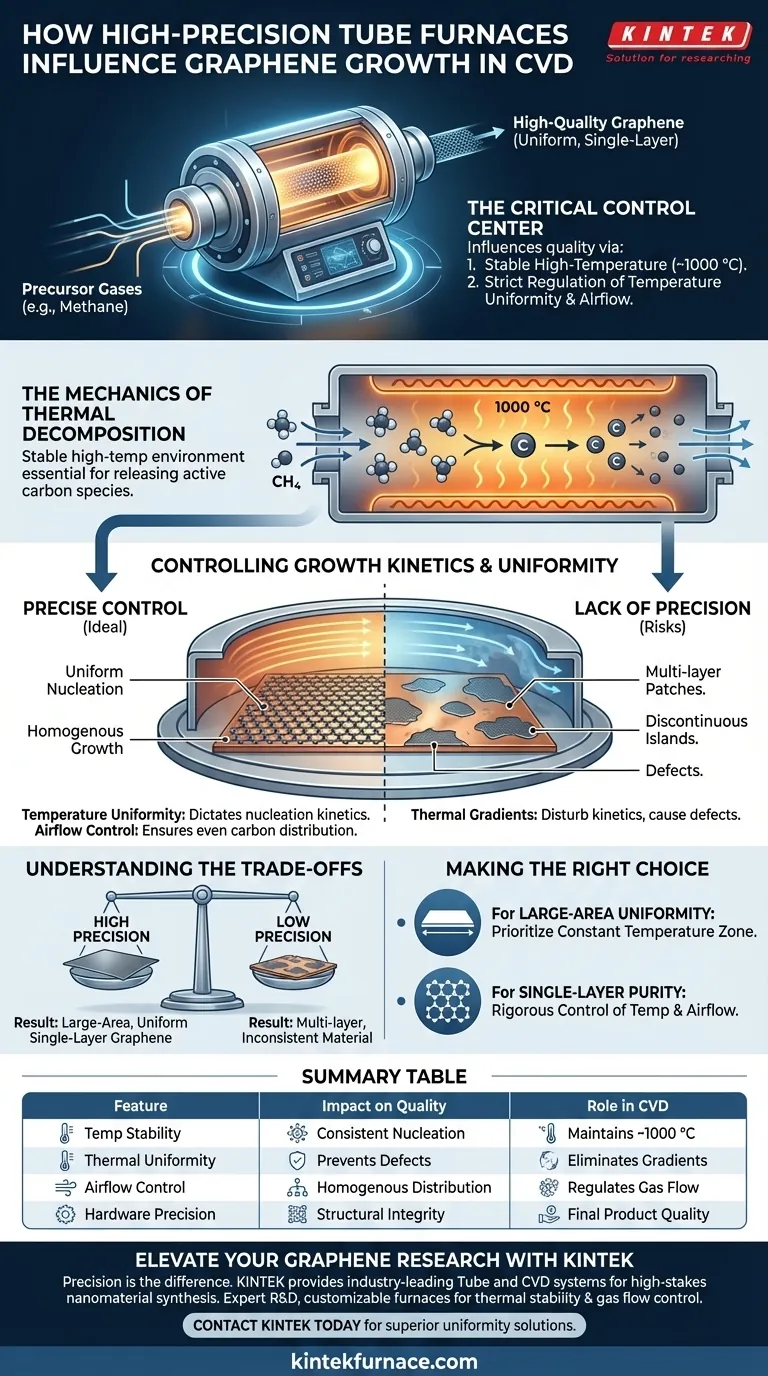
The high-precision tube furnace acts as the critical control center for graphene synthesis. It influences growth quality by maintaining a rigorous high-temperature environment, typically around 1000 °C, which is essential for the thermal decomposition of precursor gases like methane. By strictly regulating temperature uniformity and airflow, the furnace governs the reaction kinetics on metal catalysts, directly determining whether the resulting graphene is a uniform, single-layer sheet or an inconsistent material.
In Chemical Vapor Deposition (CVD), the tube furnace is not merely a heating element; it provides the precise thermodynamic stability required to control carbon atom nucleation. This hardware is the deciding factor in achieving large-area, highly uniform single-layer graphene.
The Mechanics of Thermal Decomposition
Creating the Reaction Environment
To synthesize graphene, precursor gases such as methane must be thermally decomposed to release active carbon species.
This process requires a stable high-temperature environment, generally sustained at approximately 1000 °C.
Stability and Consistency
A high-precision furnace ensures that this temperature remains constant throughout the process.
Without this thermal stability, the decomposition rate of the precursor gas would fluctuate, leading to unpredictable availability of carbon atoms.
Controlling Growth Kinetics and Uniformity
The Role of Temperature Uniformity
The primary reference highlights that temperature uniformity within the furnace chamber is vital for quality control.
This uniformity directly dictates the kinetics of how carbon atoms nucleate and grow on metal catalytic substrates, such as copper or nickel foils.
Managing Nucleation Rates
Precise thermal control allows for a regulated rate of nucleation.
When kinetics are managed correctly, carbon atoms arrange themselves into the desired lattice structure rather than clumping or forming defects.
Airflow Control
In addition to thermal regulation, the tube furnace creates specific airflow conditions within the chamber.
Proper control of gas flow ensures that the carbon source is evenly distributed across the catalytic substrate, facilitating homogenous growth.
Understanding the Trade-offs
Sensitivity to Thermal Gradients
The CVD process is unforgiving regarding temperature variations.
If a furnace lacks high precision, thermal gradients (hot or cold spots) can form within the chamber.
Impact on Layer Quality
These gradients disturb the kinetics of growth, often resulting in multi-layer patches or discontinuous islands of graphene.
Consequently, hardware that cannot maintain strict uniformity is generally unsuitable for manufacturing large-area, single-layer graphene.
Making the Right Choice for Your Goal
To maximize the quality of your graphene synthesis, align your hardware capabilities with your specific output requirements.
- If your primary focus is large-area uniformity: Prioritize a furnace with a verified constant temperature zone to ensure consistent growth kinetics across the entire substrate surface.
- If your primary focus is single-layer purity: rigorous control over both temperature and airflow is required to strictly limit carbon supply and prevent multi-layer formation.
The tube furnace is the core hardware that dictates the structural integrity and uniformity of the final graphene product.
Summary Table:
| Feature | Impact on Graphene Quality | Role in CVD System |
|---|---|---|
| Temperature Stability | Ensures consistent carbon atom nucleation | Maintains ~1000 °C for precursor decomposition |
| Thermal Uniformity | Prevents multi-layer patches and defects | Eliminates thermal gradients across the substrate |
| Airflow Control | Facilitates homogenous carbon distribution | Regulates gas flow for even reaction kinetics |
| Hardware Precision | Determines single-layer vs. multi-layer output | Governs the structural integrity of the final product |
Elevate Your Graphene Research with KINTEK
Precision is the difference between a defective material and a perfect single-layer lattice. KINTEK provides industry-leading Tube and CVD systems designed specifically for high-stakes nanomaterial synthesis. Backed by expert R&D and manufacturing, our customizable high-temperature furnaces deliver the thermal stability and gas flow control essential for consistent, large-area graphene growth.
Ready to achieve superior uniformity in your CVD process? Contact KINTEK today to consult with our experts on a solution tailored to your lab’s unique needs.
Visual Guide
References
- Fatemeh Saeedi, Mojtaba Haghgoo. Recent Advances of Graphene‐Based Wearable Sensors: Synthesis, Fabrication, Performance, and Application in Smart Device. DOI: 10.1002/admi.202500093
This article is also based on technical information from Kintek Furnace Knowledge Base .
Related Products
- Custom Made Versatile CVD Tube Furnace Chemical Vapor Deposition CVD Equipment Machine
- Split Chamber CVD Tube Furnace with Vacuum Station CVD Machine
- Multi Heating Zones CVD Tube Furnace Machine for Chemical Vapor Deposition Equipment
- Slide PECVD Tube Furnace with Liquid Gasifier PECVD Machine
- Inclined Rotary Plasma Enhanced Chemical Deposition PECVD Tube Furnace Machine
People Also Ask
- What is a CVD tube furnace and what is its primary function? Discover Precision Thin-Film Deposition
- Why are CVD tube furnace sintering systems indispensable for 2D material research and production? Unlock Atomic-Scale Precision
- How does CVD tube furnace sintering enhance graphene growth? Achieve Superior Crystallinity and High Electron Mobility
- Which industries and research fields benefit from CVD tube furnace sintering systems for 2D materials? Unlock Next-Gen Tech Innovations
- What are the key application fields of CVD tube furnaces? Unlock Precision in Thin-Film Synthesis



















