
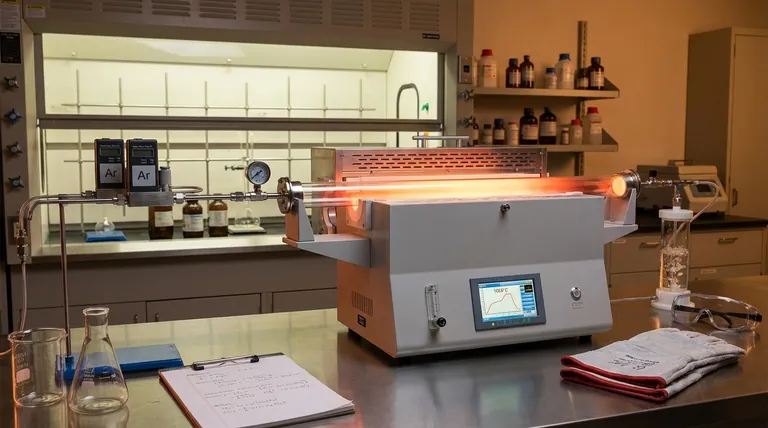
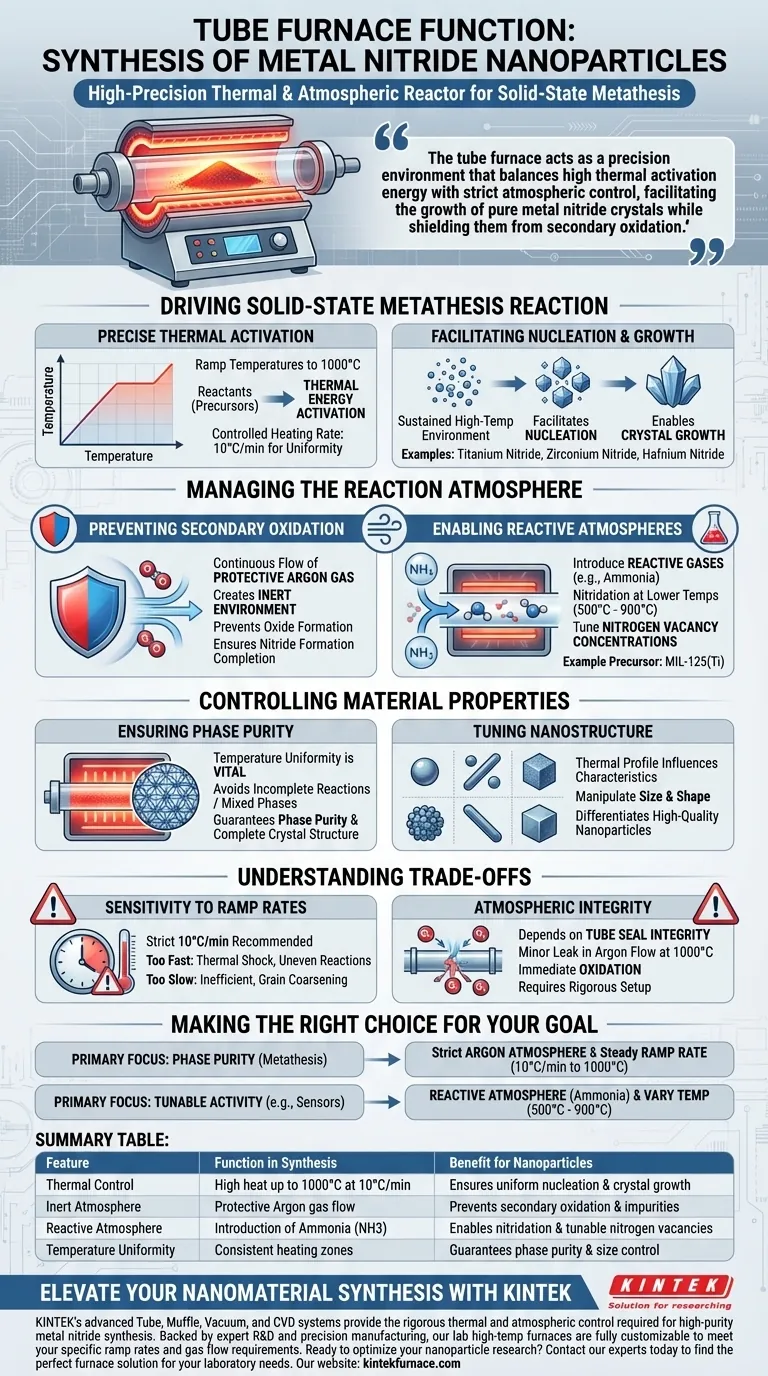
The primary function of a tube furnace in the synthesis of metal nitride nanoparticles is to provide a highly controlled thermal reactor for solid-state metathesis. By heating reactants to 1000°C at a precise rate of 10°C per minute under a flow of protective argon gas, the furnace ensures the complete nucleation and growth of crystals while strictly preventing oxidation.
The tube furnace acts as a precision environment that balances high thermal activation energy with strict atmospheric control, facilitating the growth of pure metal nitride crystals while shielding them from secondary oxidation.
Driving the Solid-State Metathesis Reaction
Precise Thermal Activation
For solid-state metathesis to occur, reactants require significant thermal energy to overcome activation barriers. A tube furnace provides this by ramping temperatures to 1000°C.
This high heat is not applied abruptly. The furnace utilizes a controlled heating rate, typically 10°C per minute, to ensure the reaction proceeds uniformly throughout the sample volume.
Facilitating Nucleation and Growth
The sustained high-temperature environment facilitates the nucleation of the metal nitride phase.
As the reaction progresses, the furnace maintains the necessary thermal conditions for these nuclei to grow into distinct crystals. This process is essential for synthesizing specific compounds such as titanium nitride, zirconium nitride, and hafnium nitride.
Managing the Reaction Atmosphere
Preventing Secondary Oxidation
One of the most critical roles of the tube furnace is the isolation of the reaction from ambient oxygen. Metal nitrides are susceptible to secondary oxidation at elevated temperatures, which would degrade the material into an unwanted oxide.
To prevent this, the furnace operates under a continuous flow of protective argon gas. This creates an inert environment that allows the nitride formation to reach completion without chemical interference.
Enabling Reactive Atmospheres
While the primary reference highlights inert argon for metathesis, the tube furnace offers versatility for other synthesis routes.
For example, when converting precursors like MIL-125(Ti), the furnace can introduce reactive gases like ammonia. This allows for nitridation at lower temperatures (500°C to 900°C) and enables researchers to tune nitrogen vacancy concentrations.
Controlling Material Properties
Ensuring Phase Purity
The temperature uniformity within the tube furnace is vital for the quality of the final nanoparticles.
Uneven heating can lead to incomplete reactions or mixed phases. By maintaining a consistent thermal zone, the furnace ensures the phase purity and complete crystal structure of the synthesized product.
Tuning Nanostructure
The specific thermal profile—including the ramp rate and maximum temperature—directly influences the physical characteristics of the nanoparticles.
By manipulating these parameters, researchers can control the size and shape of the resulting particles. This precise regulation is what differentiates high-quality engineered nanoparticles from inconsistent bulk materials.
Understanding the Trade-offs
Sensitivity to Ramp Rates
While high temperatures are necessary, the rate of heating is a critical variable. Deviating from the recommended 10°C per minute can lead to issues.
Too fast, and you risk thermal shock or uneven reaction fronts; too slow, and the process becomes inefficient or allows unwanted grain coarsening.
Atmospheric Integrity
The success of the synthesis is entirely dependent on the integrity of the tube's seal.
Even a minor leak in the argon flow system at 1000°C will result in immediate oxidation. The equipment demands rigorous setup to ensure the "protective" aspect of the atmosphere is not compromised.
Making the Right Choice for Your Goal
To maximize the effectiveness of a tube furnace for your specific synthesis, consider your primary objective:
- If your primary focus is Phase Purity (Metathesis): Prioritize a strict argon atmosphere and a steady ramp rate (10°C/min) to 1000°C to ensure complete conversion without oxidation.
- If your primary focus is Tunable Activity (e.g., Sensors): Utilize a reactive atmosphere (Ammonia) and vary the temperature between 500°C and 900°C to manipulate nitrogen vacancies.
Success in metal nitride synthesis relies not just on reaching the target temperature, but on the precise control of the atmospheric and thermal gradient throughout the entire cycle.
Summary Table:
| Feature | Function in Synthesis | Benefit for Nanoparticles |
|---|---|---|
| Thermal Control | High heat up to 1000°C at 10°C/min | Ensures uniform nucleation & crystal growth |
| Inert Atmosphere | Protective Argon gas flow | Prevents secondary oxidation & impurities |
| Reactive Atmosphere | Introduction of Ammonia (NH3) | Enables nitridation & tunable nitrogen vacancies |
| Temperature Uniformity | Consistent heating zones | Guarantees phase purity & size control |
Elevate Your Nanomaterial Synthesis with KINTEK
Precision is the difference between a successful reaction and a failed batch. KINTEK’s advanced Tube, Muffle, Vacuum, and CVD systems provide the rigorous thermal and atmospheric control required for high-purity metal nitride synthesis. Backed by expert R&D and precision manufacturing, our lab high-temp furnaces are fully customizable to meet your specific ramp rates and gas flow requirements.
Ready to optimize your nanoparticle research? Contact our experts today to find the perfect furnace solution for your laboratory needs.
Visual Guide
References
- Dreenan Shea, Mita Dasog. Decoding Plasmonic Enhancement Pathways in Group 4 Metal Nitride‐TiO<sub>2</sub> Composites: Rhodamine B Dye Degradation Case Study. DOI: 10.1002/nano.70059
This article is also based on technical information from Kintek Furnace Knowledge Base .
Related Products
- Vacuum Sealed Continuous Working Rotary Tube Furnace Rotating Tube Furnace
- 1400℃ High Temperature Laboratory Tube Furnace with Alumina Tube
- 1700℃ High Temperature Laboratory Tube Furnace with Alumina Tube
- Magnesium Extraction and Purification Condensing Tube Furnace
- High Pressure Laboratory Vacuum Tube Furnace
People Also Ask
- What is the purpose of rotary tube furnaces? Achieve Uniform Heat Treatment for Powders and Granules
- What are the key advantages of using a rotary tube furnace? Achieve Dynamic, Uniform Heating for Powders
- How does the amount of material processed vary between batch and continuous rotary tube furnaces? Scale Your Production Efficiently
- What are the advantages of rotary tube furnaces in fuel compatibility? Boost Efficiency and Cut Costs
- What is the temperature range of some rotary tube furnaces? Achieve Uniform Heating Up to 1200°C



















