
A laboratory tube furnace provides a strictly controlled thermal and atmospheric environment essential for the precise combustion synthesis of Na4Fe3(PO4)2(P2O7). It specifically manages the heating of pressed gel pellets to 300°C, a critical threshold required to trigger the necessary exothermic reaction.
Core Takeaway The tube furnace does not just supply heat; it acts as a reaction vessel that balances gas management with surface modification. By containing the reaction, it allows for the efficient discharge of nitrogen oxides while simultaneously facilitating the decomposition of citric acid to form a uniform carbon coating.
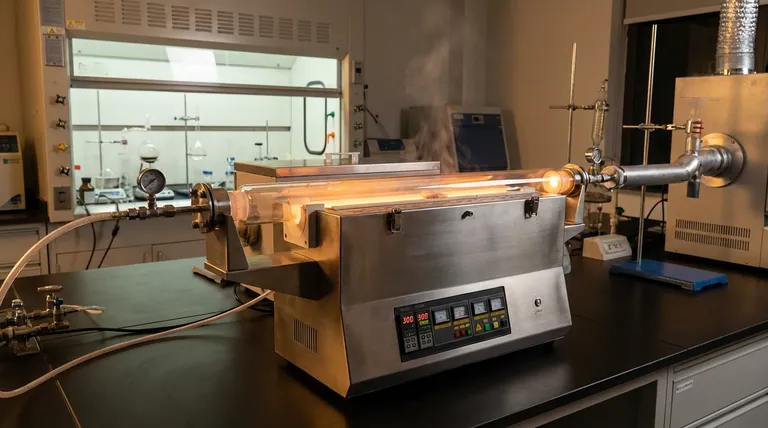
Thermal Control and Reaction Initiation
The primary function of the tube furnace in this synthesis is to create a stable thermal baseline that initiates chemical changes without overheating the material.
Precise Temperature Regulation
The furnace is utilized to heat the precursor material—specifically pressed gel pellets—to a target temperature of 300°C.
This temperature is not arbitrary; it is the specific activation point required to trigger the self-propagating combustion synthesis.
Managing the Exothermic Reaction
Once the material reaches the target temperature, an exothermic (heat-releasing) reaction occurs.
The tube furnace environment ensures this reaction proceeds uniformly across the pellets, preventing hot spots or incomplete combustion that could occur in less controlled heating devices.
Atmosphere and Byproduct Management
Beyond temperature, the physical enclosure of the tube furnace plays a vital role in chemical composition and morphology.
Efficient Gas Discharge
During the combustion process, significant gaseous byproducts are generated, specifically nitrogen oxides.
The enclosed space of the tube furnace is designed to support the efficient discharge of these gases, preventing them from interfering with the crystallization of the final product.
Formation of the Carbon Coating
The environment within the furnace triggers the decomposition of citric acid contained within the precursor gel.
Because the environment is controlled, this decomposition results in a thin, uniform initial carbon layer forming on the particle surfaces.
This carbon layer is critical for the material's electrical conductivity and electrochemical performance.
Critical Operational Constraints
While the tube furnace provides the ideal environment for this synthesis, the enclosed nature of the system introduces specific operational constraints that must be managed.
Sensitivity to Gas Flow
Because the process relies on discharging nitrogen oxides, the flow dynamics within the tube are critical.
If the discharge is obstructed, or if the atmosphere is not properly regulated, impurities may become trapped within the lattice structure of the material.
Uniformity of the Carbon Layer
The quality of the carbon coating is directly dependent on the stability of the furnace environment.
Fluctuations in temperature or atmospheric composition during the decomposition of citric acid can lead to uneven coating, which compromises the uniformity of the final particle surface.
Making the Right Choice for Your Goal
To maximize the quality of Na4Fe3(PO4)2(P2O7) synthesized in this environment, focus on the specific parameters that align with your material requirements.
- If your primary focus is material purity: Ensure the tube furnace exhaust system is optimized to fully evacuate nitrogen oxides generated during the exothermic reaction.
- If your primary focus is conductivity: Prioritize the precision of the 300°C ramp-up to guarantee the citric acid decomposes evenly, ensuring a uniform carbon layer.
The tube furnace is not merely a heater, but a critical instrument for simultaneous gas separation and surface engineering.
Summary Table:
| Feature | Function in Na4Fe3(PO4)2(P2O7) Synthesis |
|---|---|
| Temperature Control | Precise heating to 300°C to trigger exothermic reaction |
| Atmosphere Management | Enables efficient discharge of nitrogen oxide byproducts |
| Surface Engineering | Facilitates citric acid decomposition for uniform carbon coating |
| Uniformity | Ensures consistent reaction kinetics across all gel pellets |
Elevate Your Material Synthesis with KINTEK
Precision is non-negotiable when synthesizing advanced battery materials like Na4Fe3(PO4)2(P2O7). Backed by expert R&D and world-class manufacturing, KINTEK offers high-performance Tube, Muffle, Rotary, Vacuum, and CVD systems tailored for your laboratory's most demanding high-temp requirements. Whether you need precise atmosphere control for gas discharge or uniform thermal profiles for carbon coating, our systems are fully customizable to meet your unique research needs.
Ready to achieve superior material purity and conductivity? Contact KINTEK today to find your perfect furnace solution!
Visual Guide

References
- Yaprak Subaşı, Reza Younesi. Synthesis and characterization of a crystalline Na<sub>4</sub>Fe<sub>3</sub>(PO<sub>4</sub>)<sub>2</sub>(P<sub>2</sub>O<sub>7</sub>) cathode material for sodium-ion batteries. DOI: 10.1039/d4ta03554b
This article is also based on technical information from Kintek Furnace Knowledge Base .
Related Products
- 1400℃ High Temperature Laboratory Tube Furnace with Alumina Tube
- Laboratory Quartz Tube Furnace RTP Heating Tubular Furnace
- Laboratory Vacuum Tilt Rotary Tube Furnace Rotating Tube Furnace
- 1700℃ High Temperature Laboratory Tube Furnace with Alumina Tube
- Vertical Laboratory Quartz Tube Furnace Tubular Furnace
People Also Ask
- How does zone-melting in tube furnaces synthesize bismuth micro-wires? Master Single-Crystal Thermoelectric Growth
- How do high-temperature laboratory tube furnaces ensure environmental stability? Precision Thermal Reduction Tips
- How are high-temperature laboratory tube furnaces applied in long-term vacuum homogenization heat treatments for intermetallic samples?
- How are high-temp tube furnaces used to measure diffusion coefficients per Fick's law? Master Precision Annealing
- How are high-temperature tube furnaces applied in testing ceramic-supported alloy membranes? Insights



















