
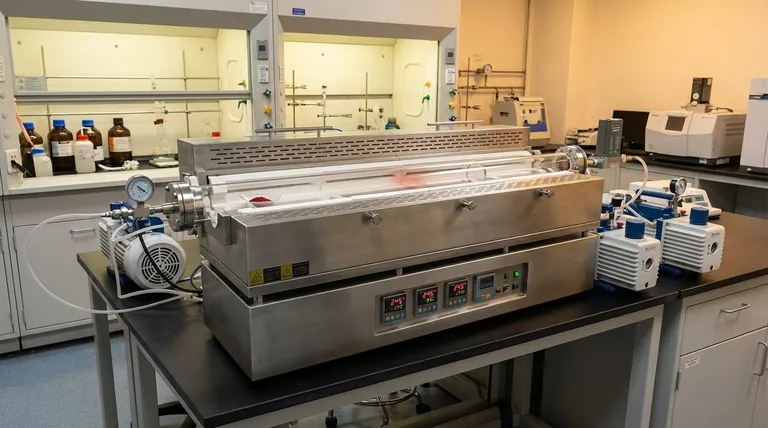
In the Physical Vapor Transport (PVT) growth of J-aggregate molecular crystals, the tube furnace functions as a strictly controlled thermal reaction chamber responsible for driving the sublimation and recrystallization process. It creates the precise environmental conditions required to vaporize organic source materials and deposit them onto a target substrate, typically hexagonal boron nitride (hBN), under a vacuum.
The tube furnace is not merely a heat source; it is a precision instrument that orchestrates the delicate phase transition of J-aggregate molecules. By executing specific multi-step heating programs, it enables the growth of large-area, high-quality monolayers essential for advanced optical performance.
The Mechanics of Thermal Control
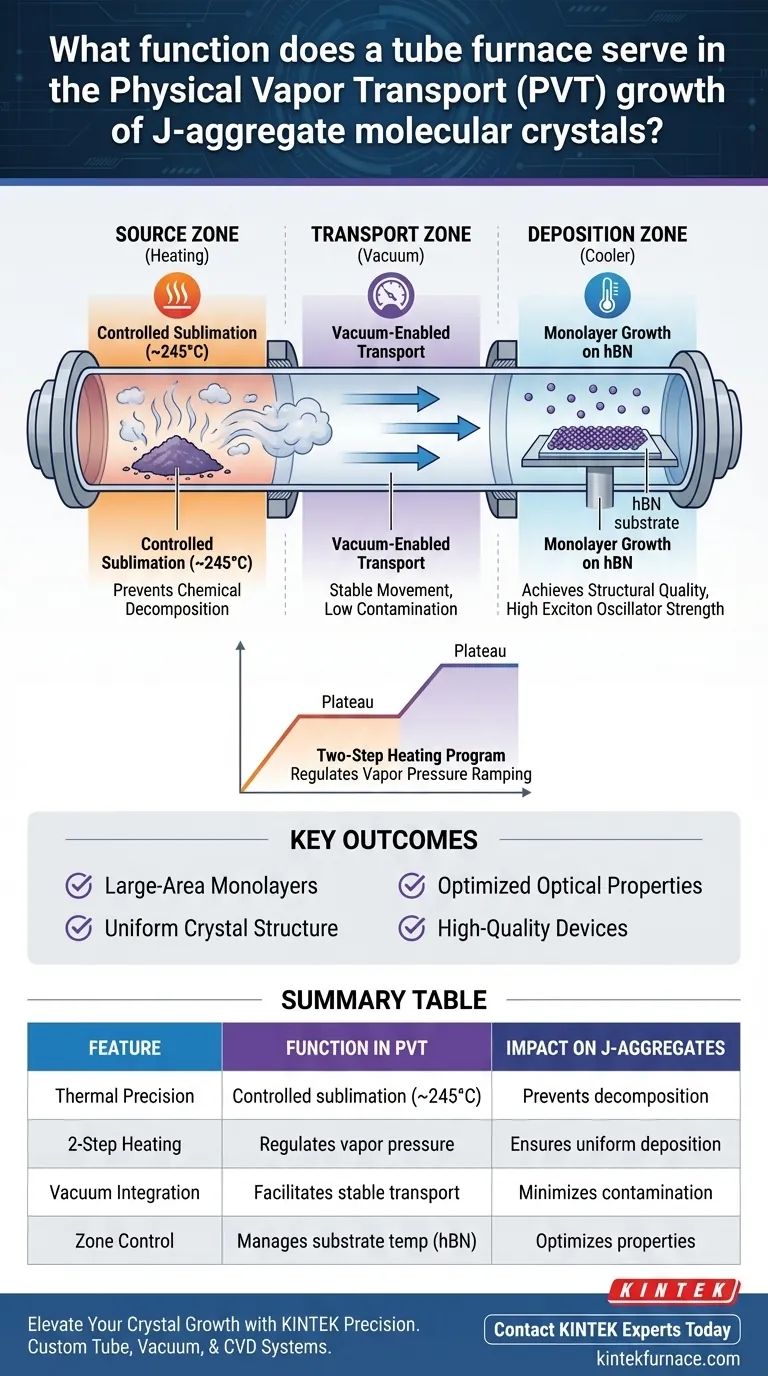
Driving Controlled Sublimation
The primary function of the tube furnace is to reach specific temperature set points that trigger the phase change of the J-aggregate molecules.
Unlike inorganic materials that may require extreme heat, these organic molecules are processed at more moderate temperatures, such as 245 degrees Celsius.
The furnace provides the thermal energy necessary to turn the solid source material into vapor without causing chemical decomposition.
The Two-Step Heating Program
Success in PVT growth relies on more than just reaching a peak temperature; it requires a dynamic thermal profile.
The tube furnace utilizes a two-step heating program to regulate the rate of sublimation.
This programmable ramping ensures that the vapor pressure builds gradually, preventing uncontrolled bursts of material that could ruin the crystal structure.
Vacuum-Enabled Transport
The tube furnace works in conjunction with a vacuum system to facilitate the movement of molecules.
By maintaining a low-pressure environment, the furnace ensures the stable transport of the vaporized molecules from the source zone to the cooler deposition zone.
This vacuum environment minimizes contamination and allows the molecules to travel efficiently to the substrate.
Achieving Structural Quality
Substrate Compatibility
The furnace is designed to accommodate specific substrates that promote high-quality growth, such as hexagonal boron nitride (hBN).
The thermal environment within the tube ensures that the hBN substrate remains at the optimal temperature to receive the depositing molecules.
This compatibility is critical for defining the orientation and flatness of the resulting crystal.
Optimizing Material Properties
The ultimate goal of this precise thermal regulation is to produce large-area, monolayer molecular crystals.
Strict control over the heating and cooling cycles directly influences the electronic properties of the material.
Properly grown crystals exhibit significant exciton oscillator strength, a key metric for their utility in photonic and optoelectronic devices.
Understanding the Trade-offs
Precision vs. Throughput
The requirement for a "strictly controlled" environment means the process is inherently sensitive to variables.
A tube furnace offers high precision, but the reliance on specific heating programs and vacuum conditions can limit the speed of production compared to less rigorous deposition methods.
Thermal Sensitivity
Organic J-aggregates are far more thermally sensitive than inorganic crystals (like Molybdenum Phosphide, which might be grown at 700°C–900°C in similar equipment).
In the context of J-aggregates, slight deviations from the 245°C target can lead to incomplete sublimation or thermal degradation.
The trade-off is that the equipment must be calibrated specifically for organic temperature ranges, rather than general high-heat applications.
Making the Right Choice for Your Goal
To maximize the effectiveness of a tube furnace in PVT growth, align your process parameters with your specific material requirements.
- If your primary focus is Optical Quality: Prioritize the precision of the two-step heating program to maximize exciton oscillator strength and monolayer uniformity.
- If your primary focus is Crystal Size: Ensure the vacuum level and thermal gradient are optimized to allow for stable, long-distance transport to the hBN substrate.
Precision in the thermal profile is the single most critical factor in converting raw organic powder into high-performance optoelectronic monolayers.
Summary Table:
| Feature | Function in PVT Growth | Impact on J-Aggregate Crystals |
|---|---|---|
| Thermal Precision | Controlled sublimation at ~245°C | Prevents chemical decomposition |
| 2-Step Heating | Regulates vapor pressure ramping | Ensures uniform monolayer deposition |
| Vacuum Integration | Facilitates stable molecular transport | Minimizes contamination & improves purity |
| Zone Control | Manages substrate temperature (hBN) | Optimizes exciton oscillator strength |
Elevate Your Crystal Growth with KINTEK Precision
Achieving high-performance optoelectronic monolayers requires absolute thermal accuracy. KINTEK provides industry-leading Tube, Vacuum, and CVD systems specifically designed for the delicate sublimation requirements of organic J-aggregates. Our expert R&D and manufacturing teams offer customizable furnace solutions that ensure stable transport, precise two-step heating programs, and the vacuum integrity your research demands.
Ready to optimize your PVT growth process? Contact KINTEK Experts Today
Visual Guide
References
- Xinyi Zhao, Jianbin Xu. Monolayer J‐Aggregate Crystals Strong Coupling with an All‐Dielectric Metasurface for Photonic Properties Modification. DOI: 10.1002/lpor.202501208
This article is also based on technical information from Kintek Furnace Knowledge Base .
Related Products
- Vacuum Sealed Continuous Working Rotary Tube Furnace Rotating Tube Furnace
- 1400℃ High Temperature Laboratory Tube Furnace with Alumina Tube
- 1700℃ High Temperature Laboratory Tube Furnace with Alumina Tube
- 1200℃ Split Tube Furnace Laboratory Quartz Tube Furnace with Quartz Tube
- Vertical Laboratory Quartz Tube Furnace Tubular Furnace
People Also Ask
- What is the purpose of rotary tube furnaces? Achieve Uniform Heat Treatment for Powders and Granules
- What are the key advantages of using a rotary tube furnace? Achieve Dynamic, Uniform Heating for Powders
- How does the amount of material processed vary between batch and continuous rotary tube furnaces? Scale Your Production Efficiently
- What are the advantages of rotary tube furnaces in fuel compatibility? Boost Efficiency and Cut Costs
- What is the temperature range of some rotary tube furnaces? Achieve Uniform Heating Up to 1200°C



















