
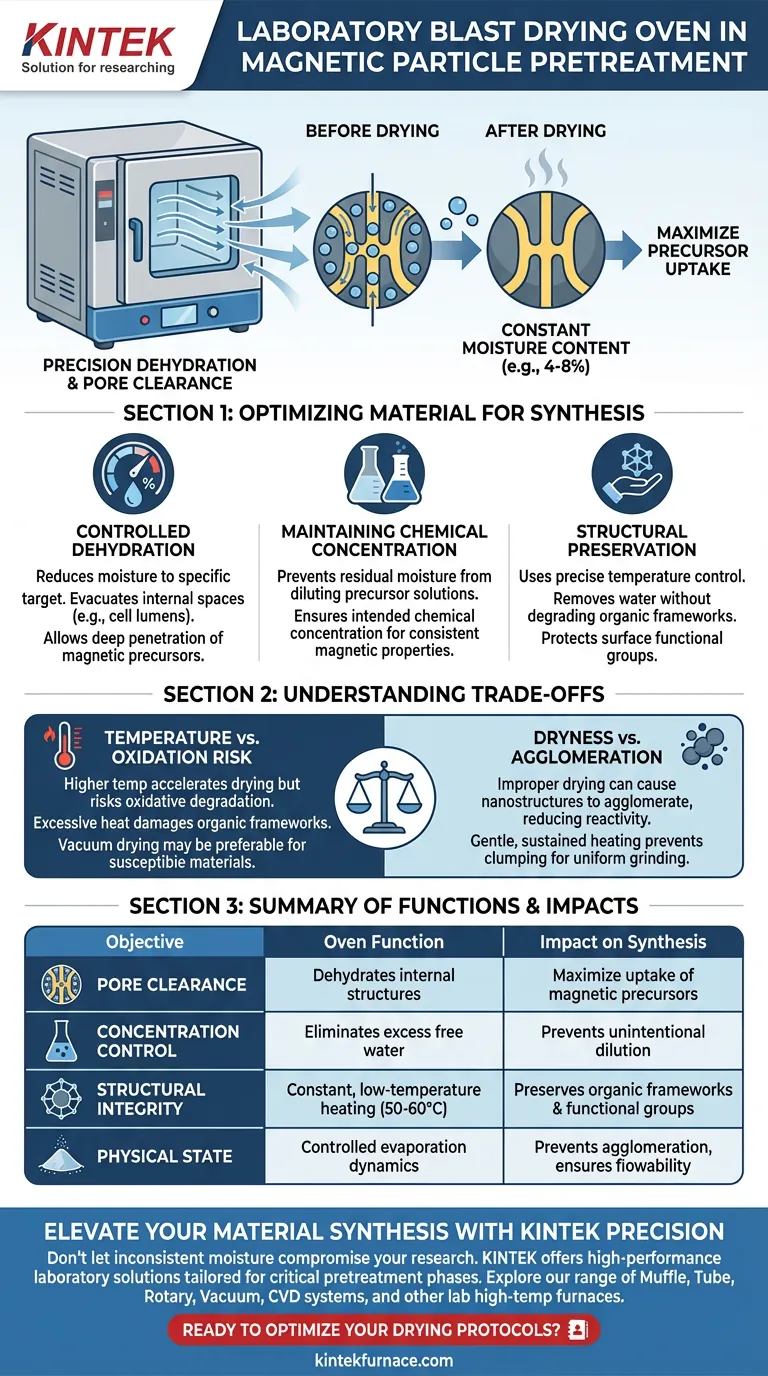
The primary function of a laboratory blast drying oven during this phase is to precisely dehydrate the substrate material to a specific constant moisture content. This process clears the internal pore structures (such as cell lumens in wood-based templates) to allow for the maximum uptake of magnetic precursor solutions, while simultaneously preventing the dilution of subsequent chemical reactions.
The oven acts as a critical preparation tool that balances moisture removal with structural preservation. By clearing internal voids without damaging the organic framework, it ensures the material is chemically receptive to the magnetic precursors used in later synthesis steps.
Optimizing the Material for Synthesis
The pretreatment phase is not merely about "drying" the material; it is about conditioning the physical structure of the particle or substrate (such as wood particles used as a magnetic carrier) to ensure the success of the chemical reaction.
Controlled Dehydration and Pore Clearance
The blast drying oven is used to reduce the moisture content of cleaned particles to a specific target, often between 4% and 8%.
By removing excess free water, the oven evacuates the internal spaces, such as cell lumens in organic templates.
This creation of physical space is vital because it allows the magnetic precursor solutions (added in the next step) to deeply penetrate and adsorb into the material structure.
Maintaining Chemical Concentration
If the particles retain too much residual moisture, the water occupying the pores will interact with the precursor solution.
This interaction causes an unintentional dilution of the reaction solution concentration, which can lead to weak or inconsistent magnetic properties in the final product.
The drying oven ensures the substrate is "thirsty" enough to absorb the precursor at the intended chemical concentration.
Structural Preservation
While moisture removal is the goal, the process must be gentle enough to preserve the material's integrity.
The blast drying oven utilizes precise temperature control to remove water without degrading the organic structure of the substrate.
For sensitive materials like magnetic nanocatalysts, maintaining a lower, constant temperature (e.g., 60°C) prevents damage to surface functional groups that are essential for future catalytic activity.
Understanding the Trade-offs
When utilizing a blast drying oven for magnetic particle pretreatment, one must balance drying speed with material stability.
Temperature vs. Oxidation Risk
While higher temperatures accelerate the removal of free water, they pose a risk to the chemical purity of the particles.
Excessive heat can cause oxidative degradation or damage the organic framework of the template, rendering it less effective as a carrier.
For susceptible materials like Fe3O4 precipitates, a vacuum drying environment may be preferable to a standard blast oven to prevent oxidation.
Dryness vs. Agglomeration
Drying is necessary to create a flowable powder, but improper drying dynamics can lead to issues.
Rapid evaporation or excessive temperatures can cause nanostructures to agglomerate (clump together), reducing their surface area and reactivity.
A gentle, sustained heating profile helps maintain the particles in a loose, dispersible state, which is essential for uniform grinding or calcination later.
Making the Right Choice for Your Goal
To ensure the highest quality pretreatment for your magnetic particles, align your drying protocol with your specific synthesis objectives:
- If your primary focus is Precursor Adsorption: Prioritize clearing the pore structure (cell lumens) to a constant low moisture content (e.g., 4-8%) to maximize solution uptake.
- If your primary focus is Structural Integrity: Use lower temperatures (50-60°C) over longer periods to evaporate solvents gently without damaging surface functional groups.
- If your primary focus is Chemical Consistency: Ensure complete removal of free water to prevent the dilution of reaction solutions and ensure accurate mass balance calculations.
The blast drying oven is the gatekeeper of your synthesis, ensuring your substrate is chemically and physically prepared to accept the magnetic properties you intend to engineer.
Summary Table:
| Process Objective | Oven Function | Impact on Synthesis |
|---|---|---|
| Pore Clearance | Dehydrates internal structures (e.g., cell lumens) | Maximize uptake of magnetic precursor solutions |
| Concentration Control | Eliminates excess free water | Prevents unintentional dilution of chemical reactants |
| Structural Integrity | Constant, low-temperature heating (50-60°C) | Preserves organic frameworks and surface functional groups |
| Physical State | Controlled evaporation dynamics | Prevents particle agglomeration and ensures flowability |
Elevate Your Material Synthesis with KINTEK Precision
Don't let inconsistent moisture levels compromise your magnetic particle research. KINTEK provides high-performance laboratory solutions tailored for critical pretreatment phases. Backed by expert R&D and manufacturing, we offer a comprehensive range of Muffle, Tube, Rotary, Vacuum, CVD systems, and other lab high-temp furnaces, all customizable to meet your unique experimental needs.
Our equipment ensures the precise temperature control required to clear internal pores without damaging sensitive organic templates, giving you total control over precursor adsorption and chemical consistency.
Ready to optimize your drying protocols? Contact us today to find the perfect thermal solution for your lab!
Visual Guide
References
- Róger Moya, Karla J. Merazzo. Magnetic and Physical-Mechanical Properties of Wood Particleboards Composite (MWPC) Fabricated with FE3o4 Nanoparticles and Three Plantation Wood. DOI: 10.22382/wfs-2023-19
This article is also based on technical information from Kintek Furnace Knowledge Base .
Related Products
- Laboratory Muffle Oven Furnace with Bottom Lifting
- 1800℃ High Temperature Muffle Oven Furnace for Laboratory
- 1200℃ Muffle Oven Furnace for Laboratory
- High Temperature Muffle Oven Furnace for Laboratory Debinding and Pre Sintering
- 1700℃ High Temperature Muffle Oven Furnace for Laboratory
People Also Ask
- Why is a high-temperature laboratory muffle furnace essential for the alkali fusion process in zeolite synthesis?
- What function does a muffle furnace perform in Ba0.75Ca0.25TiO3 calcination? Ensure Phase Purity & Synthesis
- What is the importance of the calcination process? Master High-Purity Calcium Phosphate Nanopowder Production
- Why is a high-temperature muffle furnace required for FeOx-MOx/TiO2? Engineering High-Performance Nanocomposites
- What are the primary functions of a high-temperature laboratory muffle furnace in the preparation of biosorbent materials?






