
High-purity quartz boats provide essential chemical inertness and thermal stability, ensuring the successful synthesis of nitrogen-enriched carbon nanotubes. Their primary advantage lies in their ability to withstand high-temperature Chemical Vapor Deposition (CVD) and ammonia reduction atmospheres without reacting with metal catalysts or the developing carbon nanostructure.
Core Takeaway: The use of high-purity quartz boats is critical for maintaining surface chemical purity and metal residue control. By eliminating reactions between the vessel and the catalyst, you ensure the final nitrogen-enriched carbon nanotubes are consistent and free from container-induced contamination.
Preserving Chemical Purity
Eliminating Catalyst Interference
The most critical function of the quartz boat is to remain chemically neutral. It does not react with metal catalysts (such as nickel or iron) used to grow the nanotubes.
Preventing Cross-Contamination
Because high-purity quartz contains virtually no metal impurities, it prevents the introduction of foreign elements into the reaction. This ensures that the only metal residues found in the final product are the intended catalytic particles, allowing for precise control over the nanotube's composition.
Resisting Ammonia Reduction Atmospheres
Nitrogen-enriched carbon nanotube preparation often requires harsh ammonia reduction environments. High-purity quartz remains inert under these specific chemical conditions, preventing surface degradation that could contaminate the carbon lattice.
Enduring Harsh Process Conditions
Withstanding High Temperatures
The CVD process frequently exceeds temperatures of 800°C. High-purity quartz possesses excellent thermal stability, maintaining its structural integrity without warping or melting during these intense heating cycles.
Excellent Thermal Shock Resistance
In addition to sustained heat, the process may involve rapid temperature fluctuations. Quartz boats offer superior thermal shock resistance, ensuring the vessel does not crack or fracture when subjected to the rapid heating or cooling inherent in tube furnace operations.
Facilitating Optimal Reaction Dynamics
Stable Platform for Gas Interaction
The boat provides a physically stable platform to hold the raw materials within the furnace. This stability is crucial when materials are exposed to continuous carrier gas flows.
Maximizing Catalyst Contact
By holding the substrate securely, the boat ensures maximum contact between the carbon source vapors and the catalyst bed. This promotes uniform growth and higher yield of the carbon nanotubes.
Understanding the Trade-offs
Fragility and Handling
While chemically superior, quartz is mechanically brittle compared to alternatives like high-alumina ceramic. It requires careful handling to avoid breakage during loading and unloading, as it lacks the high mechanical impact strength of ceramic vessels.
Cost Considerations
High-purity quartz is a precision material. For applications where extreme chemical purity is not the primary constraint, more robust materials like alumina might offer a more durable, albeit less inert, solution.
Making the Right Choice for Your Goal
To maximize the quality of your nitrogen-enriched carbon nanotubes, match your vessel choice to your specific experimental priorities:
- If your primary focus is strict chemical purity: Use high-purity quartz to eliminate cross-contamination and ensure the boat remains inert during ammonia reduction.
- If your primary focus is mechanical durability: Evaluate if the slight risk of impurity from a high-alumina ceramic boat is acceptable in exchange for greater resistance to physical breakage.
Selecting the correct vessel is not just about holding the sample; it is about guaranteeing the chemical integrity of your final nanomaterial.
Summary Table:
| Feature | Quartz Boat Advantage | Impact on Nanotube Quality |
|---|---|---|
| Chemical Inertness | Resists ammonia & catalyst reactions | Prevents lattice contamination |
| Purity Level | Extremely low metal impurities | Ensures precise catalyst control |
| Thermal Stability | Withstands >800°C CVD processes | Maintains structural integrity |
| Thermal Shock | High resistance to rapid cooling | Prevents vessel cracking & loss |
| Reaction Support | Stable material platform | Promotes uniform growth & yield |
Elevate Your Nanomaterial Precision with KINTEK
High-performance carbon nanotube synthesis requires equipment that never compromises on purity. Backed by expert R&D and manufacturing, KINTEK offers specialized Tube, Vacuum, and CVD systems, along with high-purity quartz boats and lab high-temp furnaces—all customizable for your unique research needs.
Don't let vessel-induced contamination undermine your results. Contact us today to discover how our high-purity components and custom furnace solutions can optimize your lab's efficiency and material quality.
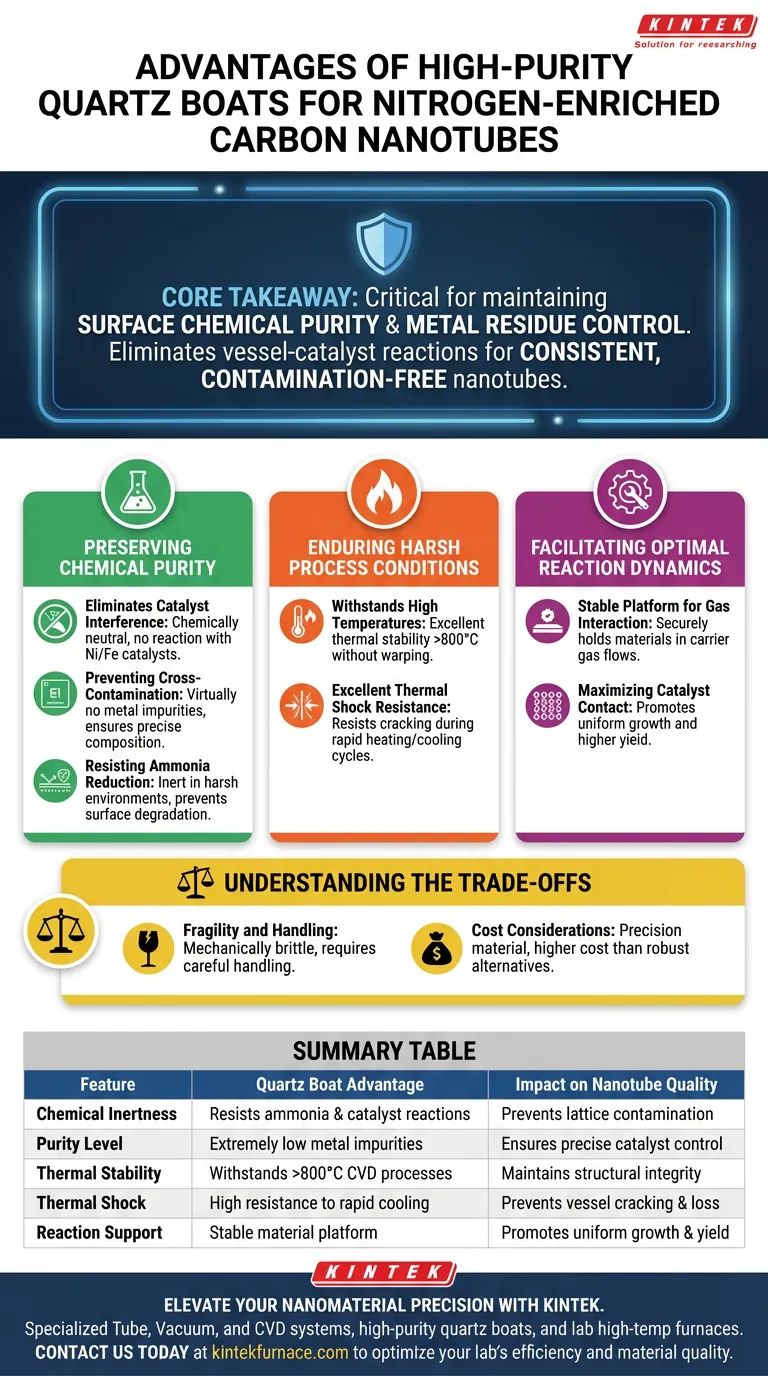
Visual Guide
References
- Neeraj Gupta, Alberto Villa. Metal-Free Catalytic Conversion of Veratryl and Benzyl Alcohols through Nitrogen-Enriched Carbon Nanotubes. DOI: 10.3390/c10010013
This article is also based on technical information from Kintek Furnace Knowledge Base .
Related Products
- High Pressure Laboratory Vacuum Tube Furnace
- Vertical Laboratory Quartz Tube Furnace Tubular Furnace
- 1200℃ Split Tube Furnace Laboratory Quartz Tube Furnace with Quartz Tube
- Magnesium Extraction and Purification Condensing Tube Furnace
People Also Ask
- What role does a high vacuum tube furnace play in Co-Al sintering? Master High-Purity Porous Material Synthesis
- What are the different types of tube furnaces available? Find the Perfect Fit for Your Lab's Needs
- What is the role of a vacuum tube furnace during the final thermal treatment stage of Fe3O4@CSAC catalysts?
- What are the main advantages of vacuum tube furnaces in the market? Achieve Purity and Precision in Material Processing
- What role does a laboratory tube furnace play in geological and mineralogical research? Unlock Earth's Secrets with Precision



