
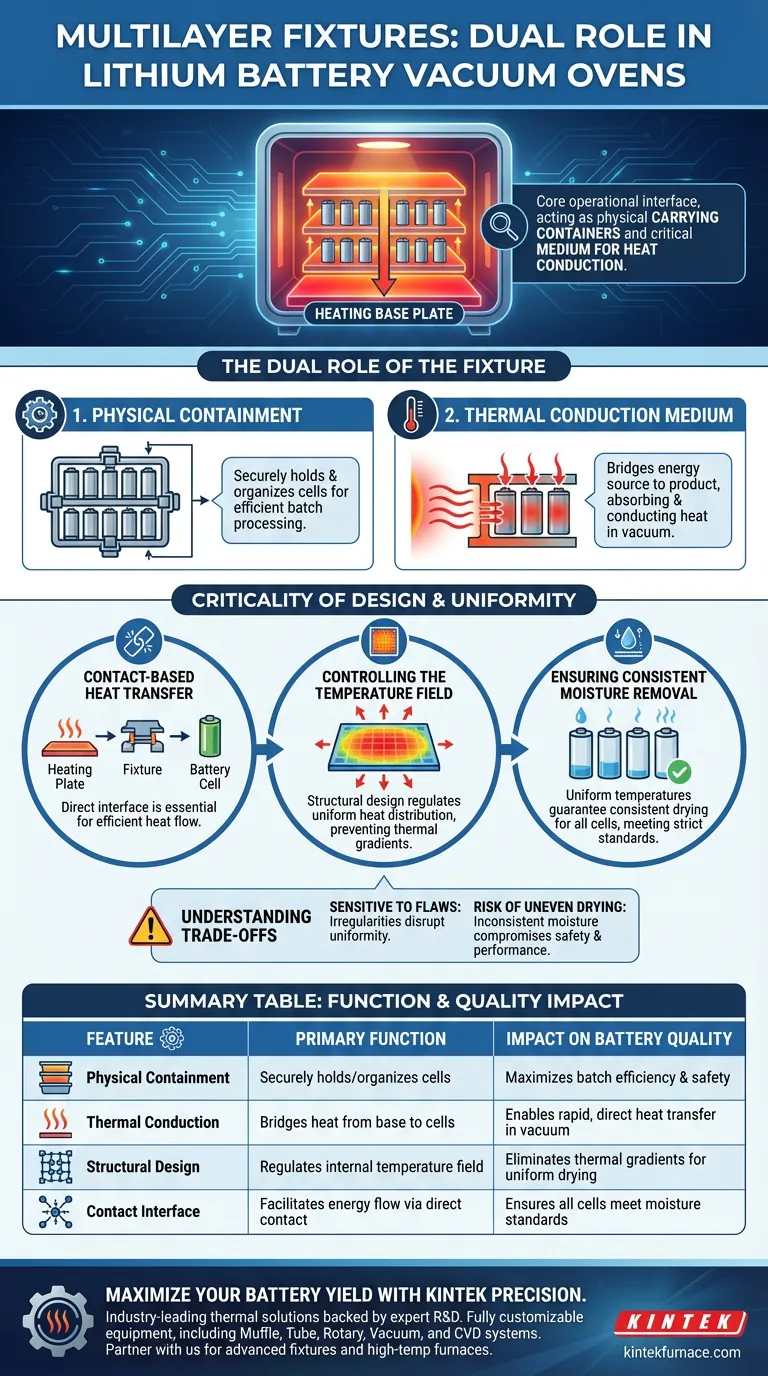
Multilayer fixtures are the operational interface of a lithium battery vacuum oven. Their primary function is twofold: they serve as the physical carrying containers for the battery cells and act as the critical medium for heat conduction. By establishing a direct link between the heating base plate and the battery cells, these fixtures facilitate the thermal transfer necessary for the drying process.
The fixture is more than just a storage rack; it is an active component in the manufacturing process. Its structural design dictates the uniformity of the temperature field, which is the deciding factor in ensuring every battery cell achieves consistent, standard-compliant moisture levels.
The Dual Role of the Fixture
Physical Containment
At the most basic level, multilayer fixtures function as carrying containers. They securely hold the batteries in place, organizing the batch for efficient processing within the vacuum environment.
Thermal Conduction Medium
More importantly, the fixture acts as the core medium for heat transfer. In a vacuum environment where convection is minimized, the fixture bridges the gap between the energy source and the product. It absorbs thermal energy from the heating system and conducts it directly to the battery cells.
The Criticality of Design and Uniformity
Contact-Based Heat Transfer
The efficiency of the oven relies on a contact-based design. The fixture must physically interface with the heating base plate. This direct contact allows heat to flow from the plate, through the fixture material, and into the battery cells.
Controlling the Temperature Field
The structural design of the fixture determines how that heat spreads. A well-engineered fixture ensures the temperature field is uniform throughout the oven. It prevents thermal gradients where some areas might be significantly hotter than others.
Ensuring Consistent Moisture Removal
Temperature uniformity is directly linked to product quality. By maintaining even heat distribution, the fixture ensures that moisture levels are reduced consistently across all battery units. This prevents "weak links" in a batch where specific cells might retain excess humidity.
Understanding the Trade-offs
Sensitivity to Structural Flaws
Because the process relies on contact and conduction, the fixture's design is unforgiving. Any irregularities in the fixture's structure can disrupt the uniformity of heat transfer.
The Risk of Uneven Drying
If the fixture fails to distribute heat evenly, the batch will suffer from inconsistent drying. This compromises the safety and performance of the batteries, as variations in moisture content can lead to failure in the field.
Making the Right Choice for Your Process
To ensure high-yield battery production, consider how your fixture design impacts your specific goals:
- If your primary focus is Product Consistency: Prioritize fixtures with precision structural design to guarantee a uniform temperature field across all layers.
- If your primary focus is Quality Assurance: rigorous verification of the fixture's contact surfaces is required to ensure moisture standards are met for every unit.
The multilayer fixture is not a passive accessory, but a precision thermal tool that directly dictates the reliability of your final product.
Summary Table:
| Feature | Primary Function | Impact on Battery Quality |
|---|---|---|
| Physical Containment | Securely holds and organizes battery cells | Maximizes batch efficiency and safety |
| Thermal Conduction | Bridges heat from base plate to cells | Enables rapid, direct heat transfer in a vacuum |
| Structural Design | Regulates the internal temperature field | Eliminates thermal gradients for uniform drying |
| Contact Interface | Facilitates energy flow via direct contact | Ensures all cells meet strict moisture standards |
Maximize Your Battery Yield with KINTEK Precision
In the competitive landscape of energy storage, thermal uniformity is the key to safety and performance. KINTEK provides industry-leading thermal solutions backed by expert R&D and manufacturing. Our diverse range of equipment—including Muffle, Tube, Rotary, Vacuum, and CVD systems—is fully customizable to meet your specific lab or industrial requirements.
Don't let inefficient heat transfer compromise your production standards. Partner with KINTEK to integrate advanced fixtures and high-temp furnace systems designed for precision. Contact our specialists today to discuss your custom project!
Visual Guide
References
- Lili Zhao, Bo Qi. Research on Temperature Field Characteristics of Lithium Battery Vacuum Drying Furnace. DOI: 10.56028/aetr.11.1.63.2024
This article is also based on technical information from Kintek Furnace Knowledge Base .
Related Products
- Vacuum Heat Treat Sintering and Brazing Furnace
- Vacuum Heat Treat Sintering Furnace Molybdenum Wire Vacuum Sintering Furnace
People Also Ask
- What is one of the most important uses of vacuum heat treating furnaces in aerospace? Achieve Superior Strength in Aircraft Alloys
- What are the benefits of using vacuum heat treating furnaces for metal alloys? Achieve Superior Metal Properties and Performance
- How does vacuum heat treating affect the grain structure of metal alloys? Achieve Precise Microstructure Control
- What is the temperature of a vacuum furnace brazing? Optimize Your Joint Strength and Cleanliness
- What are the steps involved in a typical vacuum brazing treatment? Master the Process for Strong, Clean Joints

