
A high-temperature vacuum resistance furnace provides two critical technical conditions for simulating infiltration: a thermal capacity reaching 1600 °C and a high vacuum environment below 5×10⁻⁵ Torr. These specific parameters are engineered to replicate the rigorous production processes required for manufacturing nuclear fusion components.
By eliminating atmospheric contamination, the furnace ensures that the movement of molten steel into tungsten meshes is driven solely by physical laws—specifically capillary forces—rather than chemical reactions like oxidation.
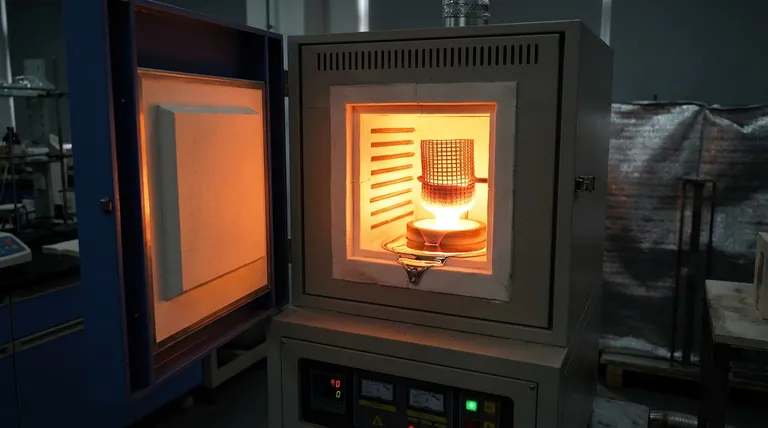
The Role of Environmental Control
To accurately simulate the infiltration of molten steel into tungsten, you must isolate the materials from external variables. The furnace achieves this through specific thermal and atmospheric controls.
Reaching the Melting Point
The furnace is capable of sustaining temperatures up to 1600 °C.
This extreme heat is necessary to fully melt the steel and bring the tungsten mesh to the correct processing temperature. It ensures the viscosity of the molten fluid is correct for infiltration.
Eliminating Oxidation Risks
The most critical function of the furnace is maintaining a vacuum level below 5×10⁻⁵ Torr.
At elevated temperatures, both tungsten and iron are highly susceptible to oxidation. Even trace amounts of oxygen can form oxide layers on the metal surfaces, which would ruin the experiment.
Ensuring Pure Capillary Action
The combination of high heat and high vacuum creates a pristine environment for the melt to spread.
Because oxidation is prevented, the infiltration of the steel into the tungsten mesh is governed entirely by capillary forces and inherent wettability. This allows researchers to observe the mechanical interactions exactly as they would occur in a perfect production scenario.
Critical Dependencies and Risks
While the furnace provides the necessary conditions, the validity of the simulation relies on the strict maintenance of these parameters.
Sensitivity to Vacuum Fluctuation
The success of the simulation is binary; it depends entirely on the integrity of the vacuum.
If the pressure rises above 5×10⁻⁵ Torr, oxidation will occur immediately. This alters the surface chemistry of the tungsten, changing how the steel wets the surface and rendering the simulation data inaccurate.
Thermal Stability Requirements
Achieving 1600 °C is not enough; the temperature must be stable to ensure consistent fluidity.
If the temperature fluctuates significantly, the viscosity of the molten steel will change. This impacts the speed and depth of infiltration, leading to results that do not accurately reflect the capillary potential of the materials.
Making the Right Choice for Your Simulation
To ensure your infiltration experiments yield valid data for nuclear fusion applications, prioritize your setup based on these goals:
- If your primary focus is Material Purity: Ensure your vacuum system can consistently hold pressures below 5×10⁻⁵ Torr throughout the entire heating cycle to prevent oxide formation.
- If your primary focus is Infiltration Mechanics: Verify the furnace can sustain 1600 °C without fluctuation to ensure the melt spreads solely via capillary forces.
Ultimately, the accuracy of your simulation depends on the furnace's ability to remove chemical interference and isolate the physical interactions between the metals.
Summary Table:
| Technical Parameter | Target Specification | Critical Role in Simulation |
|---|---|---|
| Operating Temperature | Up to 1600 °C | Ensures complete steel melting and optimal fluid viscosity. |
| Vacuum Level | < 5×10⁻⁵ Torr | Prevents oxidation of tungsten and iron to maintain material purity. |
| Infiltration Driver | Capillary Action | Enabled by the absence of chemical interference in a vacuum. |
| Application Focus | Nuclear Fusion | Replicates conditions for manufacturing high-performance components. |
Achieve Unmatched Precision in Your High-Temp Research
Don't let oxidation or thermal instability compromise your material simulations. KINTEK provides industry-leading thermal solutions backed by expert R&D and manufacturing. Our diverse range of Muffle, Tube, Rotary, Vacuum, and CVD systems are engineered for rigorous performance and are fully customizable to meet your unique laboratory needs.
Whether you are simulating molten metal infiltration or developing advanced nuclear fusion components, KINTEK ensures your results are driven by science, not environmental variables.
Ready to upgrade your lab's capabilities? Contact KINTEK today for a customized solution!
References
- N. S. Popov, Oleg Sevryukov. Interaction of iron melt with tungsten and WFe composite structure evolution. DOI: 10.3897/nucet.10.129596
This article is also based on technical information from Kintek Furnace Knowledge Base .
Related Products
- Molybdenum Vacuum Heat Treat Furnace
- 2200 ℃ Tungsten Vacuum Heat Treat and Sintering Furnace
- 1400℃ Controlled Inert Nitrogen Atmosphere Furnace
- 2200 ℃ Graphite Vacuum Heat Treat Furnace
- Vacuum Heat Treat Sintering Furnace Molybdenum Wire Vacuum Sintering Furnace
People Also Ask
- What is the primary application of vacuum heat treating furnaces in aerospace? Enhance Component Performance with Precision
- How does vacuum heat treating work in terms of temperature and time control? Master Precise Material Transformations
- How does a vacuum heat treating furnace improve the condition of metal alloys? Achieve Superior Metal Performance
- What is the process of vacuum heat treating? Achieve Superior Metallurgical Properties
- Why are vacuum heat treating furnaces essential for aerospace? Ensure Superior Material Integrity for High-Stakes Applications



















