
The primary function of a program-controlled tube furnace in this synthesis is to act as a precision reactor that orchestrates the simultaneous chemical transformation of two distinct materials. It provides a strictly regulated heating rate of 1 °C min⁻¹ and maintains a stable 800 °C environment to convert Ammonia Borane (AB) into Boron Nitride (BN) while carbonizing the surrounding ZIF-8 framework.
The furnace ensures that the conversion of precursor materials happens uniformly within the pores of the host structure. By synchronizing the heating rate and peak temperature, it enables the in-situ creation of a unified Boron Nitride-Carbon (BN@C) composite rather than separate phases.
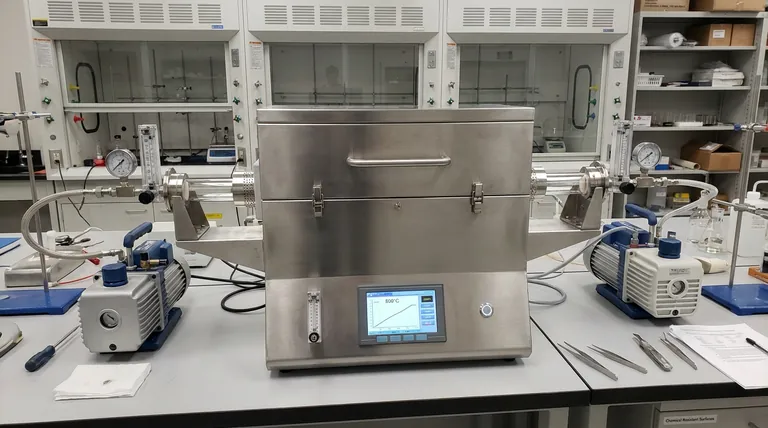
Mechanisms of Thermal Transformation
Precise Heating Rate Regulation
The furnace is programmed to adhere to a specific heating ramp of 1 °C min⁻¹.
This slow, controlled increase is critical for managing the thermal evolution of the materials.
It prevents rapid structural collapse or uneven heating that could occur with a faster, uncontrolled temperature spike.
High-Temperature Stabilization
The equipment maintains a stable pyrolysis environment at a target temperature of 800 °C.
This specific thermal plateau provides the energy required to drive the chemical bonds to break and reform.
Consistency at this temperature is necessary to ensure the reaction proceeds to completion throughout the entire sample.
The Simultaneous Chemical Conversion
In-Situ Conversion of Ammonia Borane
Within the stable high-temperature environment, the furnace drives the transformation of ammonia borane.
Because the ammonia borane is confined within the pores of the ZIF-8, this conversion to boron nitride (BN) happens in-situ (in place).
The furnace allows this reaction to occur without the guest material leaching out or agglomerating outside the pore structure.
Carbonization of the Framework
Simultaneously, the heat acts upon the ZIF-8 host framework.
The furnace processes the ZIF-8 structure, stripping away volatile components and converting the organic linkers into a stable carbon matrix.
This results in the final "C" component of the BN@C composite, which acts as the host for the newly formed boron nitride.
Critical Process Parameters
Ensuring Uniformity
The combination of the slow heating rate and the stable 800 °C temperature is what generates a uniform structure.
If the heating were erratic, the conversion of AB to BN might desynchronize from the carbonization of ZIF-8.
The program-controlled nature of the furnace eliminates these variables, ensuring a homogeneous composite.
Dependence on Process Control
The success of this synthesis relies entirely on the precision of the program control.
Any deviation from the 1 °C min⁻¹ rate could alter the pore structure of the ZIF-8 before the AB has fully converted.
Therefore, the furnace's ability to execute the program without fluctuation is the limiting factor for quality.
Optimizing the Synthesis Process
To ensure the successful transformation of AB@ZIF-8 into BN@C, you must prioritize the programming of the furnace based on your specific outcome goals.
- If your primary focus is structural integrity: strictly adhere to the 1 °C min⁻¹ heating rate to prevent thermal shock and pore collapse during the transition.
- If your primary focus is complete chemical conversion: ensure the dwell time at 800 °C is sufficient to fully convert the ammonia borane and carbonize the framework.
Mastering the thermal profile is the single most important step in achieving a high-quality, uniform BN@C composite.
Summary Table:
| Process Parameter | Role in Transformation | Outcome Objective |
|---|---|---|
| Heating Rate (1 °C min⁻¹) | Slow thermal ramp regulation | Prevents structural collapse; ensures uniform heating |
| Temperature (800 °C) | High-temp pyrolysis plateau | Converts AB to BN & carbonizes ZIF-8 framework |
| In-Situ Control | Simultaneous chemical conversion | Creates unified BN@C composite within pore structures |
| Program Precision | Eliminates thermal fluctuations | Guarantees homogeneous material quality and integrity |
Maximize Your Material Synthesis Precision with KINTEK
Achieving the perfect BN@C composite requires more than just heat—it requires absolute thermal control. KINTEK provides industry-leading Tube, Muffle, Rotary, and Vacuum systems designed to handle delicate processes like the 1 °C min⁻¹ ramp rates essential for AB@ZIF-8 transformation.
Backed by expert R&D and world-class manufacturing, our lab high-temp furnaces are fully customizable to your unique research needs. Whether you are working on carbonization, CVD, or complex pyrolysis, KINTEK ensures your results are consistent and reproducible.
Ready to elevate your lab's performance? Contact KINTEK Today to Find Your Custom Solution
References
- Carlos A. Castilla-Martinez, Umit B. Demirci. A boron nitride–carbon composite derived from ammonia borane and ZIF-8 with promises for the adsorption of carbon dioxide. DOI: 10.1039/d4nj00643g
This article is also based on technical information from Kintek Furnace Knowledge Base .
Related Products
- Split Chamber CVD Tube Furnace with Vacuum Station CVD Machine
- 1200℃ Controlled Inert Nitrogen Atmosphere Furnace
- Multi Heating Zones CVD Tube Furnace Machine for Chemical Vapor Deposition Equipment
- Custom Made Versatile CVD Tube Furnace Chemical Vapor Deposition CVD Equipment Machine
- Slide PECVD Tube Furnace with Liquid Gasifier PECVD Machine
People Also Ask
- What role does a Tube Furnace play in the CVD growth of carbon nanotubes? Achieve High-Purity CNT Synthesis
- How does a CVD tube furnace achieve high purity in gate media preparation? Master Precision Control for Flawless Films
- What are the advantages of using a CVD tube furnace for preparing gate dielectrics? Achieve High-Quality Thin Films for Transistors
- What are the operational and maintenance requirements for a CVD tube furnace? Ensure Precision for Thin Film Deposition
- What are the key features of CVD tube furnaces for 2D material processing? Unlock Precision Synthesis for Superior Materials



















