
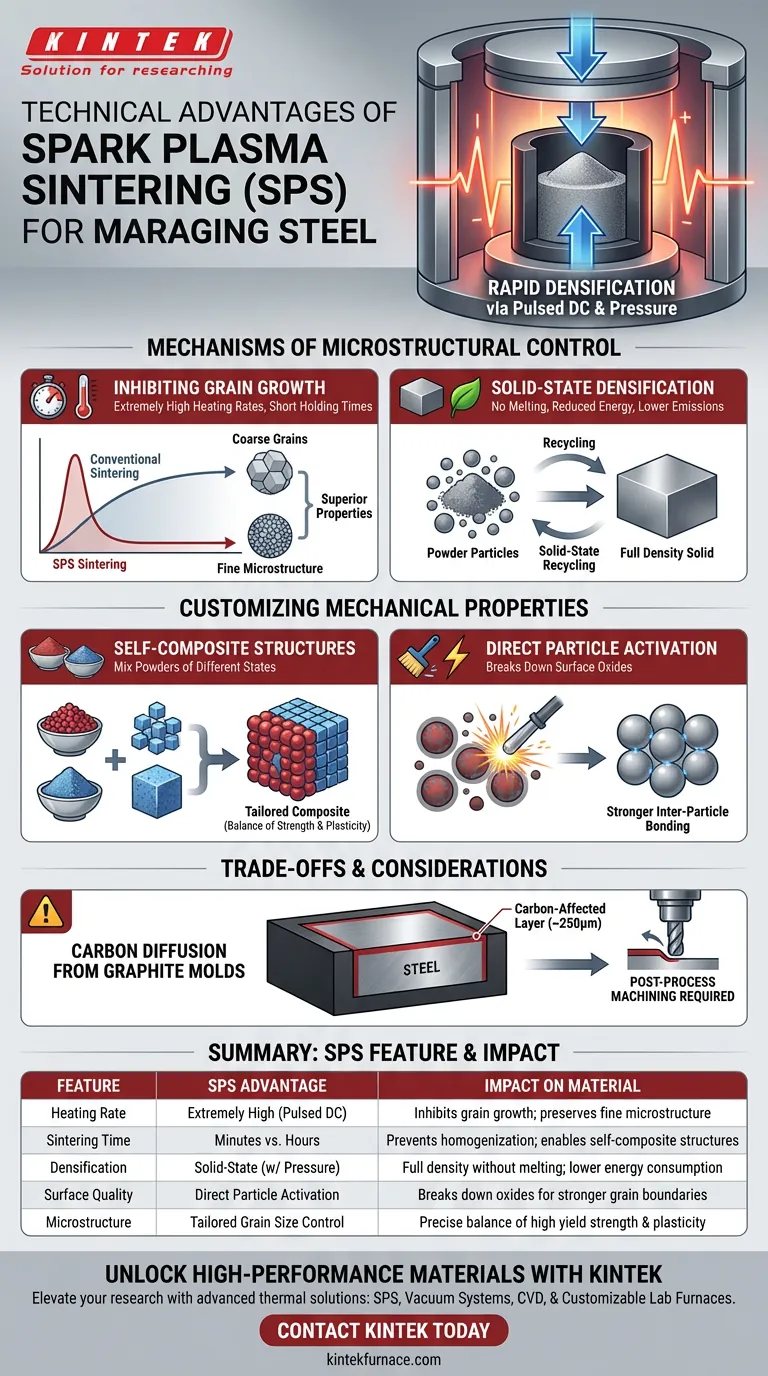
Spark Plasma Sintering (SPS) offers a distinct technical advantage for maraging steel by utilizing pulsed direct current and mechanical pressure to achieve rapid densification. This process generates extremely high heating rates with very short holding times, effectively inhibiting grain growth and preserving the fine microstructure necessary for superior mechanical properties.
By bypassing the long thermal cycles of conventional sintering, SPS enables the creation of "self-composite" structures where strength and plasticity can be precisely tuned without melting the material.
Mechanisms of Microstructural Control
Inhibiting Grain Growth
The primary advantage of SPS is the speed at which it operates. Because the pulsed current is applied directly through the powder particles, the system achieves extremely high heating rates.
This rapid heating, combined with short holding times, significantly limits the window for grain coarsening. The result is a fine-grained microstructure that retains superior mechanical strength compared to materials processed via slower, conventional sintering methods.
Solid-State Densification
SPS operates as a solid-state recycling and manufacturing method. Unlike melting processes, SPS avoids the complete phase change of the metal.
By maintaining the material in a solid state, you can achieve full densification within minutes while partially preserving the original fine microstructures of the starting powder or chips. This also results in reduced energy consumption and lower carbon emissions.
Customizing Mechanical Properties
Creating Self-Composite Structures
A unique capability of SPS is the facilitation of self-composite structures. Engineers can mix powders of different pre-treatment states before sintering.
Because the process is fast and precise, these distinct states are not homogenized into a single average structure. Instead, they form a composite within the single material, allowing for a tailored balance between high strength and plasticity.
Direct Particle Activation
The application of pulsed current and pressure helps break down surface oxides and impurities on the powder particles. This leads to cleaner grain boundaries and stronger inter-particle bonding, which is critical for the structural integrity of high-performance alloys like maraging steel.
Understanding the Trade-offs
Carbon Diffusion from Graphite Molds
While technically superior in densification, the use of graphite molds in SPS introduces a specific challenge for maraging steel. The high-temperature pressing environment facilitates carbon diffusion from the mold into the steel's surface.
The Necessity of Post-Process Machining
This diffusion typically results in a carbon-affected layer approximately 250 micrometers deep. To ensure that mechanical testing accurately reflects the properties of the maraging steel matrix—rather than this surface artifact—this layer must be removed via machining or grinding after the sintering process.
Making the Right Choice for Your Application
- If your primary focus is maximizing yield strength: Leverage the rapid heating rates of SPS to inhibit grain growth and maintain a fine microstructure.
- If your primary focus is balancing ductility and hardness: Utilize the "self-composite" technique by mixing powders of varying pre-treatment states to tune the material's plasticity.
- If your primary focus is dimensional precision: Plan for a post-sintering machining allowance of at least 250 micrometers to remove the carbon-diffusion layer caused by the graphite tooling.
SPS converts the challenge of sintering complex alloys into an opportunity for precise microstructural engineering, provided the surface interaction with tooling is managed correctly.
Summary Table:
| Technical Feature | SPS Advantage for Maraging Steel | Impact on Material |
|---|---|---|
| Heating Rate | Extremely high via pulsed DC | Inhibits grain growth; preserves fine microstructure |
| Sintering Time | Minutes vs. hours | Prevents homogenization; enables self-composite structures |
| Densification | Solid-state under mechanical pressure | Full density without melting; lower energy consumption |
| Surface Quality | Direct particle activation | Breaks down oxides for stronger grain boundaries |
| Microstructure | Tailored grain size control | Precise balance of high yield strength and plasticity |
Unlock High-Performance Materials with KINTEK
Elevate your research and production with KINTEK’s advanced thermal solutions. Whether you are working with maraging steel or complex alloys, our expertise in SPS, Vacuum systems, CVD, and customizable lab high-temp furnaces ensures you achieve precise microstructural control and superior material properties.
Backed by industry-leading R&D and manufacturing, we provide the tools you need for rapid densification and customized material performance. Contact KINTEK today to discuss your unique project requirements and let us build the perfect furnace for your laboratory’s needs.
Visual Guide
References
- Innovative Powder Pre-Treatment Strategies for Enhancing Maraging Steel Performance. DOI: 10.3390/ma18020437
This article is also based on technical information from Kintek Furnace Knowledge Base .
Related Products
- Spark Plasma Sintering SPS Furnace
- High Temperature Muffle Oven Furnace for Laboratory Debinding and Pre Sintering
- Vacuum Heat Treat Sintering Furnace with Pressure for Vacuum Sintering
- Dental Porcelain Zirconia Sintering Ceramic Vacuum Press Furnace
- 600T Vacuum Induction Hot Press Vacuum Heat Treat and Sintering Furnace
People Also Ask
- How does the heating mechanism of Spark Plasma Sintering (SPS) function? Enhance TiC/SiC Composite Fabrication
- Why is it necessary to maintain a high vacuum environment during the SPS of SiC? Key to High-Density Ceramics
- What are the technical advantages of using an SPS sintering furnace? Elevate Al2O3-TiC Material Performance
- What are the steps in the discharge plasma sintering process? Master Fast, High-Density Material Consolidation
- What are the advantages of spark plasma sintering (SPS) over traditional forging? Precision Microstructural Control












