
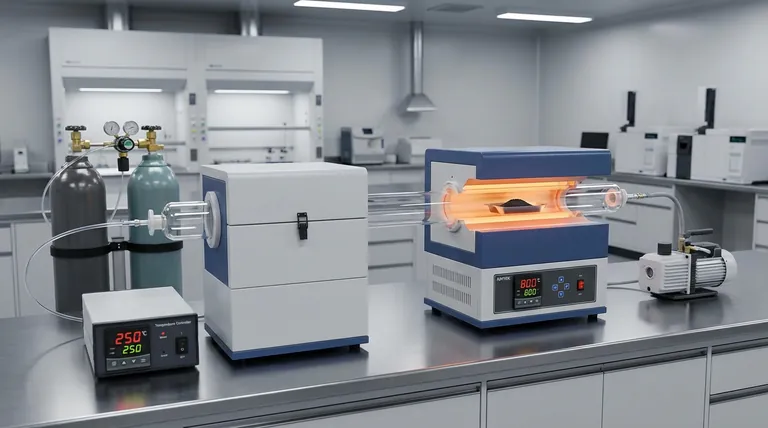
The decisive technical advantage of a dual-zone tube furnace is the decoupling of sulfur vaporization from the chemical reaction kinetics. In a single-zone setup, the source and substrate are subjected to the same thermal profile, which limits process control. A dual-zone configuration allows you to independently maintain the sulfur source at a low temperature (250 °C) to generate stable vapor, while simultaneously subjecting the Ti3C2Tx MXene to a high-temperature reaction zone (500 °C to 800 °C).
Core Takeaway By spatially separating the sulfur source from the MXene sample, a dual-zone furnace enables independent thermal management of vapor generation and surface modification. This precise regulation is the only way to achieve micro-scale control over the sulfurization degree and successfully engineer specific TiS2 and TiO2 heterojunction interfaces.
The Mechanics of Independent Thermal Control
Decoupling Process Variables
In surface sulfurization, the sublimation point of sulfur is significantly lower than the activation energy required to modify the MXene lattice.
A dual-zone furnace solves this physical mismatch by creating two distinct thermal environments. This ensures that the generation of the reactant (sulfur vapor) does not dictate the thermal conditions of the reaction itself.
The Low-Temperature Zone: Source Stability
The upstream zone is dedicated strictly to the sulfur source. By holding this zone at approximately 250 °C, the system generates a continuous, stable supply of sulfur vapor.
This stability is critical because it prevents the "flash evaporation" often seen in single-zone setups, where the sulfur might be exhausted before the substrate reaches the optimal reaction temperature.
The High-Temperature Zone: Reaction Kinetics
The downstream zone contains the Ti3C2Tx MXene sample. This zone is heated independently to a range of 500 °C to 800 °C.
At these higher temperatures, the reaction kinetics are accelerated, allowing the sulfur vapor transported from the first zone to effectively modify the MXene surface without degrading the source material upstream.
Micro-Scale Structural Engineering
Regulating Sulfurization Degree
The separation of zones allows for strict regulation of the sulfur vapor concentration reaching the sample.
By adjusting the temperature of the source zone independently of the reaction zone, you can fine-tune the partial pressure of sulfur. This provides micro-scale control over how heavily the MXene surface is sulfurized.
Controlling Interface Formation
The ultimate goal of this modification is often to create specific heterojunctions, specifically between TiS2 and TiO2.
The dual-zone setup permits the precise thermal management required to grow these interfaces. It ensures the reaction environment is optimized for phase transformation rather than simple deposition or uncontrolled degradation.
Understanding the Trade-offs
System Complexity and Calibration
While a dual-zone furnace offers superior control, it introduces more variables to the experimental design.
Operators must carefully calibrate the carrier gas flow to ensure efficient transport of vapor from the low-temperature zone to the high-temperature zone.
Spatial Dependence
The physical distance between the source and the sample becomes a critical parameter.
Unlike a single-zone batch process, the thermal gradient between zones must be managed to prevent sulfur condensation in the "dead space" between heaters before it reaches the MXene.
Making the Right Choice for Your Goal
When designing your Chemical Vapor Deposition (CVD) strategy for MXene, consider your specific material requirements:
- If your primary focus is precise stoichiometry: Use a dual-zone setup to decouple vapor pressure from reaction temperature, ensuring exact sulfurization levels.
- If your primary focus is interface engineering: Rely on the dual-zone capability to maintain high reaction temperatures (up to 800 °C) needed for forming distinct TiS2/TiO2 heterojunctions.
Ultimately, the dual-zone configuration transforms sulfurization from a passive exposure process into a tunable, highly controlled surface engineering technique.
Summary Table:
| Feature | Single-Zone Tube Furnace | Dual-Zone Tube Furnace |
|---|---|---|
| Thermal Profile | Uniform temperature for source & sample | Independent control of source & reaction zones |
| Vapor Stability | High risk of flash evaporation | Stable, continuous sulfur vapor generation |
| Reaction Precision | Limited by sublimation-reaction mismatch | Decoupled kinetics for precise stoichiometry |
| Interface Control | Low control over phase transformation | Optimized for TiS2/TiO2 heterojunction growth |
| Sulfurization Degree | Difficult to regulate accurately | Micro-scale control via partial pressure tuning |
Elevate Your MXene Research with KINTEK Precision
Unlock the full potential of your surface engineering with KINTEK's advanced thermal solutions. Backed by expert R&D and world-class manufacturing, KINTEK offers a comprehensive range of Muffle, Tube, Rotary, Vacuum, and CVD systems designed to meet the rigorous demands of material science.
Our dual-zone tube furnaces provide the precise decoupling and independent thermal management required for complex sulfurization and heterojunction interface engineering. Whether you need a standard setup or a system fully customizable for your unique research needs, KINTEK delivers the reliability and micro-scale control essential for your success.
Ready to optimize your Ti3C2Tx MXene modification? Contact us today to find your perfect furnace solution!
References
- Minghua Chen, Kun Liang. Engineering Ti3C2-MXene Surface Composition for Excellent Li+ Storage Performance. DOI: 10.3390/molecules29081731
This article is also based on technical information from Kintek Furnace Knowledge Base .
Related Products
- Magnesium Extraction and Purification Condensing Tube Furnace
- Split Multi Heating Zone Rotary Tube Furnace Rotating Tube Furnace
- Multi Heating Zones CVD Tube Furnace Machine for Chemical Vapor Deposition Equipment
- Multi Zone Laboratory Quartz Tube Furnace Tubular Furnace
- Split Chamber CVD Tube Furnace with Vacuum Station CVD Machine
People Also Ask
- What are the advantages of using a condensing tube furnace for magnesium extraction? Achieve High Purity and Efficient Metal Recovery
- How do tube furnaces contribute to transport reactions and crystal production? Master High-Purity Synthesis with Precision Control
- What are the temperature capabilities of tube furnaces? Find the Perfect Heat for Your Process
- Why is an argon atmosphere protection critical during the selenization of CoO/CoSe? Key to High-Purity Heterostructures
- What are the disadvantages of tube furnace cracking when processing heavy raw materials? Avoid Costly Downtime and Inefficiency



















