
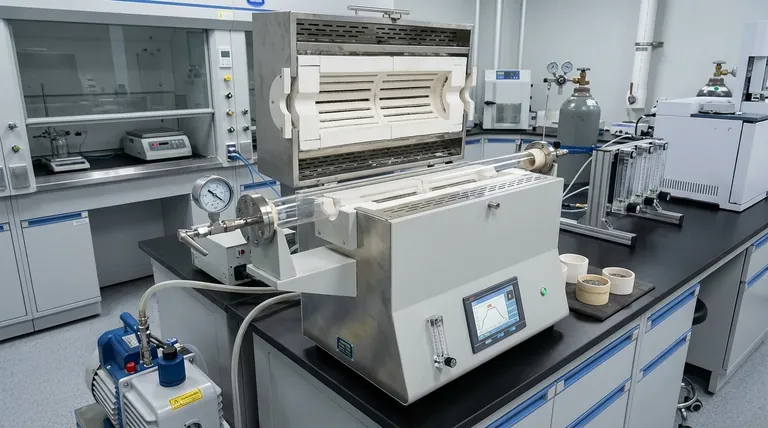
At its core, a tube furnace is a high-precision heating device used for a vast range of thermal processing applications. It is engineered to heat materials or components placed inside a separate process tube, providing exceptional temperature uniformity and the ability to control the atmospheric environment around the sample. Common uses include material synthesis, purification, annealing, sintering, drying, and catalyst research.
The defining advantage of a tube furnace is not just its ability to reach high temperatures, but its capacity to create a highly uniform and atmospherically controlled environment, making it an indispensable tool for sensitive materials research and advanced manufacturing.
The Core Function: High-Precision Thermal Processing
A tube furnace's unique design—a cylindrical chamber heating a separate process tube—is what enables its primary capabilities. This separation between the heating elements and the sample is fundamental to its performance.
Achieving High Thermal Uniformity
The tubular heating chamber is designed to distribute heat evenly along its length. This ensures that the entire sample within the central "hot zone" experiences nearly the same temperature, which is critical for consistent material processing and reliable experimental results.
Enabling Atmosphere Control
Because the sample is contained within a sealed or sealable tube, you gain complete control over its environment. The tube can be evacuated to create a high-vacuum state to prevent oxidation, or it can be filled with specific gases—such as inert argon or reactive hydrogen—to facilitate or inhibit chemical reactions.
Precise Temperature Management
Tube furnaces excel at executing programmed heating profiles. They can be set to ramp up to a specific temperature, hold it for a precise duration (a "soak"), and then cool down at a controlled rate. This level of control is essential for processes like annealing and crystal growth.
Common Applications Across Industries
The combination of uniform heating and atmosphere control makes tube furnaces versatile tools in both research and commercial settings.
Material Synthesis and Purification
Tube furnaces are widely used in chemistry and materials science to synthesize inorganic compounds, grow crystals, and purify substances through processes like sublimation. The controlled environment prevents unwanted side reactions and contamination.
Advanced Heat Treatment
Processes like annealing (softening metals), sintering (fusing powders into a solid mass), and tempering (improving toughness) rely on the precise temperature and atmospheric control that tube furnaces provide. This is critical for creating materials with specific mechanical or electrical properties.
Component Testing and Calibration
In research and development, tube furnaces are used for catalyst testing, solid oxide fuel cell research, and testing the thermal properties of aerospace ceramics and metals. They are also the standard for the high-precision calibration of thermocouples.
High-Tech Manufacturing
Tube furnaces are integral to several advanced manufacturing processes. They are used in the production of semiconductors, batteries, polymer composites, and for specialized tasks like vacuum brazing and curing of high-performance components.
Understanding the Trade-offs
While powerful, a tube furnace is not the universal solution for all heating needs. Understanding its limitations is key to using it effectively.
Sample Size and Throughput
The most significant limitation is the diameter and length of the process tube. This constrains the physical size of the sample, making tube furnaces best suited for smaller components or material batches, not for processing very large parts.
Operational Complexity
Achieving a high-vacuum or precisely mixed gas atmosphere requires auxiliary equipment like vacuum pumps, gas mixers, and flow controllers. Operating this system requires more technical expertise than using a simple oven or box furnace.
Fragility and Maintenance
The process tubes, often made of quartz, alumina, or mullite, can be fragile and susceptible to thermal shock if heated or cooled too quickly. They require careful handling and can represent a recurring operational cost.
Making the Right Choice for Your Goal
Selecting the correct heating instrument depends entirely on your specific objective. A tube furnace is a specialized tool, and its value is realized when its unique capabilities are matched to the task.
- If your primary focus is materials science research or synthesis: A tube furnace is the ideal choice for its unparalleled control over temperature profiles and atmospheric conditions.
- If your primary focus is heat-treating sensitive parts that require a vacuum or inert gas: A tube furnace provides the controlled environment necessary to prevent oxidation and ensure material integrity.
- If your primary focus is processing large components or high-volume batches in ambient air: A box furnace or a conveyor furnace would likely be a more practical and cost-effective solution.
Ultimately, understanding that the tube furnace is a tool for precision and control empowers you to leverage it for the most demanding thermal applications.
Summary Table:
| Application Category | Key Processes | Ideal For |
|---|---|---|
| Material Synthesis | Crystal Growth, Purification, Inorganic Synthesis | Research & Development Labs |
| Heat Treatment | Annealing, Sintering, Tempering | Materials Science & Manufacturing |
| Testing & Calibration | Catalyst Research, Thermocouple Calibration | Quality Control & R&D |
| Advanced Manufacturing | Semiconductor Processing, Vacuum Brazing | High-Tech Industrial Production |
Need a high-precision thermal processing solution?
At KINTEK, we leverage our exceptional R&D and in-house manufacturing to provide diverse laboratories with advanced tube furnace solutions. Our product line, including Tube Furnaces, Vacuum & Atmosphere Furnaces, and CVD/PECVD Systems, is complemented by strong deep customization capabilities to precisely meet your unique experimental requirements—whether for material synthesis, annealing, or catalyst research.
Contact us today to discuss how our tailored high-temperature furnace solutions can enhance your research or production process!
Visual Guide

Related Products
- Vacuum Sealed Continuous Working Rotary Tube Furnace Rotating Tube Furnace
- 1400℃ High Temperature Laboratory Tube Furnace with Alumina Tube
- 1700℃ High Temperature Laboratory Tube Furnace with Alumina Tube
- Magnesium Extraction and Purification Condensing Tube Furnace
- High Pressure Laboratory Vacuum Tube Furnace
People Also Ask
- What is the purpose of rotary tube furnaces? Achieve Uniform Heat Treatment for Powders and Granules
- What are the key advantages of using a rotary tube furnace? Achieve Dynamic, Uniform Heating for Powders
- How does the amount of material processed vary between batch and continuous rotary tube furnaces? Scale Your Production Efficiently
- What are the advantages of rotary tube furnaces in fuel compatibility? Boost Efficiency and Cut Costs
- What is the temperature range of some rotary tube furnaces? Achieve Uniform Heating Up to 1200°C



















