
Rapid hot pressing sintering equipment offers a decisive technical advantage by achieving complete material densification for Sn0.50Ag0.25Bi0.25Se0.50Te0.50/MWCNTs composites in a drastically reduced timeframe of just 15 minutes. By simultaneously applying high temperature (733 K) and substantial mechanical pressure (48 MPa), this process bypasses the limitations of traditional sintering, resulting in a composite with superior structural and electrical properties.
Core Takeaway The primary value of rapid hot pressing lies in its ability to decouple densification from grain growth. By minimizing the time the material spends at high temperatures, you achieve a relative density exceeding 98%—optimizing electrical conductivity—while preventing the grain coarsening that typically degrades thermoelectric performance.
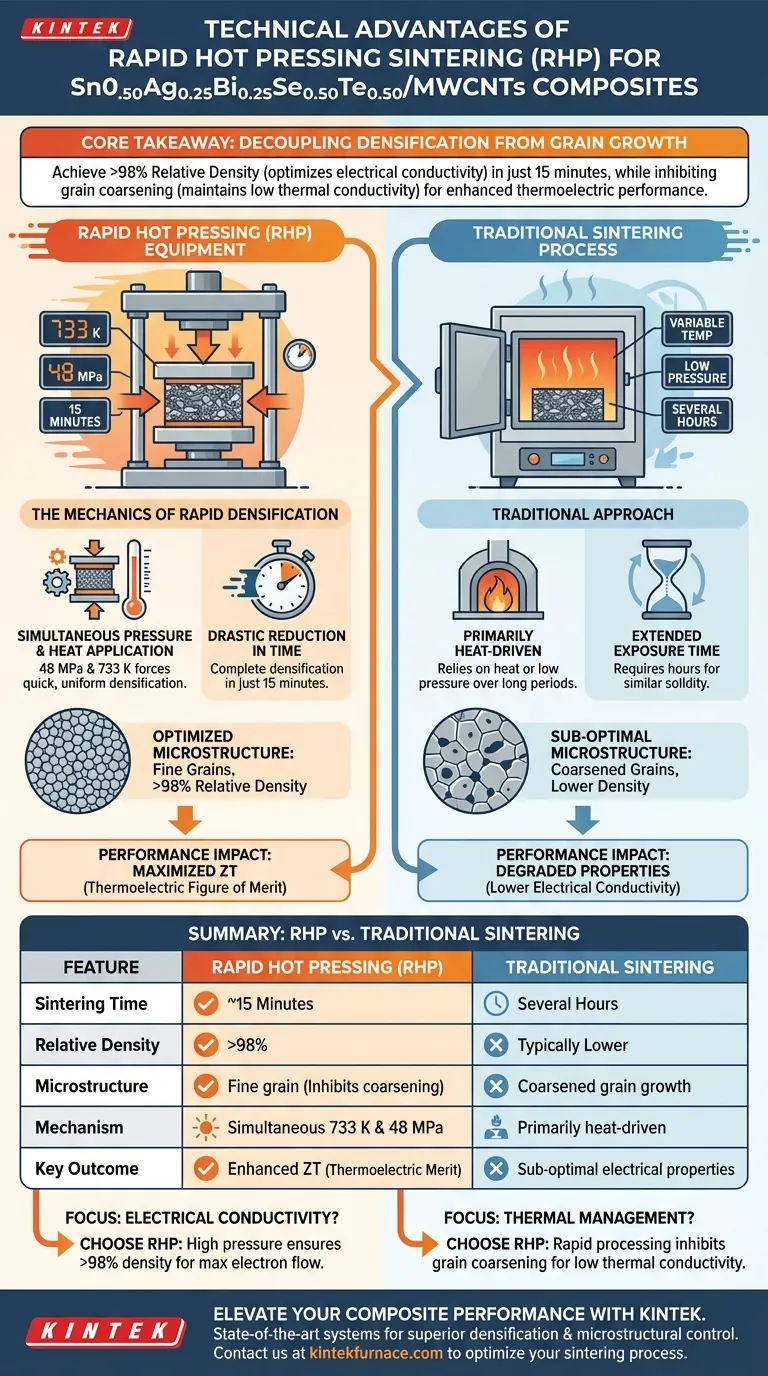
The Mechanics of Rapid Densification
Simultaneous Pressure and Heat application
Traditional sintering often relies on heat alone or low pressure over long periods.
Rapid hot pressing distinguishes itself by applying 48 MPa of pressure at a temperature of 733 K. This combination forces the material to densify quickly and uniformly.
Drastic Reduction in Processing Time
The most immediate technical benefit is efficiency.
This equipment completes the densification process in a short duration of 15 minutes. This is a significant deviation from traditional methods, which often require hours of thermal exposure to achieve similar solidity.
Microstructural Control and Performance Impact
Inhibiting Grain Coarsening
In thermoelectric materials, the size of the grains in the matrix is critical.
Extended exposure to high temperatures (common in traditional sintering) causes grains to grow or "coarsen," which can negatively alter material properties. The rapid 15-minute cycle effectively inhibits this coarsening, preserving the optimal microstructure of the thermoelectric matrix.
Maximizing Relative Density
Porosity is the enemy of electrical conductivity.
Through the application of mechanical pressure, this technique increases the relative density of the composite material to over 98 percent. This near-perfect density ensures a continuous path for electron flow.
Optimizing the Conductivity Balance
The ultimate goal for these composites is a high Figure of Merit (ZT).
The high density achieved improves electrical conductivity. Meanwhile, the preservation of the fine grain structure helps maintain low thermal conductivity, creating the ideal conditions for high-performance thermoelectric applications.
Understanding the Trade-offs
Precision Parameter Dependence
While the results are superior, the process relies on exact environmental controls.
Achieving these results requires equipment capable of maintaining precisely 733 K and 48 MPa. Deviations in pressure or temperature during the critical 15-minute window could fail to achieve the >98% density target or inadvertently allow grain growth.
Equipment Complexity
Unlike simple furnace sintering, this method introduces mechanical complexity.
The requirement to apply high pressure during the heating phase necessitates robust tooling capable of withstanding these specific forces and temperatures simultaneously.
Making the Right Choice for Your Goal
To determine if rapid hot pressing is the correct manufacturing route for your composite, evaluate your specific performance targets.
- If your primary focus is Electrical Conductivity: This method is essential, as the high pressure ensures the >98% density required for maximum electron flow.
- If your primary focus is Thermal Management: The rapid processing time is your best tool for inhibiting grain coarsening to maintain low thermal conductivity.
Rapid hot pressing is not just faster; it is a microstructural control tool that enhances the fundamental efficiency of thermoelectric composites.
Summary Table:
| Feature | Rapid Hot Pressing (RHP) | Traditional Sintering |
|---|---|---|
| Sintering Time | ~15 Minutes | Several Hours |
| Relative Density | >98% | Typically Lower |
| Microstructure | Fine grain (Inhibits coarsening) | Coarsened grain growth |
| Mechanism | Simultaneous 733 K & 48 MPa | Primarily heat-driven |
| Key Outcome | Enhanced ZT (Thermoelectric Merit) | Sub-optimal electrical properties |
Elevate Your Composite Performance with KINTEK
Are you looking to achieve superior densification and microstructural control for your advanced materials? Backed by expert R&D and manufacturing, KINTEK offers state-of-the-art Muffle, Tube, Rotary, Vacuum, and CVD systems, including customizable high-temp furnaces tailored for rapid hot pressing and advanced sintering needs.
Our equipment empowers researchers and manufacturers to reach >98% relative density while maintaining critical grain structures for maximum thermoelectric efficiency. Let our experts help you design the perfect thermal processing solution for your unique laboratory requirements.
Contact KINTEK Today to Optimize Your Sintering Process
Visual Guide
References
- Zhenyu Tan, Degang Zhao. Enhanced Thermoelectric Properties in Cubic Sn0.50Ag0.25Bi0.25Se0.50Te0.50 via MWCNTs Incorporation. DOI: 10.3390/cryst15040365
This article is also based on technical information from Kintek Furnace Knowledge Base .
Related Products
- 600T Vacuum Induction Hot Press Vacuum Heat Treat and Sintering Furnace
- Vacuum Hot Press Furnace Machine Heated Vacuum Press Tube Furnace
- Spark Plasma Sintering SPS Furnace
- Vacuum Heat Treat Sintering Furnace with Pressure for Vacuum Sintering
- 9MPa Air Pressure Vacuum Heat Treat and Sintering Furnace
People Also Ask
- Why use Vacuum Hot Press (VHP) for ZnS Ceramics? Achieve Superior IR Transparency and Mechanical Strength
- How does a vacuum hot press sintering furnace mitigate copper sintering swelling? Solve Fe-Cu Expansion Issues
- What is the core function of a vacuum hot press sintering furnace in the preparation of high-density RuTi alloys? Achieve Maximum Density and Purity
- What are the key advantages of vacuum hot press sintering furnaces? Achieve Superior Density and Purity in Materials
- What are the benefits of using a vacuum hot press sintering furnace for the preparation of SiCw/2024 aluminum matrix composites? Achieve High-Performance Aerospace Materials



















