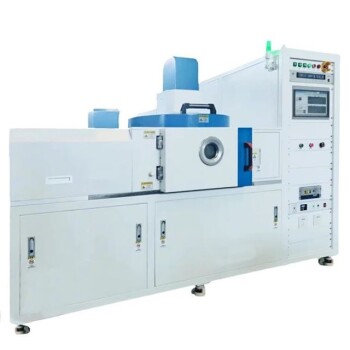
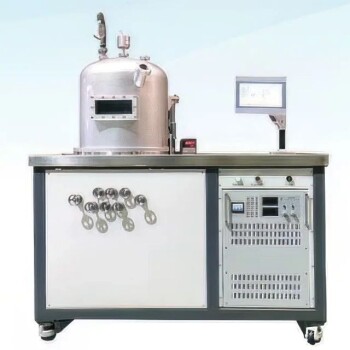
The primary structural advantage of a customized Atmospheric Pressure Spatial Chemical Vapor Deposition (AP-SCVD) system is its ability to operate in an open atmospheric environment. Unlike traditional Chemical Vapor Deposition (CVD) methods that rely on sealed chambers, this system eliminates the need for complex vacuum infrastructure while utilizing a specialized oscillating heating stage to ensure uniform thin film production.
By abandoning the constraints of vacuum-based processing, the AP-SCVD system drastically reduces equipment complexity and maintenance costs, offering a streamlined path to high-throughput, large-area tungsten trioxide ($WO_3$) film fabrication.
Eliminating Vacuum Constraints
The most significant structural shift in AP-SCVD is the removal of the vacuum requirement. This fundamental change alters both the physical footprint and the operational logic of the equipment.
Open Atmospheric Operation
Traditional CVD systems are defined by their reliance on sealed reaction chambers to maintain low-pressure environments.
The customized AP-SCVD system operates entirely in an open atmospheric environment. This design choice removes the physical barrier between the reaction zone and the lab environment, simplifying sample access and handling.
Removal of Pump Systems
A major source of complexity in traditional CVD is the vacuum pump system.
By operating at atmospheric pressure, the AP-SCVD design eliminates the need for vacuum pumps. This reduces the mechanical points of failure and significantly lowers the ongoing maintenance burden associated with high-vacuum hardware.
Advanced Reactor Head Design
The core of the AP-SCVD system's functionality lies in its unique reactor head configuration, which replaces the static gas inlets found in many traditional tube furnaces.
Continuous Precursor Delivery
The system features a unique reactor head designed to facilitate a continuous flow of materials.
This component simultaneously supplies precursors and oxidant gases directly to the substrate surface, ensuring a constant and reaction-ready environment without the need for chamber purging or cycling.
High-Throughput Capability
Because the reactor head operates in an open environment, the system is optimized for speed.
The continuous supply mechanism supports high-throughput production, making it structurally superior for applications where volume and speed are critical, compared to the batch-processing limitations of sealed vacuum systems.
The Oscillating Heating Stage
To achieve uniformity without a sealed, static environment, the AP-SCVD system employs a dynamic mechanical structure.
Reciprocating Oscillation
The system utilizes a heating stage designed for reciprocating oscillation.
This mechanical movement moves the substrate back and forth beneath the reactor head. This dynamic approach contrasts with the static positioning often used in traditional tube furnace CVD setups.
Large-Area Uniformity
The combination of the unique reactor head and the oscillating stage allows for large-area film formation.
This structural integration ensures that the $WO_3$ thin films are deposited uniformly across the entire substrate, solving the scalability issues often inherent in smaller, static CVD reactors.
Understanding the Trade-offs
While the AP-SCVD system offers clear structural advantages for specific applications, it is essential to recognize the shift in control mechanisms.
Environmental Exposure
By operating in an open environment, the system lacks the absolute isolation of a vacuum chamber.
While this reduces cost and complexity, it requires that the reactor head design be perfectly calibrated to manage gas flow and purity at the substrate surface effectively, as the safety net of a vacuum seal is absent.
Mechanical Complexity vs. Vacuum Complexity
The system trades pneumatic/vacuum complexity for mechanical complexity.
The reliance on a reciprocating oscillating stage introduces moving parts into the deposition process. While generally easier to maintain than vacuum pumps, the mechanical stability of the oscillation stage becomes the critical factor for film quality.
Making the Right Choice for Your Goal
The structural differences between AP-SCVD and traditional vacuum CVD dictate their suitability for different production scales.
- If your primary focus is Scalability and Throughput: The AP-SCVD system is the superior choice due to its open-air design and oscillating stage, which facilitate rapid, large-area production.
- If your primary focus is Reducing Operational Costs: The elimination of vacuum pumps and sealed chambers in the AP-SCVD system offers a significantly lower barrier to entry and reduced maintenance expenses.
- If your primary focus is Static Precision: Traditional vacuum-based CVD may still be relevant if absolute environmental isolation is preferred over throughput, though AP-SCVD achieves uniformity through mechanical oscillation.
The customized AP-SCVD system represents a shift from static, vacuum-reliant isolation to dynamic, atmospheric-pressure efficiency.
Summary Table:
| Feature | Traditional CVD | Customized AP-SCVD |
|---|---|---|
| Environment | Sealed Vacuum Chamber | Open Atmospheric Environment |
| Infrastructure | Complex Vacuum Pumps Required | No Vacuum Pumps Needed |
| Substrate Movement | Static Positioning | Reciprocating Oscillating Stage |
| Production Type | Batch Processing | High-Throughput Continuous |
| Scalability | Limited by Chamber Size | Optimized for Large-Area Films |
| Complexity | High Pneumatic/Vacuum Complexity | Mechanical Simplicity |
Maximize Your Deposition Efficiency with KINTEK
Ready to transition from restrictive vacuum systems to high-throughput atmospheric processing? KINTEK specializes in advanced R&D and manufacturing of high-performance thermal systems. Whether you need customized CVD, AP-SCVD, Muffle, Tube, or Vacuum furnaces, our expert team delivers tailored solutions to meet your unique thin-film production requirements.
Why partner with KINTEK?
- Expert R&D: Systems engineered for superior uniformity and precision.
- Custom Solutions: Fully adaptable hardware for your specific material needs.
- Reduced Costs: Optimized designs that lower maintenance and operational overhead.
Contact KINTEK Today to Customize Your System
References
- Zhuotong Sun, Judith L. MacManus‐Driscoll. Low-temperature open-atmosphere growth of WO<sub>3</sub> thin films with tunable and high-performance photoresponse. DOI: 10.1039/d3tc02257a
This article is also based on technical information from Kintek Furnace Knowledge Base .
Related Products
- RF PECVD System Radio Frequency Plasma Enhanced Chemical Vapor Deposition
- Custom Made Versatile CVD Tube Furnace Chemical Vapor Deposition CVD Equipment Machine
- HFCVD Machine System Equipment for Drawing Die Nano Diamond Coating
- Cylindrical Resonator MPCVD Machine System for Lab Diamond Growth
- MPCVD Machine System Reactor Bell-jar Resonator for Lab and Diamond Growth
People Also Ask
- What is RF in PECVD? A Critical Control for Plasma Deposition
- What is the role of RF power in PECVD and how does the RF-PECVD process work? Master Thin Film Deposition Control
- What are the applications of plasma enhanced chemical vapor deposition? Key Uses in Electronics, Optics & Materials
- What are the key advantages of PECVD technology? Achieve Low-Temperature, High-Quality Thin Film Deposition
- How are deposition rates and film properties controlled in PECVD? Master Key Parameters for Optimal Thin Films