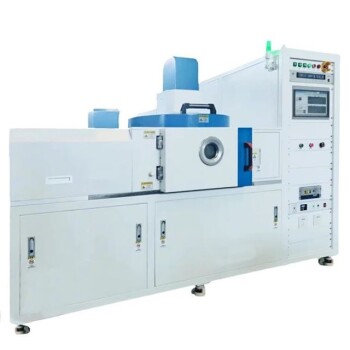
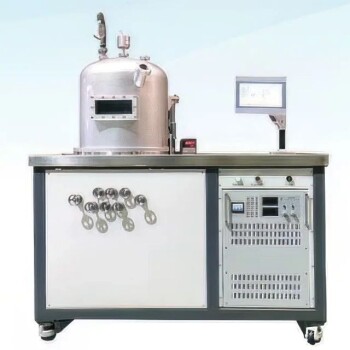
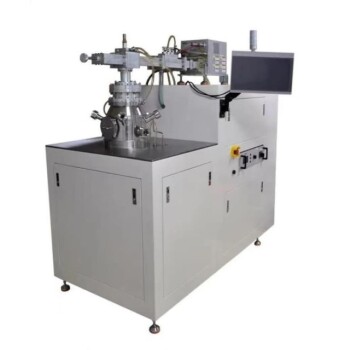
The role of a Chemical Vapor Deposition (CVD) system is to serve as the central infrastructure for synthesizing large-area, high-purity, and high-quality hexagonal Boron Nitride (h-BN) films. It functions by orchestrating a precise high-temperature environment where specific gas-phase precursors undergo chemical reactions to deposit continuous, atomic-level layers onto a catalytic substrate.
The CVD system effectively bridges the gap between raw chemical components and functional nanomaterials. By rigorously controlling environmental variables, it enables the transition from volatile gases to solid, atomically thin films with a uniformity and scalability that other methods cannot achieve.

The Core Functionality of the CVD System
The CVD system is not merely a furnace; it is a precision instrument designed to manipulate chemical kinetics. Its primary role is to maintain specific conditions that force gas-phase components to react and settle as a solid structure.
Precision Control of Precursors
The system manages the introduction and flow rate of specific precursor gases.
Common precursors include ammonia, boron trichloride, or borane (and sometimes ammonia borane).
The precise regulation of these gases determines the stoichiometry and purity of the final h-BN film.
Regulation of the Reaction Environment
The system maintains a strictly controlled atmosphere, regulating both reaction chamber pressure and temperature.
High temperatures (often around 1273 K in specific configurations) are necessary to facilitate thermal decomposition.
This thermal energy drives the chemical reactions required to break down precursors and form the hexagonal lattice structure.
Catalytic Surface Activation
The CVD system directs the reacting gases onto a catalytic substrate, such as copper foil.
The substrate acts as a template, lowering the energy barrier for nucleation.
This allows the h-BN to grow in a continuous, crystalline film rather than as amorphous dust.
Mechanisms of Growth and Quality Control
To understand the value of the CVD system, you must understand the mechanism of deposition. The system ensures that growth occurs in a controlled, layer-by-layer fashion.
Atomic-Level Thickness Control
The system enables the production of films with atomic-level thickness.
By balancing gas flow and deposition time, the system produces 2D materials that are incredibly thin yet structurally continuous.
Achieving Large-Area Uniformity
The primary advantage of CVD over other synthesis methods is scalability.
The system facilitates large-area growth, creating films that are uniform across significant dimensions.
This is essential for applications where h-BN is used as a dielectric material or a flat substrate for other 2D materials like graphene.
Understanding the Trade-offs: LPCVD vs. Standard Systems
While CVD is the standard for high-quality h-BN, not all systems yield the same results. It is critical to distinguish between general CVD and Low-Pressure CVD (LPCVD).
The Advantage of Low Pressure (LPCVD)
LPCVD systems operate at significantly reduced pressures compared to atmospheric systems.
This low-pressure environment improves the diffusion of gas species across the substrate.
Impact on Film Quality
Standard atmospheric systems may struggle with uniformity over larger areas.
LPCVD systems generally offer superior film quality and more consistent thickness control.
If your application requires minimized defects for high-performance electronics, the pressure regime of the CVD system is a critical variable.
Making the Right Choice for Your Goal
Selecting the right CVD configuration depends heavily on the specific requirements of your end application.
- If your primary focus is Scalability and Uniformity: Prioritize a Low-Pressure CVD (LPCVD) system to ensure consistent thickness across large-area substrates like copper foil.
- If your primary focus is Material Purity: Focus on systems with high-precision mass flow controllers to strictly regulate the ratio of precursors like ammonia and boron trichloride.
- If your primary focus is Electronic Integration: Ensure the system can sustain stable high temperatures (approx. 1273 K) to maximize crystallinity, which is vital when using h-BN as a dielectric substrate.
The CVD system is the definitive tool for converting volatile precursors into the high-quality, large-area 2D dielectrics required for next-generation devices.
Summary Table:
| Feature | Role in h-BN Synthesis | Key Impact |
|---|---|---|
| Precursor Regulation | Manages flow of Ammonia, BCl3, or Borane | Ensures stoichiometry and chemical purity |
| Thermal Control | Sustains high temperatures (e.g., 1273 K) | Drives thermal decomposition and crystallization |
| Pressure Control | Low-Pressure (LPCVD) vs. Atmospheric | Enhances gas diffusion and film uniformity |
| Substrate Interaction | Directs gases onto catalytic copper foil | Facilitates nucleation and atomic-layer growth |
| Scalability | Uniform deposition over large surface areas | Enables industrial-scale 2D material production |
Elevate Your 2D Material Research with KINTEK
Precision is the difference between amorphous dust and high-performance hexagonal Boron Nitride films. Backed by expert R&D and manufacturing, KINTEK offers cutting-edge CVD and LPCVD systems specifically designed for the rigorous demands of h-BN and graphene synthesis.
Whether you require customizable Tube, Vacuum, or High-Temperature furnace systems, our technology ensures the atomic-level thickness control and large-area uniformity your lab needs to innovate.
Ready to optimize your deposition process? Contact us today to discuss your unique requirements with our technical experts.
Visual Guide

References
- Shaojie Zhang, Hao Wang. Memristors based on two-dimensional h-BN materials: synthesis, mechanism, optimization and application. DOI: 10.1038/s41699-024-00519-z
This article is also based on technical information from Kintek Furnace Knowledge Base .
Related Products
- 915MHz MPCVD Diamond Machine Microwave Plasma Chemical Vapor Deposition System Reactor
- Custom Made Versatile CVD Tube Furnace Chemical Vapor Deposition CVD Equipment Machine
- RF PECVD System Radio Frequency Plasma Enhanced Chemical Vapor Deposition
- MPCVD Machine System Reactor Bell-jar Resonator for Lab and Diamond Growth
- HFCVD Machine System Equipment for Drawing Die Nano Diamond Coating
People Also Ask
- What is the MPCVD method and why is it considered effective for diamond deposition? Superior Purity & High Growth Rates
- What factors influence the quality of diamond deposition in the MPCVD method? Master the Critical Parameters for High-Quality Diamond Growth
- What are some key features and benefits of the microwave plasma chemical vapor deposition system? Achieve Unmatched Material Synthesis
- What is the purpose of a microwave plasma chemical vapor deposition system? Grow High-Purity Diamonds and Advanced Materials
- What is the basic principle of operation for the microwave plasma chemical vapor deposition system? Unlock High-Purity Material Growth