
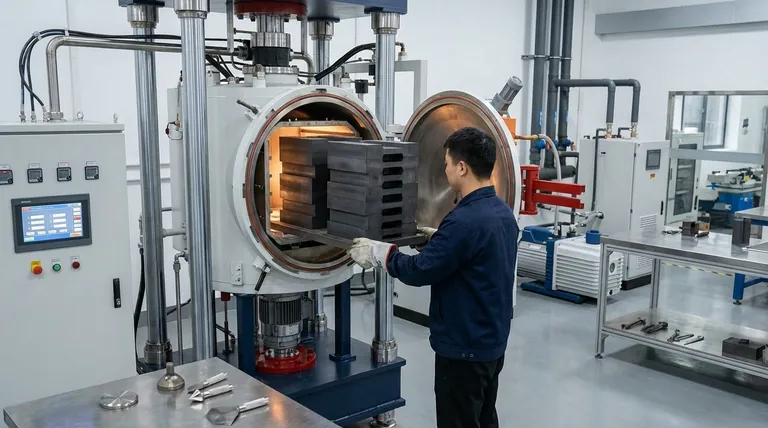
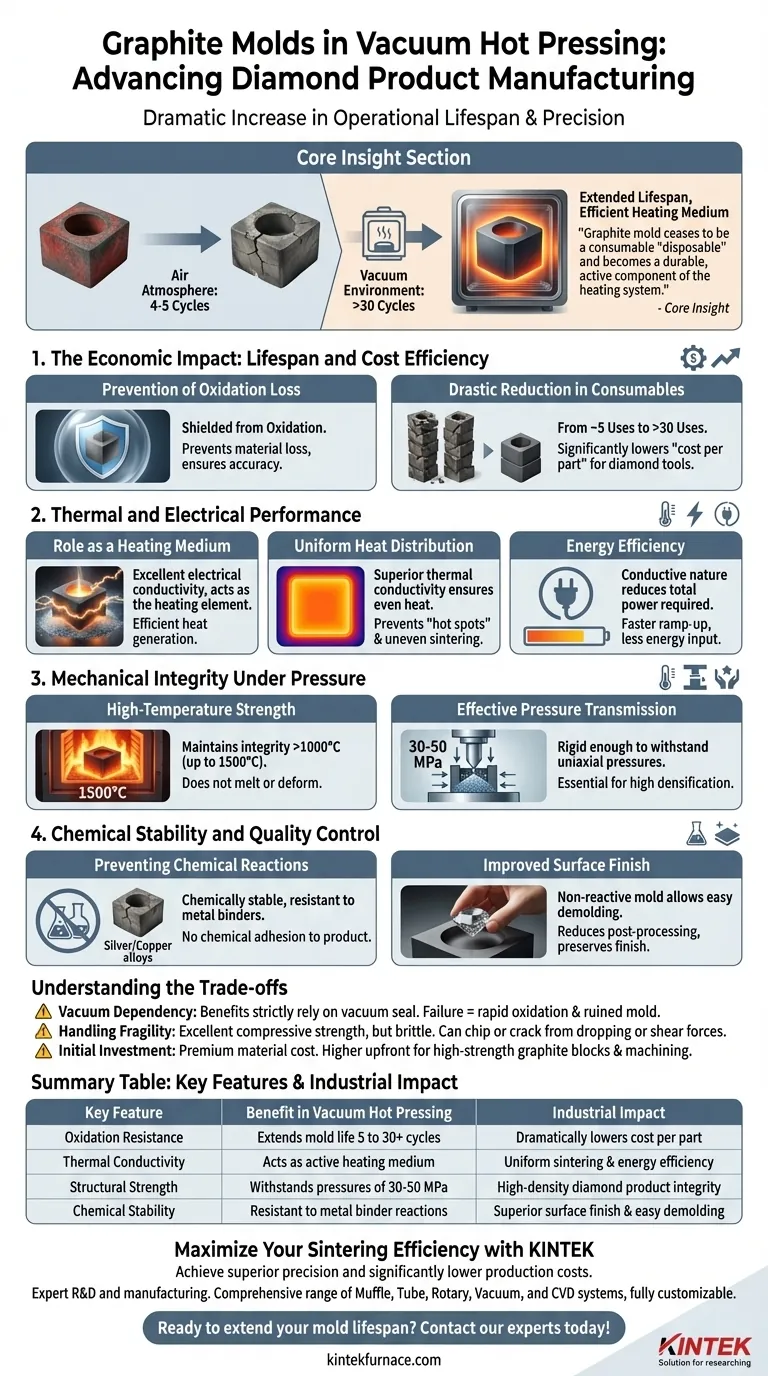
The most significant advantage of using graphite molds in vacuum hot pressing is a dramatic increase in operational lifespan. By eliminating oxygen from the environment, graphite resists high-temperature oxidation, extending mold usage from a typical 4–5 cycles in air to over 30 cycles in a vacuum. This longevity, combined with graphite’s ability to act as an efficient heating medium, fundamentally alters the economics and precision of manufacturing diamond products.
Core Insight: In vacuum hot pressing, the graphite mold ceases to be a consumable "disposable" and becomes a durable, active component of the heating system. This shift drives down material costs while simultaneously enabling the extreme pressures and temperatures required for high-density diamond sintering.
The Economic Impact: Lifespan and Cost Efficiency
The primary driver for using graphite in a vacuum environment is the protection it affords against oxidation.
Prevention of Oxidation Loss
In an air atmosphere, graphite degrades rapidly at sintering temperatures. The vacuum environment effectively shields the mold, preventing the material loss that usually ruins dimensional accuracy after a few uses.
Drastic Reduction in Consumables
Data indicates that mold life extends from roughly 5 uses to over 30 uses when switching to vacuum. This reduces the frequency of mold replacement, significantly lowering the "cost per part" for diamond tool manufacturing.
Thermal and Electrical Performance
Graphite is not merely a container; it serves as a critical, active participant in the thermal process.
Role as a Heating Medium
Because of its excellent electrical conductivity, the graphite mold often serves as the heating element itself (especially in induction heating or direct current sintering). It generates heat efficiently, transferring it directly to the diamond powder matrix.
Uniform Heat Distribution
Graphite possesses superior thermal conductivity. This ensures that heat is distributed evenly throughout the mold, preventing "hot spots" that could cause uneven sintering or internal stresses in the diamond product.
Energy Efficiency
Due to its conductive nature, graphite reduces the total power required to reach sintering temperatures. The material allows the furnace to ramp up heat quickly and maintain it with less energy input compared to less conductive mold materials.
Mechanical Integrity Under Pressure
Sintering diamond products requires immense pressure to achieve the necessary density. Graphite molds provide the structural backbone for this process.
High-Temperature Strength
Unlike many metals that soften under heat, high-strength graphite maintains its mechanical integrity at temperatures exceeding 1000°C (and up to 1500°C). It does not melt or deform, ensuring the final product matches the mold's design specifications.
Effective Pressure Transmission
Graphite molds are rigid enough to withstand uniaxial pressures of 30 to 50 MPa. They effectively transmit this hydraulic force to the diamond powder, which is essential for particle rearrangement and high densification.
Chemical Stability and Quality Control
The quality of a diamond tool depends heavily on the purity of the sintering process. Graphite excels in maintaining a clean environment.
Preventing Chemical Reactions
Graphite is chemically stable and resistant to reacting with many metal binders (such as Silver or Copper alloys) used in diamond composites. This prevents the mold from chemically adhering to the product.
Improved Surface Finish
Because the mold does not react with the part, demolding is significantly smoother. Often used with a graphite paper lining, the mold allows the sintered product to release easily, reducing post-processing cleanup and preserving the surface finish.
Understanding the Trade-offs
While graphite is the industry standard for this application, there are specific limitations you must manage to ensure success.
Vacuum Dependency
The benefits listed above are strictly reliant on the vacuum environment. If the vacuum seal fails or the atmosphere is compromised, the graphite will oxidize rapidly at high temperatures, ruining the mold.
Handling Fragility
While graphite has excellent compressive strength (it handles squeezing well), it is brittle. It can chip or crack if dropped or subjected to shear forces during loading and unloading.
Initial Investment
High-strength, high-density graphite is a premium material. While the cost is amortized over its long lifespan, the upfront cost for raw graphite blocks and machining is higher than for lower-grade alternatives.
Making the Right Choice for Your Goal
To maximize the value of graphite molds in your specific diamond sintering process, focus on these actionable takeaways:
- If your primary focus is Cost Reduction: Implement strict vacuum maintenance protocols to ensure you achieve the full >30 cycle lifespan of the molds, thereby amortizing the material cost effectively.
- If your primary focus is Product Density: Ensure you are using "High-Strength" grade graphite capable of withstanding >30 MPa pressure to facilitate maximum particle compaction without mold deformation.
- If your primary focus is Process Speed: Leverage graphite's electrical conductivity by utilizing induction heating methods, which heat the mold (and product) faster than radiant heating elements.
The successful application of graphite molds lies in treating them not just as containers, but as precision thermal tools that require a controlled vacuum environment to perform.
Summary Table:
| Key Feature | Benefit in Vacuum Hot Pressing | Industrial Impact |
|---|---|---|
| Oxidation Resistance | Extends mold life from 5 to 30+ cycles | Dramatically lowers cost per part |
| Thermal Conductivity | Acts as an active heating medium | Uniform sintering & energy efficiency |
| Structural Strength | Withstands pressures of 30-50 MPa | High-density diamond product integrity |
| Chemical Stability | Resistant to metal binder reactions | Superior surface finish & easy demolding |
Maximize Your Sintering Efficiency with KINTEK
Achieve superior precision and significantly lower production costs in your diamond tool manufacturing. Backed by expert R&D and manufacturing, KINTEK offers a comprehensive range of Muffle, Tube, Rotary, Vacuum, and CVD systems, along with other specialized lab high-temp furnaces—all fully customizable to your unique thermal and pressure requirements.
Ready to extend your mold lifespan and enhance product quality? Contact our experts today for a tailored solution!
Visual Guide
Related Products
- 2200 ℃ Graphite Vacuum Heat Treat Furnace
- Vacuum Heat Treat Sintering Furnace with Pressure for Vacuum Sintering
- Vacuum Heat Treat Sintering Furnace Molybdenum Wire Vacuum Sintering Furnace
- 600T Vacuum Induction Hot Press Vacuum Heat Treat and Sintering Furnace
- Vacuum Hot Press Furnace Machine Heated Vacuum Press Tube Furnace
People Also Ask
- Why are vacuum heat treating furnaces essential for aerospace? Ensure Superior Material Integrity for High-Stakes Applications
- What is the primary application of vacuum heat treating furnaces in aerospace? Enhance Component Performance with Precision
- How does a vacuum heat treating furnace improve the condition of metal alloys? Achieve Superior Metal Performance
- How does vacuum heat treating work in terms of temperature and time control? Master Precise Material Transformations
- What is the process of vacuum heat treating? Achieve Superior Metallurgical Properties













