
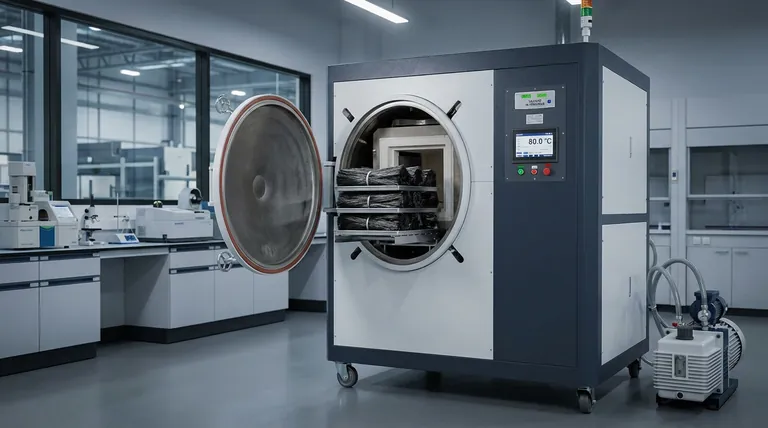
The definitive process advantage is the ability to thoroughly dry materials at a significantly lower thermal, specifically around 80 degrees Celsius. By creating a vacuum environment, the oven lowers the boiling point of water, allowing moisture to evaporate rapidly without subjecting the recovered carbon fibers to the high temperatures required by conventional hot-air ovens.
Core Takeaway Conventional drying relies on high heat to force evaporation, which risks altering the chemical and physical structure of sensitive materials. Vacuum drying circumvents this by using negative pressure to remove moisture efficiently at lower temperatures, preserving the fiber's surface properties and ensuring stability for reuse.
The Physics of Efficient Drying
Lowering the Boiling Point
The fundamental mechanism of a vacuum oven is the reduction of ambient pressure. By lowering the pressure within the chamber, the boiling point of water and other residual solvents drops significantly.
This allows the system to operate effectively at a moderate temperature of 80 degrees Celsius. In a conventional oven, removing the same amount of moisture would require temperatures well above 100 degrees Celsius, which introduces thermal stress.
Rapid Moisture Evaporation
Vacuum drying is not just cooler; it is often faster. The pressure differential creates a strong driving force that pulls moisture from the surface of the fibers.
This results in the rapid and thorough removal of residual water. Unlike air convection, which relies on surface airflow, the vacuum environment promotes volatilization even from complex geometries or bundled fiber clusters.
Preserving Material Integrity
Protecting Surface Properties
Recovered carbon fibers often retain specific surface chemistries that are critical for their performance in composite materials. Prolonged heating in a standard oven can degrade these surface properties.
Vacuum drying prevents these potential changes. By minimizing thermal exposure, the process ensures the quality and stability of the fibers remains intact for subsequent characterization and reuse.
Preventing Oxidation
While standard ovens circulate hot air, vacuum ovens operate in an oxygen-depleted environment. High-temperature air drying carries the risk of oxidation, which can weaken the fibers or alter their functional groups.
The vacuum environment effectively eliminates this variable. It ensures that the chemical structure of the carbon fiber is preserved, preventing the degradation that occurs when carbon materials are heated in the presence of oxygen.
Maintaining Pore Structure
Although the primary focus is surface drying, the vacuum method also protects the physical structure of the material. High-heat atmospheric drying can sometimes cause shrinkage or pore blockage in porous carbon materials.
Vacuum drying allows moisture trapped deep within the material to evaporate without collapsing the structure. This preserves the fiber's morphology, ensuring it retains the necessary surface area for future applications.
Understanding the Trade-offs
Equipment Complexity vs. Simplicity
While vacuum ovens offer superior quality control, they represent a more complex system than conventional ovens. They require a vacuum pump and a sealed chamber, which introduces more variables to manage than a simple heating element and fan.
Batch vs. Continuous Processing
Vacuum drying is inherently a batch process; the chamber must be sealed and pumped down for every cycle. Conventional ovens can often be configured for continuous conveyor processing. Therefore, while vacuum drying is superior for quality and preservation, it may present a bottleneck in extremely high-volume, low-sensitivity production lines.
Making the Right Choice for Your Goal
To determine if a vacuum oven is required for your specific application, evaluate your priorities regarding material quality versus throughput.
- If your primary focus is Material Quality and Reuse: Use a vacuum oven to ensure the surface chemistry and physical structure of the recovered fibers remain unaltered for high-performance applications.
- If your primary focus is Speed and Oxidation Prevention: Choose vacuum drying to accelerate the removal of moisture at low temperatures while eliminating the risk of thermal degradation caused by oxygen exposure.
Summary: For recovered carbon fibers, vacuum drying provides a critical safeguard, decoupling the drying process from high heat to deliver a chemically and physically superior product.
Summary Table:
| Feature | Vacuum Oven Drying | Conventional Oven Drying |
|---|---|---|
| Drying Temp | Lower (approx. 80°C) | Higher (typically >100°C) |
| Mechanism | Reduced boiling point via pressure | Thermal evaporation via hot air |
| Material Integrity | High; preserves surface chemistry | Risk of thermal stress/degradation |
| Oxidation Risk | Near zero (oxygen-depleted) | Moderate to high (air circulation) |
| Speed | Rapid moisture removal | Slower for complex geometries |
Elevate Your Carbon Fiber Recovery with KINTEK Precision
Don't compromise the integrity of your recovered materials with excessive heat. Backed by expert R&D and manufacturing, KINTEK offers specialized Vacuum, Muffle, Tube, and CVD systems tailored for high-performance lab and industrial needs.
Our customizable high-temp furnaces ensure your carbon fibers maintain optimal surface properties and pore structure through precise atmosphere control. Ready to optimize your drying process?
Contact our technical experts today to find your custom solution!
References
- Takaaki Wajima, K. Yamashita. Recovery of carbon fiber from carbon fiber reinforced plastics using alkali molten hydroxide. DOI: 10.1038/s41598-024-84293-4
This article is also based on technical information from Kintek Furnace Knowledge Base .
Related Products
- Vacuum Heat Treat Sintering and Brazing Furnace
- Vacuum Heat Treat Sintering Furnace Molybdenum Wire Vacuum Sintering Furnace
- Dental Porcelain Zirconia Sintering Ceramic Vacuum Press Furnace
- Vacuum Hot Press Furnace Machine for Lamination and Heating
- Vacuum Hot Press Furnace Machine Heated Vacuum Press
People Also Ask
- What are the benefits of using vacuum heat treating furnaces for metal alloys? Achieve Superior Metal Properties and Performance
- What is one of the most important uses of vacuum heat treating furnaces in aerospace? Achieve Superior Strength in Aircraft Alloys
- How does vacuum heat treating affect the grain structure of metal alloys? Achieve Precise Microstructure Control
- What is the temperature of a vacuum furnace brazing? Optimize Your Joint Strength and Cleanliness
- What are the steps involved in a typical vacuum brazing treatment? Master the Process for Strong, Clean Joints

















