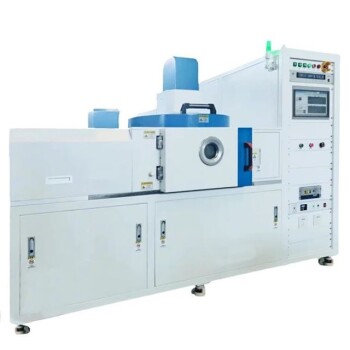
Spark Plasma Sintering (SPS) offers a distinct processing advantage by utilizing high-voltage pulsed current to generate internal heat and pressure simultaneously. Unlike traditional external heating methods, this allows protonic ceramic electrolytes to achieve rapid densification at significantly lower temperatures.
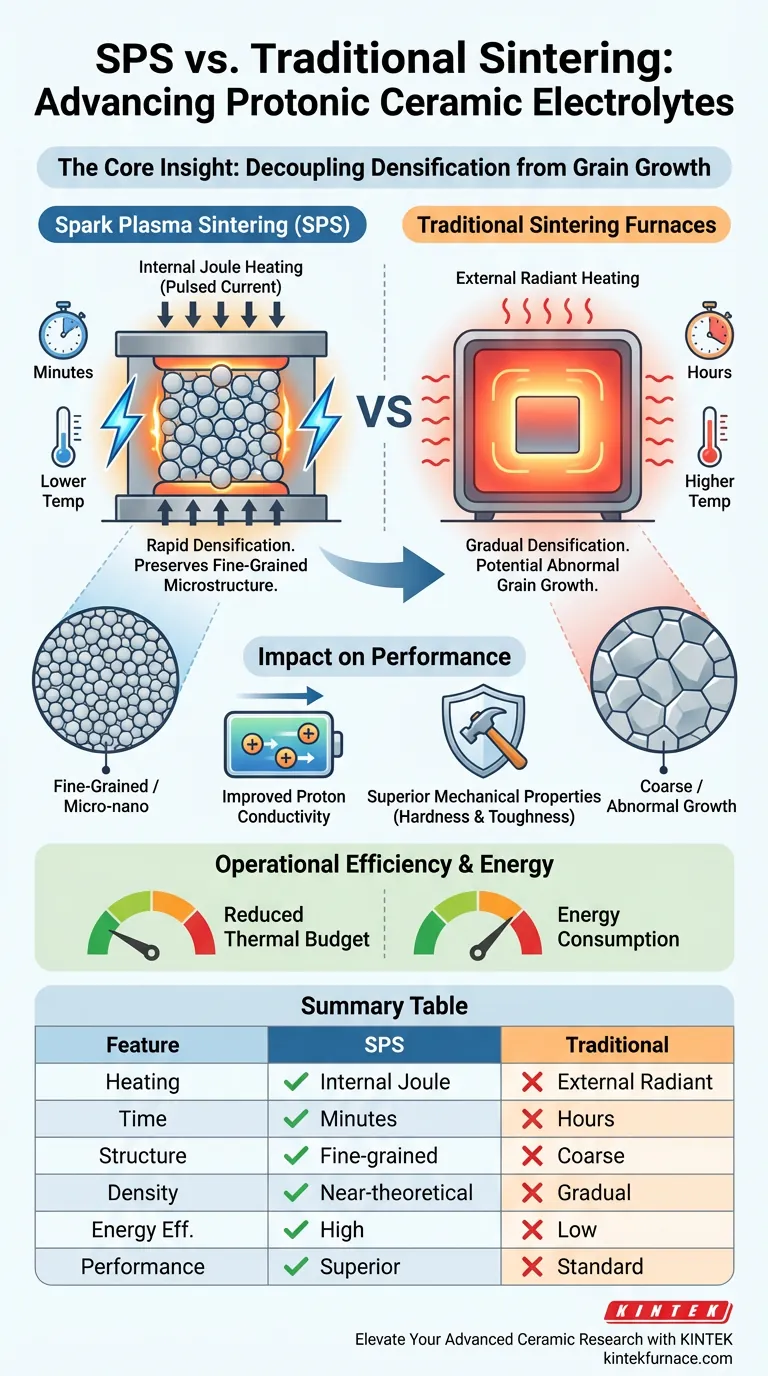
The Core Insight: The defining characteristic of SPS is its ability to decouple densification from grain growth. By achieving full density in minutes rather than hours, the process preserves a fine-grained microstructure, which is critical for maximizing both the mechanical integrity and the proton conductivity of the electrolyte.
The Mechanism of Rapid Densification
Internal Joule Heating
Traditional furnaces rely on radiant heat transfer from the outside in. In contrast, SPS applies pulsed current directly to the sample and mold. This generates Joule heating and plasma discharge between particles, creating immediate internal heat.
Simultaneous Pressure Application
SPS integrates synchronous mechanical pressure during the heating phase. This provides an additional driving force for sintering, allowing the material to reach near-theoretical density through particle rearrangement and plastic flow much faster than pressureless methods.
Localized Activation
The pulsed current causes temperatures at the specific contact points between particles to spike significantly higher than the overall sample temperature. This localized energy facilitates particle bonding (or liquid phase formation) without requiring the entire bulk material to reach excessive thermal extremes.
Impact on Microstructure and Performance
Inhibition of Grain Growth
Because the heating rate is extremely high and the holding time is very short, the window for grain coarsening is minimized. Traditional sintering often leads to abnormal grain growth due to prolonged high-temperature exposure, but SPS effectively "freezes" the fine grain structure in place.
Isotropic Fine-Grained Structure
The result is a ceramic with an isotropic micro-nano fine grain structure. For protonic electrolytes, this structural uniformity is vital for consistent performance across the material.
Enhanced Electrolyte Properties
The primary reference indicates a direct correlation between this fine-grained structure and performance. A dense electrolyte produced via SPS exhibits improved proton conductivity alongside superior mechanical properties, such as hardness and fracture toughness.
Operational Efficiency and Energy
Reduced Thermal Budget
The rapid heating mechanism significantly lowers the overall bulk sintering temperature required to densify the ceramic. This reduction in thermal budget prevents the degradation of volatile components often found in complex ceramic chemistries.
Energy Consumption
Compared to traditional pressureless sintering, SPS substantially reduces energy consumption. The process eliminates the need for long ramp-up and cool-down cycles, focusing energy only where and when it is needed.
Understanding the Process Nuances
Temperature Gradients
While the bulk temperature remains low, the local temperature at particle contact points is extreme. Users must understand that the "measured" temperature of the mold may differ from the microscopic temperature at the particle interface, which drives the sintering physics.
Making the Right Choice for Your Goal
If you are developing protonic ceramic electrolytes, the choice between SPS and traditional methods depends on your specific performance targets:
- If your primary focus is Conductivity and Strength: Choose SPS to achieve a high-density, fine-grained structure that maximizes proton transport and fracture toughness.
- If your primary focus is Processing Speed: Choose SPS to leverage rapid heating rates and short holding times, reducing cycle times from hours to minutes.
- If your primary focus is Material Stability: Choose SPS to sinter at lower bulk temperatures, minimizing the risk of volatilization or abnormal grain growth.
SPS provides a high-precision pathway to producing robust, highly conductive electrolytes that traditional thermal cycling simply cannot replicate.
Summary Table:
| Feature | Spark Plasma Sintering (SPS) | Traditional Sintering Furnaces |
|---|---|---|
| Heating Mechanism | Internal Joule Heating (Pulsed Current) | External Radiant Heating |
| Sintering Time | Minutes | Hours |
| Grain Structure | Fine-grained / Micro-nano (Inhibited growth) | Coarse / Potential abnormal growth |
| Density | Near-theoretical (Rapidly achieved) | Gradual densification |
| Energy Efficiency | High (Low thermal budget) | Low (Long ramp-up/cool-down) |
| Key Performance | Superior conductivity & toughness | Standard mechanical/electrical properties |
Elevate Your Advanced Ceramic Research with KINTEK
Unlock the full potential of your protonic ceramic electrolytes with KINTEK’s high-precision sintering solutions. Backed by expert R&D and manufacturing, we offer customizable Spark Plasma Sintering (SPS), Vacuum, CVD systems, and Muffle furnaces tailored to your unique research needs. Whether you are aiming for superior proton conductivity or optimized mechanical integrity, our systems provide the control and efficiency required for next-generation material science.
Ready to transform your lab's capabilities? Contact KINTEK today to find the perfect high-temperature furnace for your application.
Visual Guide
References
- Mengyang Yu, Shenglong Mu. Recent Novel Fabrication Techniques for Proton-Conducting Solid Oxide Fuel Cells. DOI: 10.3390/cryst14030225
This article is also based on technical information from Kintek Furnace Knowledge Base .
Related Products
- Spark Plasma Sintering SPS Furnace
- Chairside Dental Porcelain Zirconia Sintering Furnace with Transformer for Ceramic Restorations
- 600T Vacuum Induction Hot Press Vacuum Heat Treat and Sintering Furnace
- 9MPa Air Pressure Vacuum Heat Treat and Sintering Furnace
- Dental Porcelain Zirconia Sintering Ceramic Vacuum Press Furnace
People Also Ask
- How does the heating mechanism of Spark Plasma Sintering (SPS) function? Enhance TiC/SiC Composite Fabrication
- Why is it necessary to maintain a high vacuum environment during the SPS of SiC? Key to High-Density Ceramics
- What are the technical advantages of using an SPS sintering furnace? Elevate Al2O3-TiC Material Performance
- What are the steps in the discharge plasma sintering process? Master Fast, High-Density Material Consolidation
- What are the advantages of spark plasma sintering (SPS) over traditional forging? Precision Microstructural Control