
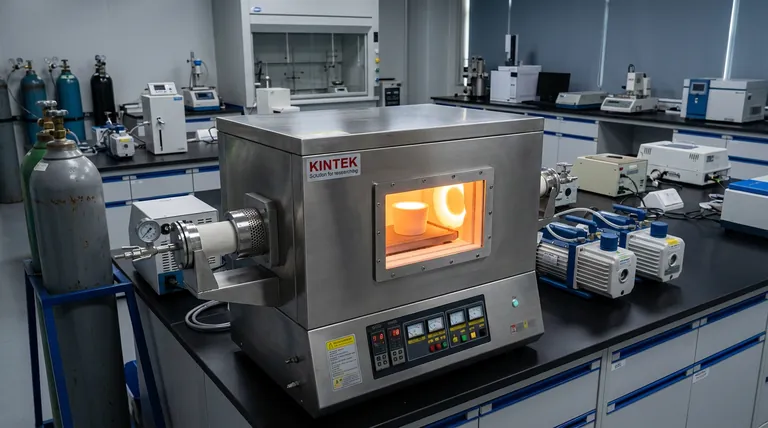
The primary functional task of a high-temperature graphite resistance furnace is to generate and maintain the specific thermal and atmospheric conditions required to synthesize Titanium Diboride (TiB₂) via carbothermal reduction. The furnace serves as a controlled reactor that sustains stable temperatures exceeding 1700°C while simultaneously managing a vacuum or inert environment. This combination allows for the precise redox reaction between titanium dioxide and boron sources, ensuring the removal of byproducts and the prevention of impurities.
The success of TiB₂ synthesis depends not just on reaching extreme temperatures, but on the precise management of the reaction environment. The furnace's true value lies in balancing high heat with vacuum control to effectively vent carbon monoxide, which is critical for achieving high-purity results.
Achieving the Necessary Thermal Environment
Sustaining Temperatures Above 1700°C
The core requirement for the carbothermal reduction of titanium dioxide is extreme heat. The graphite resistance furnace is tasked with providing a stable high-temperature zone that consistently exceeds 1700°C. This energy input is necessary to activate the reaction between the titanium source and boron compounds like boron carbide or boric anhydride.
Precise Temperature Regulation
Merely reaching high temperatures is insufficient; the furnace must also maintain them with exact precision. Fluctuations in heat can alter reaction kinetics or result in incomplete reduction. Stable thermal control ensures the formation of high-quality, single-crystal Titanium Diboride powder.
Atmosphere and Pressure Management
Establishing Vacuum or Inert Conditions
To prevent oxidation and unwanted chemical side effects, the synthesis cannot occur in open air. The furnace functions to create and hold a specific vacuum or inert atmosphere throughout the process. This controlled environment protects the integrity of the reactants and the developing product.
Facilitating Gas Discharge
A critical function of the furnace is the removal of gaseous reaction products. The redox reaction generates carbon monoxide (CO) as a byproduct. The furnace's vacuum or flow systems must efficiently discharge this gas to prevent back-reaction and ensure the synthesis moves forward to completion.
Understanding the Trade-offs
Preventing Excess Carbides
While the graphite environment is necessary for the resistance heating mechanism, it introduces the risk of carbon contamination. If the temperature or atmosphere is not strictly controlled, the environment can lead to the formation of excess carbides. This compromises the purity of the final TiB₂ powder.
Balancing Reaction Speed and Purity
Pushing the furnace to higher temperatures can accelerate the reaction, but it increases the risk of sintering or impurity formation. The operator must rely on the furnace's precision to find the optimal window where the reaction is efficient without degrading the single-crystal quality of the product.
Optimizing Synthesis for Your Goals
To derive the best performance from your high-temperature graphite resistance furnace, align your operational parameters with your specific output requirements.
- If your primary focus is Product Purity: Prioritize the stability of the vacuum or inert atmosphere to ensure maximal venting of carbon monoxide and minimal carbide formation.
- If your primary focus is Crystal Quality: Focus on the precision of temperature regulation above 1700°C to foster consistent, single-crystal growth.
By mastering the balance between extreme thermal energy and atmospheric control, you ensure the consistent production of superior Titanium Diboride.
Summary Table:
| Functional Task | Description | Key Performance Metric |
|---|---|---|
| Thermal Input | Sustaining stable heat above 1700°C | Temperature Uniformity |
| Atmosphere Control | Maintaining vacuum or inert gas conditions | Oxygen/Impurity Prevention |
| Byproduct Management | Efficiently venting Carbon Monoxide (CO) | Reaction Completion Rate |
| Purity Protection | Preventing excess carbide formation | Final TiB2 Crystal Quality |
Elevate Your Advanced Material Synthesis with KINTEK
Precision is the difference between impure powders and high-quality Titanium Diboride crystals. Backed by expert R&D and manufacturing, KINTEK offers high-temperature Graphite, Vacuum, and CVD systems designed to maintain the rigorous 1700°C+ environments and vacuum control your lab requires.
Whether you need standard lab high-temp furnaces or fully customizable systems for unique material research, KINTEK provides the reliability and technical support to ensure your success. Contact us today to optimize your synthesis process!
References
- Xinran Lv, Gang Yu. Review on the Development of Titanium Diboride Ceramics. DOI: 10.21926/rpm.2402009
This article is also based on technical information from Kintek Furnace Knowledge Base .
Related Products
- 2200 ℃ Graphite Vacuum Heat Treat Furnace
- Vertical Laboratory Quartz Tube Furnace Tubular Furnace
- High Temperature Muffle Oven Furnace for Laboratory Debinding and Pre Sintering
- 1700℃ High Temperature Laboratory Tube Furnace with Alumina Tube
- 1200℃ Muffle Oven Furnace for Laboratory
People Also Ask
- Why are vacuum heat treating furnaces essential for aerospace? Ensure Superior Material Integrity for High-Stakes Applications
- What is the primary application of vacuum heat treating furnaces in aerospace? Enhance Component Performance with Precision
- How does a vacuum heat treating furnace improve the condition of metal alloys? Achieve Superior Metal Performance
- How does vacuum heat treating work in terms of temperature and time control? Master Precise Material Transformations
- What is the process of vacuum heat treating? Achieve Superior Metallurgical Properties



















