
A high-temperature resistance furnace serves as a precision simulation tool that replicates the thermal stress of a building fire on mortar specimens. By maintaining a specific heating rate and stable constant-temperature environment, it induces the necessary chemical decomposition required to evaluate how the material's structural integrity evolves under extreme heat.
The furnace is not merely a heater; it is a controlled environment that mimics the progression of a fire. It allows researchers to systematically decompose cement hydration products at specific thermal milestones to map the material's failure points.
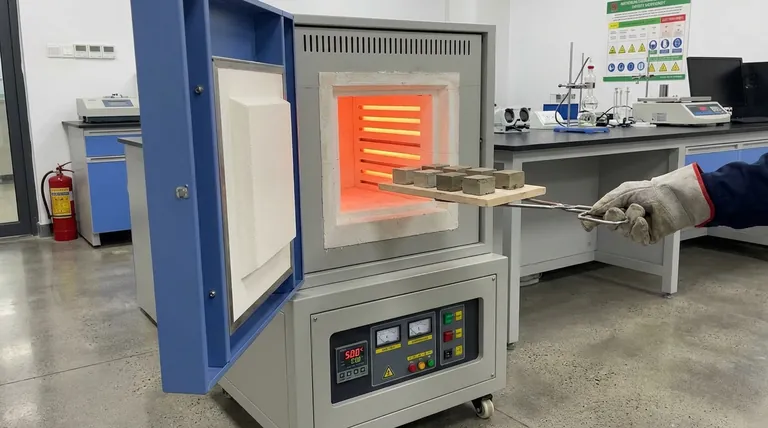
Simulating Real-World Fire Conditions
Precise Heating Control
To accurately evaluate fire resistance, you cannot simply expose material to random heat. The furnace provides a controlled heating rate, typically set at 5 °C/min based on standard protocols.
This gradual increase is critical. It ensures that the specimen is heated uniformly, preventing thermal shock from occurring before the material reaches the target temperature.
Creating a Stable Thermal Environment
Once the target temperature is reached, the furnace maintains a stable constant-temperature environment.
This stability ensures that the entire mortar specimen—from the surface to the core—is subjected to the exact same thermal conditions. This consistency is required to obtain reproducible scientific data regarding the material's performance.
Analyzing Material Evolution
Targeting Critical Temperature Ranges
The furnace is designed to target specific temperature points, primarily between 100°C and 500°C.
This range is significant because it covers the initial stages of a fire where structural changes begin. By stopping at specific intervals within this range, researchers can pinpoint exactly when the material begins to lose its integrity.
Inducing Physicochemical Decomposition
The primary function of the heat is to force the physicochemical decomposition of cement hydration products.
Hydration products are the chemical bonds that give mortar its strength. By systematically breaking these down using heat, the furnace allows researchers to study the evolution of the material's properties as it degrades.
Understanding the Trade-offs
Simulation vs. Reality
While the furnace provides precision, it represents a simplified version of a real-world disaster.
A controlled rate of 5 °C/min is excellent for study, but actual building fires can be chaotic with unpredictable temperature spikes. The data derived is ideal for comparative analysis but must be contextualized against real-world unpredictability.
Temperature Limitations
The evaluation described focuses on the 100°C to 500°C range.
While this covers the decomposition of hydration products, some catastrophic fires exceed these temperatures. If your goal is to test total structural melting or failure at extreme temperatures (1000°C+), this specific protocol may be insufficient.
Making the Right Choice for Your Goal
To maximize the value of your fire resistance evaluation, align the furnace settings with your specific objectives.
- If your primary focus is fundamental research: Prioritize the 5 °C/min heating rate to ensure you can observe the gradual evolution of cement hydration products without thermal shock interference.
- If your primary focus is safety compliance: Ensure your testing protocol covers the entire 100°C to 500°C range to identify the exact temperature threshold where material properties begin to degrade significantly.
Validating fire resistance requires precise thermal control to turn raw data into safer construction materials.
Summary Table:
| Feature | Function in Fire Resistance Testing | Research Benefit |
|---|---|---|
| Heating Rate | Controlled 5°C/min progression | Prevents thermal shock for uniform heating |
| Temperature Range | Focused testing between 100°C - 500°C | Targets cement hydration product decomposition |
| Thermal Stability | Constant-temperature environment | Ensures consistent core-to-surface heat exposure |
| Decomposition | Induced physicochemical breakdown | Maps material failure points and structural evolution |
Elevate Your Material Testing with KINTEK Precision
Ensure the highest accuracy in your fire resistance evaluations with KINTEK’s industry-leading thermal solutions. Backed by expert R&D and world-class manufacturing, KINTEK offers a comprehensive range of Muffle, Tube, Rotary, Vacuum, and CVD systems. Whether you need standard protocols or a fully customizable high-temperature furnace tailored to your unique research needs, our systems provide the stability and control required for critical material analysis.
Ready to optimize your lab’s thermal performance? Contact us today to discuss your custom furnace requirements with our specialists!
References
- Xiang Zhao, Jiaxing Shao. Mechanical Properties, Impermeability, and Microstructure of Mortar Containing Recycled Fine Aggregates Modified by Graphene Oxide After High-Temperature Exposure. DOI: 10.3390/buildings15020212
This article is also based on technical information from Kintek Furnace Knowledge Base .
Related Products
- 1400℃ High Temperature Laboratory Tube Furnace with Alumina Tube
- 1700℃ High Temperature Muffle Oven Furnace for Laboratory
- 1700℃ Controlled Inert Nitrogen Atmosphere Furnace
- 1700℃ High Temperature Laboratory Tube Furnace with Alumina Tube
- 1400℃ Controlled Inert Nitrogen Atmosphere Furnace
People Also Ask
- How are high-temperature laboratory tube furnaces applied in long-term vacuum homogenization heat treatments for intermetallic samples?
- How do high-temperature laboratory tube furnaces ensure environmental stability? Precision Thermal Reduction Tips
- What is the function of a furnace in CuAlMn alloy treatment? Achieve Perfect Microstructural Homogenization
- What is the mechanism of a high-temperature furnace in Bi-2223 sintering? Achieve Precision Phase Transformation
- How does a laboratory high-temperature tube furnace contribute to the conversion of electrospun fibers? Expert Insights



















