
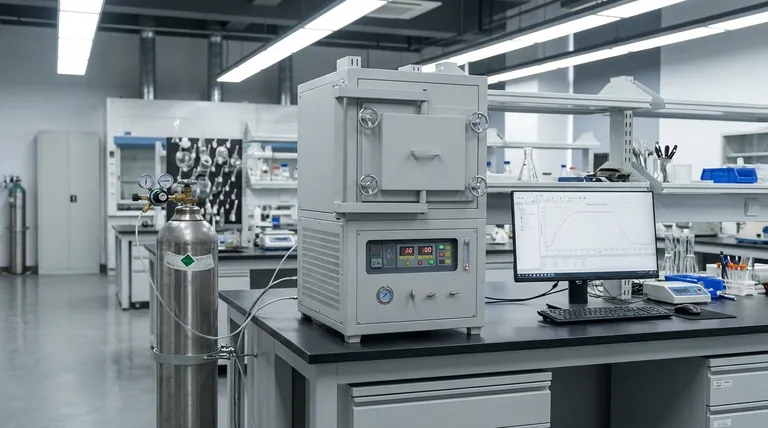
In material science and advanced manufacturing, a program-controlled atmosphere furnace is a specialized high-temperature oven that gives you precise, automated control over two critical variables: temperature and the gaseous environment. Unlike a conventional furnace that operates in ambient air, this equipment allows you to execute a pre-set program, creating highly specific and repeatable conditions to alter or protect materials during heat treatment.
The fundamental challenge in high-temperature processing is that ambient air causes unwanted chemical reactions, like oxidation. A program-controlled atmosphere furnace solves this by replacing the air with a carefully managed gas, giving engineers and scientists ultimate control over the material's final properties.
The Core Components: How It Achieves Precision Control
A program-controlled atmosphere furnace operates as an integrated system. Its precision comes not from a single component, but from how three core systems work together under the direction of a central controller.
The Heating System
The furnace generates heat using robust electric heating elements, such as wires or plates, designed to withstand extreme temperatures and specific chemical environments. These elements transfer thermal energy to the workpiece inside the chamber.
This process is not static. The control system uses temperature sensors (thermocouples) to monitor the furnace temperature in real-time, constantly adjusting the power sent to the heating elements to precisely follow a programmed heating and cooling curve.
The Atmosphere Control System
This is what distinguishes an atmosphere furnace. The process begins within a tightly sealed furnace chamber designed to prevent any infiltration of outside air.
First, the system purges the chamber of oxygen and moisture, typically using a vacuum pump or by flooding it with an inert gas. Then, it introduces a specific gas or mixture of gases at a controlled flow rate to create the desired environment.
The Program Control System
The "brain" of the furnace is the programmable controller. This system allows an operator to define a detailed recipe, or "program," for the entire process.
This program dictates the temperature ramp rates, the duration of temperature holds (soaks), the cooling profile, and which gases are introduced into the chamber at what time. This automation ensures every part undergoes the exact same treatment, guaranteeing consistency and enabling highly complex processes.
The Fundamental Purpose: Why Control the Atmosphere?
Replacing the air inside a furnace is essential for two primary reasons: to prevent harmful reactions or to intentionally cause beneficial ones. The choice of gas defines the outcome.
Preventing Unwanted Reactions (Protective Atmospheres)
The most common goal is to prevent oxidation and contamination. At high temperatures, most metals will rapidly react with oxygen in the air, forming a brittle oxide layer (scale) that degrades the material's surface and properties.
By filling the furnace with an inert gas like Nitrogen (N₂) or Argon (Ar), you create a protective blanket around the workpiece. This is critical for processes like annealing, brazing, and sintering where a clean, bright finish is required.
Inducing Desired Reactions (Reactive Atmospheres)
More advanced applications use the atmosphere as an active ingredient in the process. By introducing reactive gases, you can intentionally alter the surface chemistry of a material.
Common examples include using carbon-rich gases for carburizing (hardening the surface of steel), ammonia for nitriding, or hydrogen (H₂) for reduction processes that remove oxides. Highly specialized processes like Chemical Vapor Deposition (CVD) use reactive gases to deposit entirely new layers of material onto a substrate.
Understanding the Trade-offs and Considerations
While incredibly powerful, these furnaces introduce complexities that demand careful management. Understanding these trade-offs is key to successful implementation.
Gas Handling and Safety
The gases used can be hazardous. Hydrogen, for example, is highly flammable and explosive, requiring specialized safety interlocks, leak detectors, and ventilation. Even inert gases like nitrogen can pose an asphyxiation risk in a confined space if a major leak occurs. Proper facility design and safety protocols are non-negotiable.
Sealing Integrity and Maintenance
The performance of the entire system depends on the integrity of the furnace seal. Gaskets and door seals wear down over time with thermal cycling. Regular inspection and maintenance are critical to prevent leaks that would compromise the atmosphere and ruin the process.
Process Complexity
Developing a successful heat treatment program is a science. It requires a deep understanding of metallurgy and chemistry to select the right gas flows, temperatures, and timings. These are not "plug-and-play" devices and require a higher level of operator skill compared to a simple air furnace.
Making the Right Choice for Your Goal
Selecting the right thermal processing environment depends entirely on your material and desired outcome.
- If your primary focus is preventing oxidation: A furnace with a simple inert gas system (Nitrogen or Argon) is sufficient for applications like bright annealing or brazing.
- If your primary focus is altering surface chemistry: You need a furnace rated for reactive gases to perform processes like carburizing, nitriding, or oxide reduction.
- If your primary focus is depositing new material layers: A specialized system designed for Chemical Vapor Deposition (CVD) is required, which represents an advanced application of atmosphere control.
Ultimately, mastering the atmosphere inside your furnace provides direct control over the final chemical and physical properties of your material.
Summary Table:
| Component | Function | Key Features |
|---|---|---|
| Heating System | Generates and regulates heat | Electric heating elements, thermocouples for real-time control |
| Atmosphere Control System | Manages gas environment | Sealed chamber, gas purging, controlled flow rates |
| Program Control System | Automates process execution | Programmable recipes for temperature, gas timing, and consistency |
| Applications | Common uses | Oxidation prevention, carburizing, nitriding, CVD processes |
Unlock the full potential of your material processing with KINTEK's advanced furnace solutions! Leveraging exceptional R&D and in-house manufacturing, we provide diverse laboratories with high-temperature furnace systems tailored to your needs. Our product line includes Muffle, Tube, Rotary Furnaces, Vacuum & Atmosphere Furnaces, and CVD/PECVD Systems, all backed by strong deep customization capabilities to precisely meet your unique experimental requirements. Whether you're preventing oxidation or inducing surface reactions, KINTEK delivers reliable, automated control for superior results. Contact us today to discuss how we can enhance your lab's efficiency and achieve your material science goals!
Visual Guide

Related Products
- 1200℃ Controlled Inert Nitrogen Atmosphere Furnace
- Mesh Belt Controlled Atmosphere Furnace Inert Nitrogen Atmosphere Furnace
- Controlled Inert Nitrogen Hydrogen Atmosphere Furnace
- 1400℃ Controlled Inert Nitrogen Atmosphere Furnace
- 1700℃ Controlled Inert Nitrogen Atmosphere Furnace
People Also Ask
- What Roles Do a Controlled Atmosphere Furnace and Oil Quenching Tank Play in AISI 5140 Steel Heat Treatment?
- What are the operational advantages of using a controlled atmosphere furnace? Boost Quality and Efficiency in Heat Treatment
- What are the advantages of a controlled atmosphere furnace over tube furnaces? Superior Process Control for Sensitive Materials
- How does a controlled atmosphere furnace prevent oxidation and decarburization? Master Precision Heat Treatment
- What are the key benefits of precise temperature control in a controlled atmosphere furnace? Unlock Superior Quality and Efficiency










