
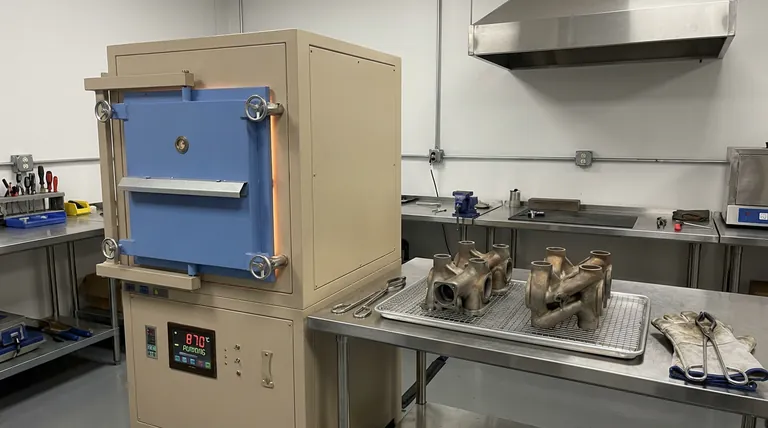
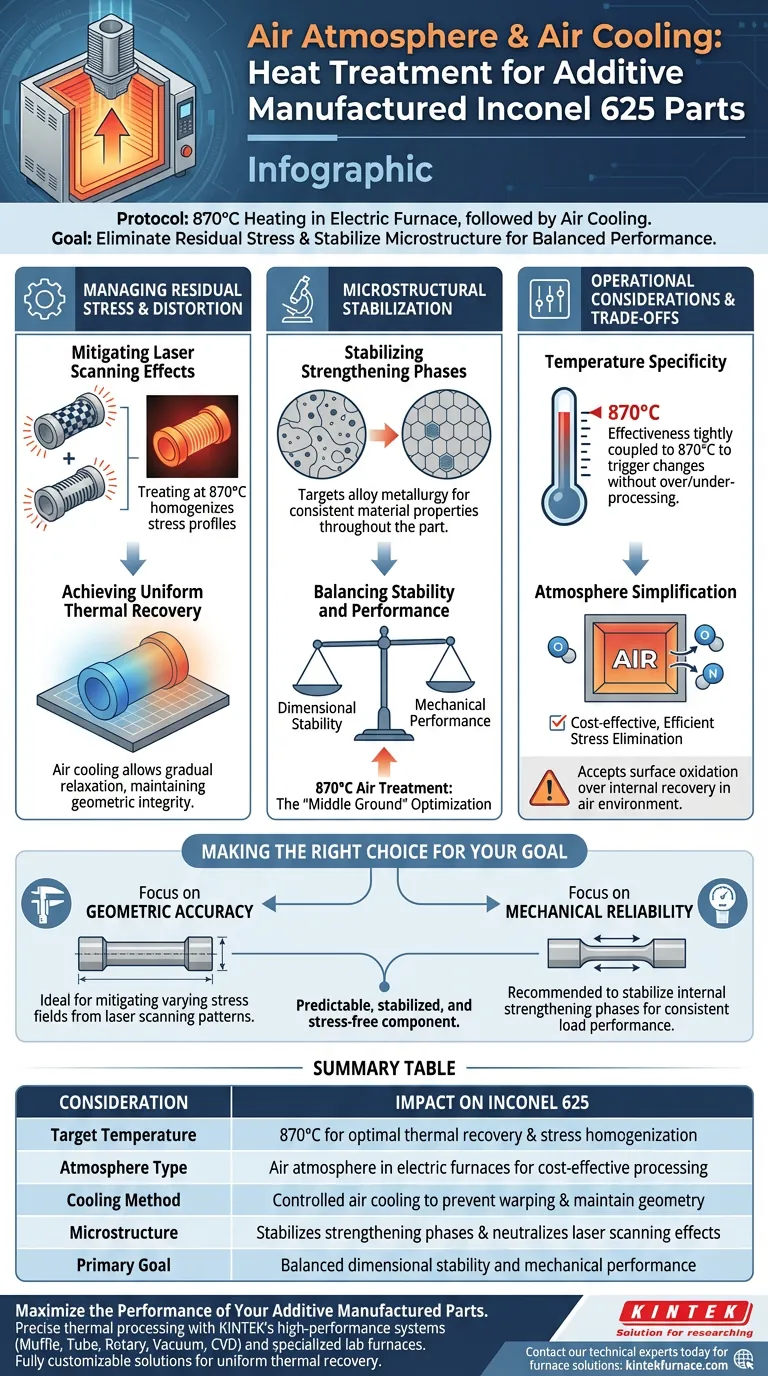
Selecting an air atmosphere and air cooling for additive manufactured Inconel 625 parts relies on a specific protocol of heating to 870°C in an electric furnace. This approach is primarily utilized to eliminate residual stress and stabilize the alloy's internal microstructure, offering a practical balance between dimensional stability and mechanical performance.
The core value of this method lies in its ability to provide uniform thermal recovery. It effectively neutralizes the varying stress fields caused by different laser scanning strategies, ensuring consistent material properties regardless of the printing pattern.
Managing Residual Stress and Distortion
Mitigating Laser Scanning Effects
Additive manufacturing introduces complex stress fields into parts based on how the laser moves. Different strategies, such as checkerboard or strip patterns, create varying residual stress profiles.
Treating the part at 870°C serves to homogenize these differences. The process mitigates the specific stress signatures left by the printing strategy, resetting the material's internal state.
Achieving Uniform Thermal Recovery
The combination of heating and subsequent air cooling provides a uniform thermal recovery effect. This uniformity is critical for preventing warping or distortion after the part is removed from the build plate.
By allowing the part to cool in air, the material relaxes gradually. This helps maintain the geometric integrity of the component while releasing the internal tension built up during the rapid heating and cooling of the printing process.
Microstructural Stabilization
Stabilizing Strengthening Phases
Beyond simple stress relief, this specific thermal cycle targets the alloy's metallurgy. The treatment stabilizes the internal strengthening phases of the Inconel 625.
This stabilization is essential for reliable performance. It ensures that the material's microstructure is consistent throughout the part, rather than varying based on local cooling rates experienced during printing.
Balancing Stability and Performance
The ultimate goal of this protocol is equilibrium. It is designed to balance dimensional stability with mechanical performance.
You are not sacrificing the shape of the part to gain strength, nor are you sacrificing strength to keep the part straight. The 870°C air treatment achieves a "middle ground" optimization suitable for functional components.
Operational Considerations and Trade-offs
Temperature Specificity
The effectiveness of this method is tightly coupled to the 870°C set point. This temperature is specifically selected to trigger the necessary microstructural changes without overheating or under-processing the material.
Atmosphere Simplification
Using an air atmosphere in a standard electric furnace simplifies the operational requirements compared to vacuum or inert gas treatments. However, it implies that the surface chemistry interaction with air at this temperature is acceptable for the application.
The primary trade-off here is accepting an air environment to achieve cost-effective and efficient stress elimination. The process prioritizes internal structural recovery over surface oxidation concerns typically associated with non-vacuum environments.
Making the Right Choice for Your Goal
To determine if this heat treatment protocol aligns with your manufacturing objectives, consider your specific requirements for stress management and mechanical consistency.
- If your primary focus is geometric accuracy: This method is ideal as it mitigates the varying stress fields from laser scanning patterns (like checkerboard or strip) to ensure dimensional stability.
- If your primary focus is mechanical reliability: This approach is recommended to stabilize internal strengthening phases, ensuring the alloy performs consistently under load.
By adhering to the 870°C air atmosphere and air cooling protocol, you ensure a predictable, stabilized, and stress-free component ready for service.
Summary Table:
| Consideration | Impact on Inconel 625 |
|---|---|
| Target Temperature | 870°C for optimal thermal recovery and stress homogenization |
| Atmosphere Type | Air atmosphere in electric furnaces for cost-effective processing |
| Cooling Method | Controlled air cooling to prevent warping and maintain geometry |
| Microstructure | Stabilizes strengthening phases and neutralizes laser scanning effects |
| Primary Goal | Balanced dimensional stability and mechanical performance |
Maximize the Performance of Your Additive Manufactured Parts
Precise thermal processing is the key to unlocking the full potential of Inconel 625. Backed by expert R&D and manufacturing, KINTEK offers high-performance Muffle, Tube, Rotary, Vacuum, and CVD systems, along with other specialized lab high-temp furnaces—all fully customizable to meet your unique metallurgical needs.
Whether you are mitigating residual stress from complex laser patterns or stabilizing alloy microstructures, our equipment ensures the uniform thermal recovery your functional components require.
Ready to elevate your heat treatment precision? Contact our technical experts today to find the perfect furnace solution for your laboratory or production line.
Visual Guide
References
- Alexandru Paraschiv, Mihai Vlăduț. Assessment of Residual Stresses in Laser Powder Bed Fusion Manufactured IN 625. DOI: 10.3390/ma17020413
This article is also based on technical information from Kintek Furnace Knowledge Base .
Related Products
- 9MPa Air Pressure Vacuum Heat Treat and Sintering Furnace
- 1400℃ Controlled Inert Nitrogen Atmosphere Furnace
- 1200℃ Controlled Inert Nitrogen Atmosphere Furnace
- 1700℃ Controlled Inert Nitrogen Atmosphere Furnace
- Controlled Inert Nitrogen Hydrogen Atmosphere Furnace
People Also Ask
- What are the key features of vacuum pressure sintering furnaces? Unlock High-Purity, Dense Materials
- What materials can be processed using vacuum pressure sintering furnaces? Unlock High-Performance Material Densification
- What safety features are integrated into vacuum pressure sintering furnaces? Ensure Operator and Equipment Protection
- What are the key components of a vacuum pressure sintering furnace? Essential Systems for High-Performance Materials
- What are the main technical parameters of vacuum pressure sintering furnaces? Key Specs for Advanced Materials













