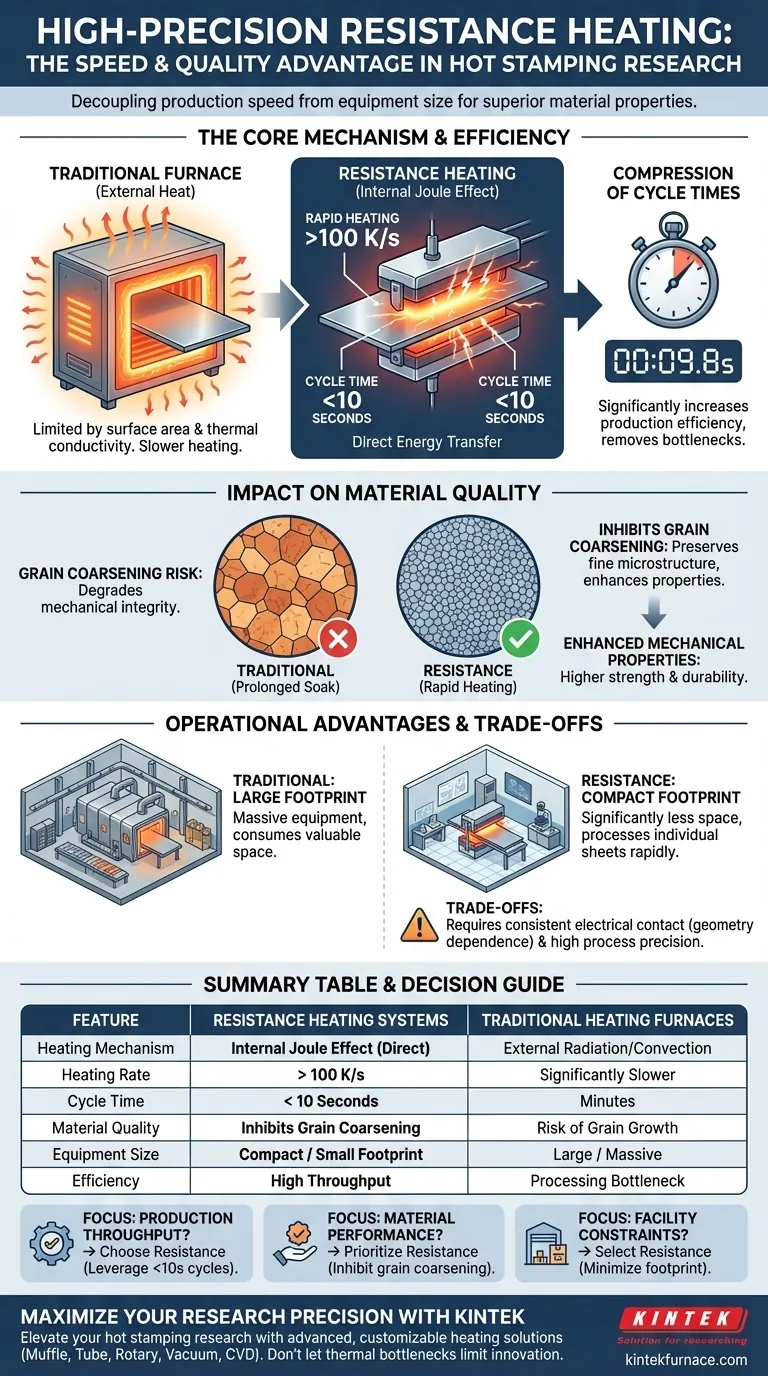
High-precision resistance heating systems offer a distinct performance advantage over traditional furnaces by utilizing Joule heating to pass high electrical current directly through the metal sheet. This direct energy transfer enables heating rates exceeding 100 K/s, allowing the complete heating process to finish in under 10 seconds, drastically outperforming the slower thermal transfer mechanisms of conventional radiation or convection furnaces.
Core Takeaway By shifting from external heat sources to internal resistance heating, these systems decouple production speed from equipment size. The result is a process that is not only faster and more compact but also produces superior material properties by strictly limiting the time available for microstructural degradation.
The Efficiency of Direct Energy Transfer
Rapid Heating via Joule Effect
Traditional furnaces rely on heat transferring from the environment to the material, a process limited by surface area and thermal conductivity.
Resistance systems bypass this by using the Joule effect, generating heat internally within the metal sheet itself.
This mechanism achieves aggressive heating rates of over 100 K/s, ensuring the target temperature is reached almost instantly.
Compression of Cycle Times
The ability to complete the heating phase in less than 10 seconds fundamentally changes the production rhythm.
In high-volume hot stamping, the heating phase is often the bottleneck; reducing this to seconds significantly increases overall production efficiency.
This allows for higher throughput without the need to maintain large banks of idle furnaces.
Impact on Material Quality
Inhibiting Grain Coarsening
Prolonged exposure to high temperatures is the primary cause of grain coarsening, which degrades the metal's mechanical integrity.
Because resistance heating is so rapid, the material spends minimal time at critical temperatures before forming.
This speed inhibits grain coarsening, preserving a finer microstructure.
Enhancing Mechanical Properties
The direct result of controlled grain structure is an improvement in the final mechanical properties of the hot-stamped component.
By minimizing the thermal history of the sheet, engineers can ensure the final part retains higher strength and durability compared to parts soaked in traditional furnaces.
Operational Advantages
Reducing Physical Footprint
Traditional furnaces are often massive to accommodate the residence time required for heating multiple sheets simultaneously.
High-precision resistance systems require significantly less space because they process individual sheets rapidly.
This reduction in equipment footprint frees up valuable floor space in research labs and manufacturing facilities.
Understanding the Trade-offs
Geometry and Contact Dependence
While not explicitly detailed in the reference, the reliance on passing current through the sheet implies a need for consistent electrical contact.
Unlike a batch furnace which heats whatever is inside, resistance heating requires specific electrode setups for different sheet geometries.
Process Control Sensitivity
With heating rates exceeding 100 K/s, the window for error is infinitesimal compared to slow-heating furnaces.
System precision is paramount; a deviation of mere seconds can drastically alter the temperature profile and material properties.
Making the Right Choice for Your Goal
When evaluating heating technologies for hot stamping research or production, align the method with your primary constraints.
- If your primary focus is Production Throughput: Choose resistance heating to leverage the <10 second cycle times and remove thermal bottlenecks.
- If your primary focus is Material Performance: Prioritize resistance heating to inhibit grain coarsening and maximize mechanical strength.
- If your primary focus is Facility Constraints: Select resistance heating to minimize equipment footprint and maximize floor space utilization.
High-precision resistance heating transforms the heating phase from a passive wait time into an active, quality-enhancing process step.
Summary Table:
| Feature | Resistance Heating Systems | Traditional Heating Furnaces |
|---|---|---|
| Heating Mechanism | Internal Joule Effect (Direct) | External Radiation/Convection |
| Heating Rate | > 100 K/s | Significantly Slower |
| Cycle Time | < 10 Seconds | Minutes |
| Material Quality | Inhibits Grain Coarsening | Risk of Grain Growth |
| Equipment Size | Compact / Small Footprint | Large / Massive |
| Efficiency | High Throughput | Processing Bottleneck |
Maximize Your Research Precision with KINTEK
Elevate your hot stamping and material science research with KINTEK’s advanced heating solutions. Backed by expert R&D and world-class manufacturing, KINTEK offers a comprehensive range of Muffle, Tube, Rotary, Vacuum, and CVD systems, as well as specialized high-temp lab furnaces—all fully customizable to meet your unique performance requirements.
Don't let thermal bottlenecks limit your innovation. Contact us today to discover how our high-precision systems can optimize your material properties and streamline your production efficiency.
Visual Guide
References
- Bernd‐Arno Behrens, Lorenz Albracht. Increasing the performance of hot forming parts by resistance heating in XHV-adequate atmosphere. DOI: 10.1051/matecconf/202540801025
This article is also based on technical information from Kintek Furnace Knowledge Base .
Related Products
- Multi Heating Zones CVD Tube Furnace Machine for Chemical Vapor Deposition Equipment
- Laboratory Quartz Tube Furnace RTP Heating Tubular Furnace
- Silicon Carbide SiC Thermal Heating Elements for Electric Furnace
- Molybdenum Disilicide MoSi2 Thermal Heating Elements for Electric Furnace
People Also Ask
- What is the function of a multi-zone tube furnace in CVD synthesis? Master 2D In2Se3 Nanosheet Precision
- What environmental protection applications utilize multi zone tube furnaces? Unlock Precision in Waste Treatment and Green Tech
- What temperature-related capabilities make multi zone tube furnaces valuable for research? Unlock Precision Thermal Control
- Why are multi zone tube furnaces particularly useful for nanomaterial research? Unlock Precise Thermal Control for Advanced Synthesis
- What role do multi zone tube furnaces play in new energy research? Unlock Precise Thermal Control for Innovation