
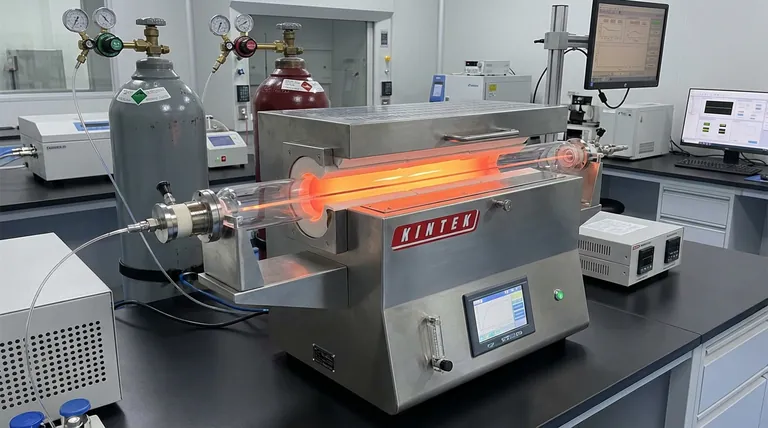
High-purity quartz serves as the definitive material choice for continuous thermal chemical vapor deposition (th-CVD) reactors due to its unique combination of thermal resilience, optical clarity, and chemical purity. It provides a stable environment capable of withstanding temperatures exceeding 800°C while preventing the reactor walls from interacting with sensitive process gases.
The core value of a high-purity quartz tube is its ability to maintain a contaminant-free reaction zone. By eliminating metal impurities from the reactor structure itself, it ensures that carbon nanotube growth is driven solely by the intended catalyst, preserving the chemical integrity of the final product.
Thermal and Chemical Stability
Withstanding Extreme Temperatures
Carbon nanotube growth requires high-energy environments. High-purity quartz tubes are engineered to operate effectively in temperatures exceeding 800°C.
This thermal stability ensures the reactor maintains its structural integrity without softening or deforming during continuous heating cycles.
Chemical Inertness
In a CVD process, reactive gases like acetylene (carbon source) and argon (carrier gas) are introduced into the chamber. Quartz possesses excellent chemical inertness, meaning it does not react with these gases.
Furthermore, it remains stable even in ammonia reduction atmospheres. This prevents unwanted chemical side-reactions that could alter the gas composition or degrade the reactor walls over time.
Purity and Process Control
Preventing Cross-Contamination
One of the most critical advantages of high-purity quartz is its lack of metal impurities. In metal-based reactors, trace elements can leach into the growth zone, acting as unintended catalysts or contaminants.
Quartz eliminates this variable. By preventing cross-contamination, it ensures that the synthesized carbon nanotubes maintain high consistency regarding metal residue control and surface chemical purity.
Real-Time Process Monitoring
Unlike opaque ceramic or metal reactors, high-purity quartz provides optical transparency. This allows operators to perform real-time observation of the internal mechanics.
Specifically, in continuous th-CVD systems, this transparency allows for the direct monitoring of the wire-feeding process. Operators can visually confirm that the substrate is moving correctly through the reaction zone, enabling immediate troubleshooting if mechanical issues arise.
Operational Considerations
While quartz offers superior purity and visibility, it is important to acknowledge the physical trade-offs compared to metal alternatives.
Mechanical Fragility
Quartz is a ceramic material and is inherently brittle. Unlike stainless steel reactors, quartz tubes require careful handling during installation and maintenance to avoid fractures or chipping.
Making the Right Choice for Your Goal
When selecting a reactor material for carbon nanotube synthesis, the decision often comes down to the balance between durability and product quality.
- If your primary focus is Product Purity: Choose high-purity quartz to eliminate the risk of metal cross-contamination and ensure consistent surface chemistry.
- If your primary focus is Process Optimization: Choose high-purity quartz to leverage its transparency for visual monitoring of wire-feeding and gas flow dynamics.
High-purity quartz transforms the reactor from a simple container into a proactive tool for quality control.
Summary Table:
| Feature | High-Purity Quartz Advantage | Impact on CNT Growth |
|---|---|---|
| Thermal Stability | Withstands temperatures >800°C | Ensures structural integrity during continuous heating |
| Chemical Purity | Zero metal impurities | Prevents catalyst poisoning and ensures high product purity |
| Optical Clarity | Transparent reactor walls | Enables real-time monitoring of wire-feeding and process flow |
| Chemical Inertness | Non-reactive with acetylene/argon | Eliminates side reactions and preserves gas composition |
Elevate Your Nanomaterial Synthesis with KINTEK
Precision in carbon nanotube growth demands equipment that guarantees zero contamination and absolute thermal control. Backed by expert R&D and manufacturing, KINTEK offers high-performance CVD systems, Tube, Muffle, Rotary, and Vacuum furnaces tailored to your specific research or production requirements. Whether you need a standard setup or a fully customizable high-purity quartz solution, our systems are designed to deliver the consistency your lab deserves.
Ready to optimize your thermal CVD process?
Contact KINTEK Today for a Expert Consultation
References
- Jean‐Luc Meunier, Jason R. Tavares. Continuous Reactive-Roll-to-Roll Growth of Carbon Nanotubes for Fog Water Harvesting Applications. DOI: 10.3390/c10010009
This article is also based on technical information from Kintek Furnace Knowledge Base .
Related Products
- High Pressure Laboratory Vacuum Tube Furnace
- Laboratory Quartz Tube Furnace RTP Heating Tubular Furnace
- Vertical Laboratory Quartz Tube Furnace Tubular Furnace
- 1200℃ Split Tube Furnace Laboratory Quartz Tube Furnace with Quartz Tube
- Magnesium Extraction and Purification Condensing Tube Furnace
People Also Ask
- What role does a high vacuum tube furnace play in Co-Al sintering? Master High-Purity Porous Material Synthesis
- What are the different types of tube furnaces available? Find the Perfect Fit for Your Lab's Needs
- What are the main advantages of vacuum tube furnaces in the market? Achieve Purity and Precision in Material Processing
- What is the role of a vacuum tube furnace during the final thermal treatment stage of Fe3O4@CSAC catalysts?
- What conditions do tube furnaces provide for Au-Seeded TiO2 nanowires? Master Precision Thermal Synthesis


















