
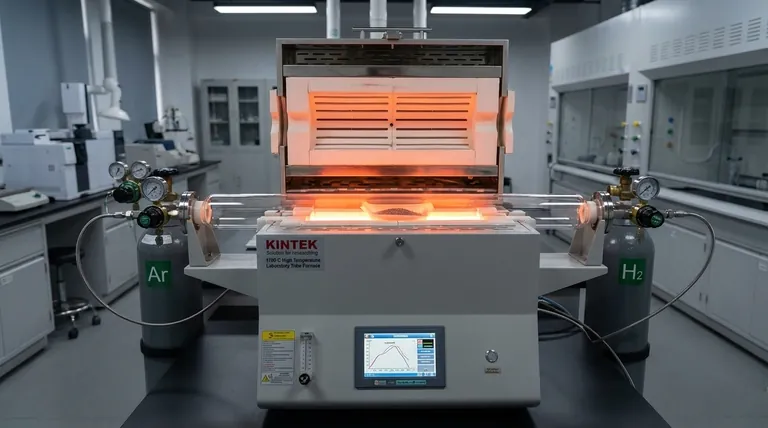
The high-temperature tubular furnace serves as the critical reaction chamber for synthesizing carrier-type high-entropy alloy (HEA) catalysts. It provides a precise thermal environment to anneal metal precursors with carbon sources, ensuring the formation of stable, conductive, and catalytically active materials.
Core Takeaway The furnace’s primary function is to facilitate high-temperature annealing under a controlled atmosphere, enabling the simultaneous carbonization of precursors, nitrogen doping, and the stable anchoring of HEA nanoparticles onto a conductive support.
Creating the Microstructure
The performance of a carrier-type catalyst depends heavily on how the metal interacts with its support. The tubular furnace drives the physicochemical changes necessary to build this structure.
Facilitating Carbonization and Doping
According to the primary methodology, the furnace is used to treat precursors at high temperatures, typically around 800 °C.
During this phase, nitrogen-containing carbon sources (such as C3N4 and glucose) are carbonized. This process simultaneously dopes nitrogen atoms into the material, creating a nitrogen-doped graphene carrier.
Anchoring High-Entropy Nanoparticles
The thermal treatment does not just create the support; it integrates the metal.
The high temperature promotes the stable loading of high-entropy alloy nanoparticles onto the newly formed carrier. This strong interaction prevents particle detachment and ensures long-term stability.
Enhancing Electrical Conductivity
A critical outcome of this annealing process is the improvement of the catalyst's electrical properties.
By converting precursors into a graphitized structure, the furnace significantly enhances the catalytic electrical conductivity. This allows for faster electron transfer during chemical reactions, boosting overall efficiency.
Controlling the Chemical Atmosphere
Unlike standard heating ovens, the defining feature of a tubular furnace is its ability to manage the gas environment surrounding the sample.
Protection via Inert Gas
To prepare these specific alloys, the furnace operates under a protective atmosphere, typically argon.
This prevents uncontrolled oxidation of the metal nanoparticles at high temperatures, which would otherwise degrade the catalytic activity and alter the alloy's composition.
Reduction of Metal Precursors
While the primary focus is annealing, the furnace also acts as a reduction reactor.
Supplementary data indicates that by utilizing reducing gases (such as a mixture of hydrogen and argon), the furnace converts metal oxide precursors into active metallic states.
This controlled reduction—often performed at lower temperatures like 350 °C—is essential for forming the specific face-centered cubic (FCC) structure required for high-entropy alloys.
Understanding the Trade-offs
While the tubular furnace is essential for atmosphere control, it requires careful management compared to other heating methods.
Throughput vs. Control
Tubular furnaces offer superior control over the reaction atmosphere (gas flow, pressure, and composition) compared to muffle furnaces.
However, muffle furnaces are often better suited for simple calcination in air where high throughput is required. If your process requires strict protection from oxygen or precise hydrogen reduction, the tubular furnace is the non-negotiable choice.
Thermal Profile Precision
The furnace must maintain excellent thermal field stability.
Inconsistencies in the heating rate or dwelling time can lead to incomplete reduction or secondary oxidation. Precise control is required to ensure the nanoparticles do not aggregate, which would reduce the active surface area.
Making the Right Choice for Your Goal
To maximize the effectiveness of your tubular furnace in catalyst preparation, align your parameters with your specific objective:
- If your primary focus is Electrical Conductivity: Prioritize high-temperature annealing (approx. 800 °C) under Argon to maximize carbonization and nitrogen doping of the graphene carrier.
- If your primary focus is Phase Purity: rigorous control of the reducing atmosphere (H2/Ar mixture) at moderate temperatures (350 °C) is critical to transform oxides into the correct crystal structure without over-sintering.
Success relies on balancing the thermal energy needed for carbonization with the atmospheric control required for metallic reduction.
Summary Table:
| Function | Key Process | Impact on Catalyst |
|---|---|---|
| Carbonization | 800 °C Annealing | Creates nitrogen-doped graphene support |
| Atmosphere Control | Argon/Hydrogen flow | Prevents oxidation and ensures metal reduction |
| Phase Formation | Controlled 350 °C - 800 °C | Develops specific FCC crystal structures |
| Conductivity | Graphitization | Facilitates faster electron transfer |
| Nanoparticle Anchoring | Thermal Integration | Prevents particle detachment for long-term stability |
Elevate Your Material Research with KINTEK Precision
High-entropy alloy synthesis demands absolute control over thermal fields and chemical atmospheres. Backed by expert R&D and world-class manufacturing, KINTEK offers high-performance Tubular, Muffle, Rotary, Vacuum, and CVD systems designed to meet the rigorous standards of modern lab research.
Whether you need precise nitrogen doping or stable FCC phase formation, our lab high-temperature furnaces are fully customizable to your unique catalyst preparation needs. Contact us today to find your custom thermal solution and ensure your research is supported by industry-leading stability and performance.
References
- Ziwei Yao, Xiaoguang Duan. High-entropy alloys catalyzing polymeric transformation of water pollutants with remarkably improved electron utilization efficiency. DOI: 10.1038/s41467-024-55627-7
This article is also based on technical information from Kintek Furnace Knowledge Base .
Related Products
- 1400℃ High Temperature Laboratory Tube Furnace with Alumina Tube
- 1700℃ High Temperature Laboratory Tube Furnace with Alumina Tube
- 1200℃ Split Tube Furnace Laboratory Quartz Tube Furnace with Quartz Tube
- Vertical Laboratory Quartz Tube Furnace Tubular Furnace
- High Temperature Muffle Oven Furnace for Laboratory Debinding and Pre Sintering
People Also Ask
- How does zone-melting in tube furnaces synthesize bismuth micro-wires? Master Single-Crystal Thermoelectric Growth
- How are high-temp tube furnaces used to measure diffusion coefficients per Fick's law? Master Precision Annealing
- How do high-temperature laboratory tube furnaces ensure environmental stability? Precision Thermal Reduction Tips
- How are high-temperature laboratory tube furnaces applied in long-term vacuum homogenization heat treatments for intermetallic samples?
- How are high-temperature tube furnaces applied in testing ceramic-supported alloy membranes? Insights



















