
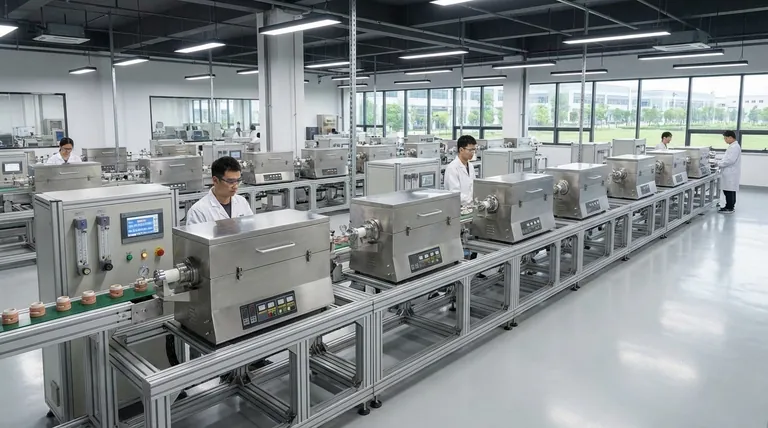
At their core, tube furnaces are made suitable for large-scale production through a combination of modular scalability and continuous processing capabilities. Instead of relying on a single massive unit, industrial operations combine multiple tube furnaces into a larger, integrated system that ensures high throughput and consistent product quality.
The true advantage of tube furnaces for large-scale production is not their individual size, but their ability to be linked into a continuous, precisely controlled line. This modular approach allows for scalable, high-fidelity manufacturing that is impossible to achieve with a single, monolithic furnace.
The Principles of Scaling with Tube Furnaces
True industrial scale with tube furnaces is achieved by rethinking the concept of a "single furnace." The strategy is to multiply precision units to create a larger, high-throughput system.
Modular Design for Linear Scaling
A single tube furnace is often a bench-top device. Large-scale production is achieved by combining multiple units in series or parallel.
This modularity allows a production line to grow with demand. You can add more furnace segments as needed without redesigning the entire process, offering significant financial and operational flexibility.
Continuous Processing Capability
Many industrial tube furnace systems, especially rotary or conveyor-based designs, are built for continuous operation. Raw material is fed into one end and processed material is removed from the other without interruption.
This continuous flow ensures consistent output and high productivity, a stark contrast to batch processing which involves cycles of loading, heating, cooling, and unloading.
High-Fidelity Process Replication
When you scale by adding identical units, you replicate the exact processing conditions across the entire line. Each furnace module can run the same validated temperature and atmosphere profile.
This ensures that the millionth part produced has the same quality as the first, a critical requirement for industries with stringent material specifications.
Key Enabling Features for Industrial Use
Several key technical features make tube furnaces uniquely suited for this modular, high-precision approach to manufacturing.
Unmatched Temperature Uniformity
Tube furnaces offer exceptional temperature control, with capabilities often exceeding 1700°C. Multi-zone configurations use several independent heating elements and controllers along the tube's length.
This allows for the creation of highly precise and uniform temperature profiles or controlled gradients, ensuring every part of the material receives the exact same thermal treatment.
Precise Atmosphere Control
Many advanced material processes cannot occur in open air. Tube furnaces excel at atmosphere control through sealed end caps, vacuum systems, and gas mixing capabilities.
They can operate under a high vacuum (down to 10⁻⁵ torr) or be filled with a specific inert gas like argon or nitrogen. This prevents oxidation and enables specialized chemical reactions essential for producing semiconductors, alloys, and advanced ceramics.
Robust Design and Operator Safety
Industrial environments demand durability and safety. Tube furnaces are typically built with durable stainless steel housings and heat-resistant internal materials.
Modern designs feature double-walled housings that keep the external surface temperature low (around 30°C) even when the interior is at 800°C or higher, protecting operators and surrounding equipment.
Understanding the Trade-offs
While powerful, the modular tube furnace approach is not a universal solution. It involves specific trade-offs that must be considered.
Throughput vs. Individual Part Size
The diameter of the processing tube inherently limits the size of the material that can pass through it. This makes the system ideal for powders, wires, wafers, or small components.
It is not suitable for processing large, bulky individual items, which are better served by large-volume batch furnaces.
System Complexity vs. Monolithic Simplicity
Integrating multiple furnaces, controllers, vacuum pumps, and gas delivery systems creates a more complex system than a single large furnace.
This requires more sophisticated engineering for initial setup and a more detailed maintenance plan to ensure the reliability of the entire interconnected line.
Footprint and Physical Layout
A long, continuous line of tube furnaces requires a significant amount of linear floor space. While flexible, the physical layout must be planned carefully, which can be a constraint in facilities with limited space.
Making the Right Choice for Your Production Goal
Selecting the correct heating technology requires aligning its strengths with your specific production needs.
- If your primary focus is high-purity materials with strict process control: A modular tube furnace line is the ideal solution, offering unparalleled precision in temperature and atmosphere.
- If your primary focus is high-volume processing of large, non-sensitive bulk materials: A traditional large-capacity batch furnace or a large rotary kiln may be a more cost-effective and simpler choice.
- If your primary focus is flexibility and future growth: The scalable, modular nature of tube furnaces allows you to start small and expand your production capacity incrementally as demand grows.
Ultimately, leveraging tube furnaces for large-scale production is a strategic decision to prioritize process precision and consistency over raw volume.
Summary Table:
| Feature | Benefit for Large-Scale Production |
|---|---|
| Modular Design | Allows linear scaling by adding units, supporting growth without full redesign |
| Continuous Processing | Enables non-stop material flow, increasing throughput and consistency |
| High Temperature Uniformity | Ensures precise thermal treatment across all parts for uniform quality |
| Atmosphere Control | Prevents oxidation and enables specialized reactions in controlled environments |
| Robust Safety Features | Protects operators with durable, low-external-temperature designs |
Ready to scale your production with precision? At KINTEK, we leverage exceptional R&D and in-house manufacturing to provide advanced high-temperature furnace solutions tailored for industries requiring strict process control. Our product line includes Tube Furnaces, Muffle Furnaces, Rotary Furnaces, Vacuum & Atmosphere Furnaces, and CVD/PECVD Systems, all backed by strong deep customization capabilities to meet your unique experimental and production needs. Contact us today to discuss how our modular tube furnace systems can enhance your large-scale operations with unmatched quality and efficiency!
Visual Guide

Related Products
- Vacuum Sealed Continuous Working Rotary Tube Furnace Rotating Tube Furnace
- 1400℃ High Temperature Laboratory Tube Furnace with Alumina Tube
- 1700℃ High Temperature Laboratory Tube Furnace with Alumina Tube
- High Pressure Laboratory Vacuum Tube Furnace
- Vertical Laboratory Quartz Tube Furnace Tubular Furnace
People Also Ask
- What is the purpose of rotary tube furnaces? Achieve Uniform Heat Treatment for Powders and Granules
- What are the key advantages of using a rotary tube furnace? Achieve Dynamic, Uniform Heating for Powders
- How does the amount of material processed vary between batch and continuous rotary tube furnaces? Scale Your Production Efficiently
- What are the advantages of rotary tube furnaces in fuel compatibility? Boost Efficiency and Cut Costs
- What is the temperature range of some rotary tube furnaces? Achieve Uniform Heating Up to 1200°C



















