
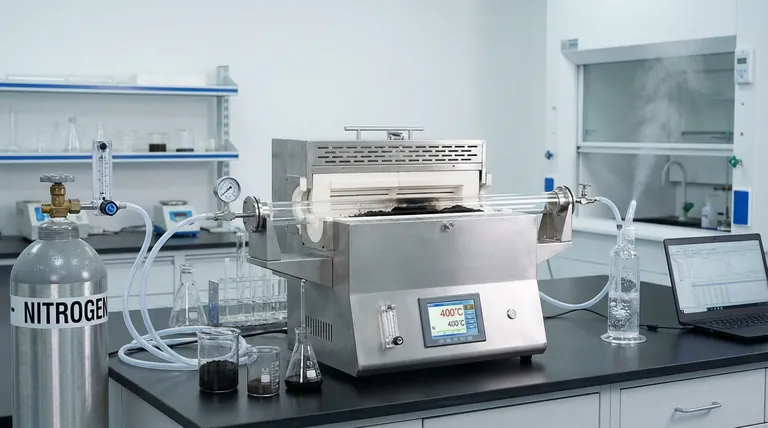
A Tube Resistance Furnace facilitates biomass pyrolysis by establishing a strictly controlled thermal environment where a continuous flow of high-purity nitrogen displaces all oxygen. This setup ensures the biomass undergoes carbonization—thermal degradation—rather than combustion, effectively converting organic precursors into biochar with a defined preliminary pore structure.
By excluding oxygen during the heating process, the furnace forces the material to decompose chemically rather than burn. This preservation of the carbon skeleton is the fundamental requirement for generating high-quality biochar.
The Mechanism of Inert Atmosphere Control
Preventing Combustion
The most critical function of the Tube Resistance Furnace is the total exclusion of oxygen. If oxygen were present at 400 °C, the biomass would simply burn, resulting in ash rather than carbon.
The Role of Nitrogen Flow
High-purity nitrogen acts as a carrier and shielding gas. It continuously sweeps through the tube, flushing out oxygen and carrying away volatile byproducts generated during heating.
Ensuring Process Stability
Advanced tube furnaces often employ gas flow control systems. These mechanisms ensure the supply of nitrogen is stable and uniform, preventing fluctuations that could lead to localized oxidation or inconsistent heating.
Thermal Degradation of Biomass
Breaking Down Organic Polymers
Under the nitrogen blanket, the furnace heats the biomass to approximately 400 °C. At this temperature, the complex structures of cellulose, hemicellulose, and lignin begin to thermally degrade.
Formation of Biochar
Because the material cannot burn, the carbon atoms rearrange rather than bond with oxygen. This transforms the raw biomass into biochar, a stable solid residue rich in carbon.
Developing Pore Structure
As the volatile components are driven off by the heat, they leave behind voids. This process creates a preliminary pore structure within the biochar, which is essential for applications requiring high surface area.
Understanding the Trade-offs
Sensitivity to Oxygen Leaks
The efficiency of this process relies entirely on the integrity of the seal. Even a micro-leak in the tube or flange can introduce enough oxygen to degrade the quality of the biochar or increase ash content.
Throughput Limitations
Tube resistance furnaces are typically designed for precision over volume. While they offer excellent control for research and small-batch production, they generally have lower throughput compared to industrial rotary kilns.
Making the Right Choice for Your Goal
To maximize the effectiveness of a Tube Resistance Furnace for pyrolysis, align your operational parameters with your specific objectives:
- If your primary focus is material purity: Prioritize the use of high-purity nitrogen and verify seal integrity to strictly prevent oxidation of the precursor.
- If your primary focus is structural consistency: Utilize the gas flow control system to maintain a uniform environment, ensuring even degradation across the entire sample.
Mastering the inert atmosphere is the single most important factor in converting raw biomass into valuable, porous carbon.
Summary Table:
| Process Component | Role in Biomass Pyrolysis |
|---|---|
| Inert Atmosphere | Displaces oxygen with Nitrogen to prevent combustion and ash formation. |
| Nitrogen Flow | Flushes oxygen and carries away volatile byproducts during thermal degradation. |
| Thermal Degradation | Breaks down cellulose, hemicellulose, and lignin at approximately 400°C. |
| Carbonization | Preserves the carbon skeleton to create stable, porous biochar structures. |
| Seal Integrity | Crucial for preventing oxygen micro-leaks that degrade material quality. |
Elevate Your Material Research with KINTEK
Precision is non-negotiable when converting biomass into high-value carbon. KINTEK provides industry-leading Tube, Muffle, Rotary, and Vacuum furnace systems, backed by expert R&D and manufacturing to ensure your pyrolysis processes are seamless and oxygen-free.
Whether you require standard lab equipment or a fully customizable high-temperature furnace tailored to your unique research needs, our solutions deliver the thermal stability and gas control necessary for superior pore structure development.
Ready to optimize your carbonization results? Contact KINTEK today to discuss your project requirements.
Visual Guide

References
- Sylwia Kukowska, Katarzyna Szewczuk‐Karpisz. New fruit waste-derived activated carbons of high adsorption performance towards metal, metalloid, and polymer species in multicomponent systems. DOI: 10.1038/s41598-025-85409-0
This article is also based on technical information from Kintek Furnace Knowledge Base .
Related Products
- Vertical Laboratory Quartz Tube Furnace Tubular Furnace
- High Pressure Laboratory Vacuum Tube Furnace
- 1700℃ High Temperature Laboratory Tube Furnace with Alumina Tube
- 1200℃ Split Tube Furnace Laboratory Quartz Tube Furnace with Quartz Tube
- Vacuum Sealed Continuous Working Rotary Tube Furnace Rotating Tube Furnace
People Also Ask
- What are the key differences between single-zone and multi-zone vertical tube furnaces? Choose the Right Furnace for Your Lab
- What are the main characteristics of vertical tube furnaces? Optimize Your Lab with Space-Saving, Uniform Heating
- How do heat treatment processes influence the configuration of a vertical tube furnace? Optimize for Quenching, Annealing, and More
- How does a vertical single-temperature zone tube furnace facilitate the growth of high-quality PdSe2 single crystals?
- What is a vertical tube furnace and how does it function? Optimize Material Processing with Precision



















