
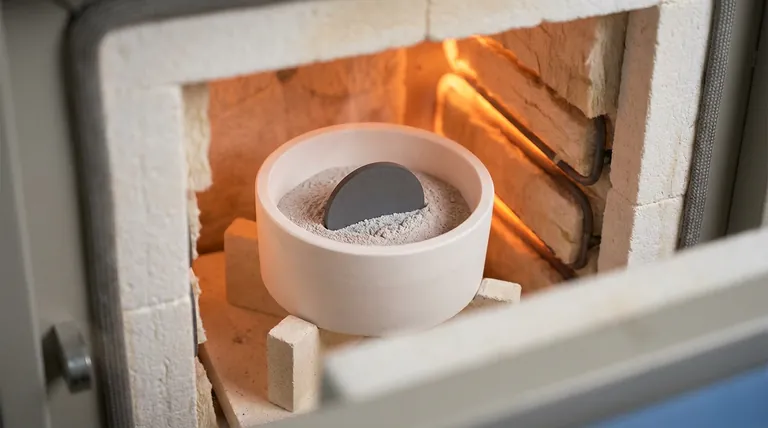
Effective pressureless sintering of silicon nitride relies on a dual-protection system. The boron nitride (BN) crucible functions as a chemically inert, high-temperature vessel, while the internal packing powder creates a saturated micro-atmosphere that actively prevents the sample from decomposing before it can densify.
The Core Insight Silicon nitride is prone to volatilization (turning into gas) at the high temperatures required for sintering. The packing powder serves as a "sacrificial" atmosphere generator, maintaining high local vapor pressures to suppress this decomposition, while the crucible ensures this environment remains contained and uncontaminated.
The Role of the Boron Nitride Crucible
Chemical Inertness and Purity
The primary function of the BN crucible is to provide a non-reactive containment vessel. High-purity BN is chemically stable and inert, ensuring it does not react with the silicon nitride sample even at extreme processing temperatures.
High-Temperature Stability
Sintering silicon nitride requires intense heat to achieve densification. BN crucibles possess high thermal stability, capable of maintaining structural integrity and preventing reactions at temperatures up to 1850°C.
Contamination Prevention
By isolating the sample from the furnace elements and the external environment, the crucible acts as a barrier. This prevents carbon contamination or carburization—common issues when using graphite heating elements or molds—ensuring the purity of the final ceramic.
The Function of the Internal Packing Powder
Regulating the Chemical Atmosphere
The packing powder, typically a mixture of silicon nitride ($Si_3N_4$) and boron nitride, is critical for controlling the local environment. It generates and maintains high local vapor pressures of SiO (Silicon Monoxide) and $N_2$ (Nitrogen).
Suppressing Thermal Decomposition
Silicon nitride has a tendency to decompose and volatilize at high sintering temperatures. By saturating the immediate atmosphere with SiO and $N_2$, the packing powder thermodynamically inhibits the decomposition of the sample, preserving its stoichiometric ratio.
Promoting Densification
Because the packing powder minimizes mass loss due to volatilization, the material can undergo proper sintering mechanisms. This allows the silicon nitride to achieve high density and maintain its intended structural integrity.
Physical Support
Beyond chemical regulation, the packing powder provides mechanical support to the "green" (unfired) body. This helps prevent deformation or warping of the sample geometry during the initial heating phases.
Understanding the Trade-offs
Sensitivity to Powder Composition
The effectiveness of this system relies entirely on the correct chemistry of the packing powder. If the packing powder does not generate adequate vapor pressure, the sample will suffer from mass loss and surface degradation.
Surface Interaction Risks
While the BN within the packing powder acts as a release agent to prevent sticking, improper packing density or composition can lead to minor surface reactions. This requires careful balancing of the silicon nitride-to-boron nitride ratio in the powder mix.
Making the Right Choice for Your Goal
To optimize your sintering process, align your setup with your specific material requirements:
- If your primary focus is High Density: Ensure your packing powder contains sufficient silicon nitride to maximize local vapor pressure and suppress all volatilization.
- If your primary focus is Chemical Purity: Utilize a high-purity BN crucible to strictly isolate the sample from graphite furnace components and prevent carbon contamination.
- If your primary focus is Dimensional Control: Pay close attention to the physical packing density of the powder to provide adequate support without restricting shrinkage.
By controlling the micro-atmosphere with packing powder and the macro-environment with a BN crucible, you ensure the successful densification of silicon nitride.
Summary Table:
| Component | Primary Function | Key Benefit |
|---|---|---|
| BN Crucible | Chemical containment & isolation | Prevents carbon contamination and withstands up to 1850°C. |
| Packing Powder | Atmosphere regulation (SiO & N2) | Suppresses thermal decomposition and maintains stoichiometry. |
| BN in Powder | Non-stick release agent | Prevents sample adhesion and provides mechanical support. |
| The System | Dual-layer protection | Ensures high density, dimensional control, and structural integrity. |
Achieve Perfection in Your High-Temperature Ceramic Sintering
Don't let volatilization or contamination compromise your silicon nitride components. Backed by expert R&D and manufacturing, KINTEK offers high-purity Boron Nitride crucibles and precision heating solutions tailored for your unique lab needs. Whether you require Muffle, Tube, or Vacuum systems, our customizable high-temperature furnaces provide the stability your research demands.
Ready to enhance your material densification and purity? Contact KINTEK today to find the perfect sintering setup for your lab!
References
- You Zhou, Manabu Fukushima. Effects of packing powder on densification and properties of pressureless sintered silicon nitride ceramics. DOI: 10.1111/ijac.70001
This article is also based on technical information from Kintek Furnace Knowledge Base .
Related Products
- High Temperature Muffle Oven Furnace for Laboratory Debinding and Pre Sintering
- 1200℃ Controlled Inert Nitrogen Atmosphere Furnace
- Vertical Laboratory Quartz Tube Furnace Tubular Furnace
- 1400℃ Muffle Oven Furnace for Laboratory
- Small Vacuum Heat Treat and Tungsten Wire Sintering Furnace
People Also Ask
- What thermal phenomena occur during polymer binder burnout in ceramic green bodies? Lab Furnace Guide
- Why is controlled heat treatment in a muffle furnace necessary for calcined clay? Achieve Optimal Pozzolanic Activity
- What role does a high-temperature muffle furnace play in STFO synthesis? Achieve Pure Perovskite Results
- How does a high-temperature muffle furnace facilitate the formation of LaNbxAl1−xO3+δ perovskite structures? Key Roles
- What role does a high-temperature muffle furnace play in the multi-stage synthesis of Li0.5MnFe1.5O4? Key to Pure Spinel



















