
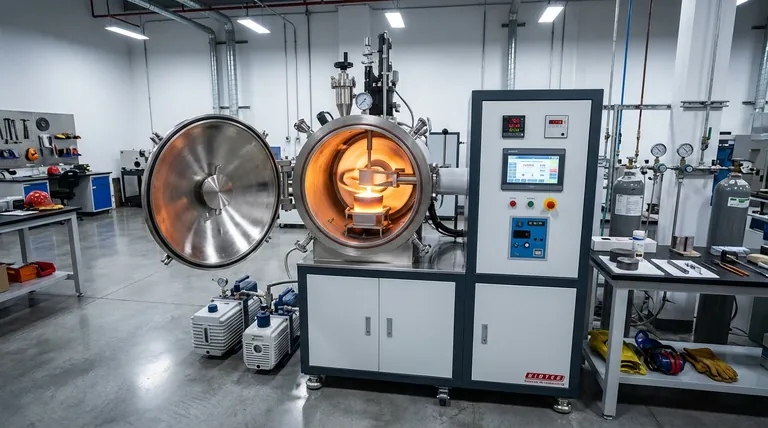
A high vacuum induction melting (VIM) furnace functions as a critical isolation and homogenization chamber for the processing of CM186LC nickel-based superalloys. Its primary mechanism involves creating an extremely low-oxygen environment to prevent the oxidative loss of reactive alloying elements, specifically hafnium (Hf) and aluminum (Al). Simultaneously, it utilizes electromagnetic forces to vigorously stir the molten metal, ensuring the chemical uniformity required for high-performance casting.
The VIM furnace serves a dual purpose: it acts as a protective barrier against oxidation for sensitive elements and as an active mixer to ensure the compositional homogeneity essential for defect-free single-crystal components.
Preserving Chemical Precision via Vacuum
Eliminating Oxidative Loss
The foremost function of the VIM furnace is to establish a high-purity vacuum environment. For CM186LC alloys, this is vital to prevent the oxidation of active elements such as hafnium (Hf) and aluminum (Al). If these elements contact oxygen, they form unwanted oxides rather than strengthening the alloy matrix.
Degassing and Purification
Beyond preventing oxidation, the vacuum environment actively cleans the alloy. The low pressure facilitates the removal of volatile impurities and gases from the melt. This "degassing" process ensures that the final material meets the stringent purity requirements necessary for aerospace applications.
Achieving Structural Integrity via Induction
Electromagnetic Stirring
The induction heating mechanism does more than simply melt the charge; it generates strong electromagnetic forces within the crucible. These forces induce a natural stirring action throughout the molten metal. This continuous movement prevents the heavier elements from settling, preventing segregation within the complex nickel matrix.
Foundation for Single-Crystal Casting
The homogeneity achieved through this stirring is not merely a quality standard; it is a fundamental requirement for the next stage of processing. CM186LC is often used for single-crystal castings, which require a perfectly uniform chemical composition to form correctly. Without the precise mixing provided by the VIM furnace, the formation of high-quality single crystals would be compromised.
Understanding the Trade-offs
Process Sensitivity
While VIM is highly effective, the process is unforgiving regarding vacuum integrity. Any breach or inability to maintain the specific low-pressure range (typically extremely low Pa levels) leads to the immediate loss of active elements like Hf. This requires rigorous maintenance of vacuum seals and pumps to ensure consistent alloy chemistry.
Crucible Interactions
The electromagnetic stirring, while beneficial for mixing, creates physical interaction between the melt and the furnace crucible. If not carefully controlled, aggressive stirring at high temperatures can lead to refractory erosion. This introduces the risk of trace ceramic inclusions entering the melt, counteracting the purity goals of the process.
Making the Right Choice for Your Goal
To maximize the efficacy of a VIM furnace for CM186LC, align your process controls with your specific material objectives:
- If your primary focus is Chemical Specification: Prioritize vacuum depth and leak rate integrity to maximize the retention of reactive elements like hafnium and aluminum.
- If your primary focus is Structural Homogeneity: Optimize the induction frequency and power input to maximize the electromagnetic stirring effect without eroding the crucible.
The success of processing CM186LC relies on viewing the VIM furnace not just as a heat source, but as a precision chemical reactor that balances atmosphere control with physical agitation.
Summary Table:
| Core Function | Mechanism | Benefit for CM186LC Alloy |
|---|---|---|
| Atmosphere Control | High Vacuum (Low Pa) | Prevents oxidative loss of Hafnium (Hf) and Aluminum (Al) |
| Purification | Degassing | Removes volatile impurities and dissolved gases for aerospace purity |
| Homogenization | Electromagnetic Stirring | Prevents element segregation; ensures uniform chemical composition |
| Structural Foundation | Induction Agitation | Vital for successful single-crystal casting and defect reduction |
Elevate Your Superalloy Processing with KINTEK Precision
High-performance materials like CM186LC demand uncompromising thermal environments. KINTEK provides industry-leading Vacuum Induction Melting (VIM) systems backed by expert R&D and manufacturing. Our customizable high-temp furnaces—including Muffle, Tube, Rotary, and CVD systems—are designed to meet your unique metallurgical needs, ensuring precise chemical retention and superior structural integrity.
Ready to optimize your lab's high-temperature capabilities?
References
- A.B. Baldissera, Uwe Glatzel. Single‐Crystal Castability of CM186LC Nickel‐Based Superalloy. DOI: 10.1002/adem.202500837
This article is also based on technical information from Kintek Furnace Knowledge Base .
Related Products
- Vacuum Induction Melting Furnace
- 600T Vacuum Induction Hot Press Vacuum Heat Treat and Sintering Furnace
- 2200 ℃ Tungsten Vacuum Heat Treat and Sintering Furnace
- 9MPa Air Pressure Vacuum Heat Treat and Sintering Furnace
- 2200 ℃ Graphite Vacuum Heat Treat Furnace
People Also Ask
- What are the core functions of the High Vacuum Induction Melting (VIM) furnace? Optimize DD5 Superalloy Purification
- What role does a Vacuum Induction Melting furnace play in the production of high-aluminum nickel-based superalloys?
- What are the technical advantages of using a Vacuum Induction Melting furnace in the development of advanced packaging steel?
- Why is a Vacuum Induction Melting furnace (VIM) used for Cu-Zn-Al-Sn alloys? Achieve Precision Composition Control
- What are the advantages of using a VIM furnace to control residual oxygen pressure? Achieve Superior Metal Uniformity



















