
The integration of vibration sensors with Long Short-Term Memory (LSTM) networks transforms maintenance from a reactive necessity into a precise, predictive strategy. By capturing real-time mechanical subtleties and analyzing them against historical wear trends, this system provides high-accuracy failure forecasts that protect critical high-temperature assets.
Core Takeaway: This technical combination enables a shift from reactive repairs to predictive maintenance, offering 94% forecast accuracy up to 72 hours before a breakdown occurs. This advanced warning is critical for eliminating unplanned downtime in complex rotary furnace operations.
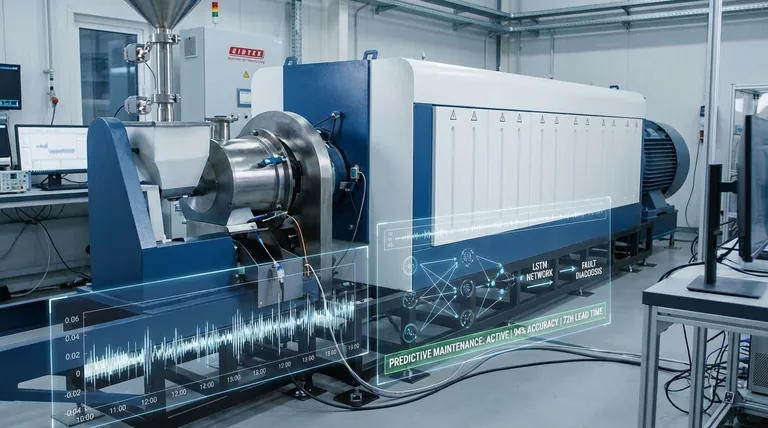
Capturing the Invisible: The Role of Vibration Sensors
Real-Time Mechanical Monitoring
Vibration sensors serve as the nervous system of the predictive maintenance architecture. They are attached directly to critical rotating parts, such as the bearings of the rotary furnace system.
Detecting Subtle Anomalies
These sensors capture subtle mechanical vibrations in real-time that human operators often miss. They detect early signs of distress long before they manifest as audible noise or catastrophic heat signatures.
Interpreting the Data: How LSTM Networks Function
Processing Data Sequences
Unlike standard algorithms that analyze isolated data points, Long Short-Term Memory (LSTM) networks are designed to process sequences of data. They understand the "story" of the machine over time.
Recognizing Wear Trends
LSTM networks analyze the stream of vibration data to identify specific historical wear patterns. They compare current sensor inputs against learned behaviors to distinguish between normal operational variance and genuine degradation.
The Operational Edge: Predictive Accuracy
High-Fidelity Forecasting
The primary benefit of this synergy is precision. The system allows operators to forecast failures with 94% accuracy. This level of reliability is essential for furnaces that manage critical processes like catalyst roasting or atmosphere control.
Gaining Strategic Lead Time
The system provides alerts up to 72 hours before a breakdown actually occurs. This three-day window allows maintenance teams to schedule repairs during planned shifts rather than suffering the costs of emergency shutdowns.
Understanding the Trade-offs
Data Quality Dependence
The accuracy of an LSTM network is directly tied to the quality of the data it is trained on. To achieve 94% accuracy, the system requires a robust set of historical data representing both healthy operations and past failure modes.
Sensor Placement and Environment
Rotary furnaces operate in high-temperature environments often involving inert or oxidizing atmospheres. Sensors must be carefully shielded and precisely calibrated to withstand these conditions without producing noisy, unreliable data.
Making the Right Choice for Your Goal
To determine if this predictive maintenance solution fits your operational strategy, consider your primary objectives:
- If your primary focus is Maximizing Uptime: Leverage the 72-hour warning window to convert emergency repairs into scheduled maintenance tasks, ensuring continuous production.
- If your primary focus is Process Integrity: Use the 94% accuracy rate to ensure that critical rotating components—essential for uniform heating and eliminating cold spots—never fail unexpectedly during sensitive processing.
Ultimately, adopting this technology allows you to move from repairing broken equipment to managing the health of active assets.
Summary Table:
| Feature | Vibration Sensors | LSTM Networks |
|---|---|---|
| Function | Real-time mechanical monitoring | Sequential data analysis & trend recognition |
| Capability | Detects subtle, invisible anomalies | Distinguishes normal variance from degradation |
| Key Outcome | Captures raw mechanical distress | Provides 94% forecast accuracy |
| Strategic Gain | Prevents catastrophic failure | Offers 72-hour maintenance lead time |
Maximize Uptime with KINTEK Expertise
Don't let unplanned downtime disrupt your critical high-temperature processes. Backed by expert R&D and manufacturing, KINTEK offers high-performance Rotary, Muffle, Tube, Vacuum, and CVD systems—all fully customizable to integrate advanced monitoring for your unique needs.
Ready to shift from reactive repairs to predictive excellence? Contact our specialists today to discover how our lab-grade furnace solutions and technical expertise can safeguard your production and enhance process integrity.
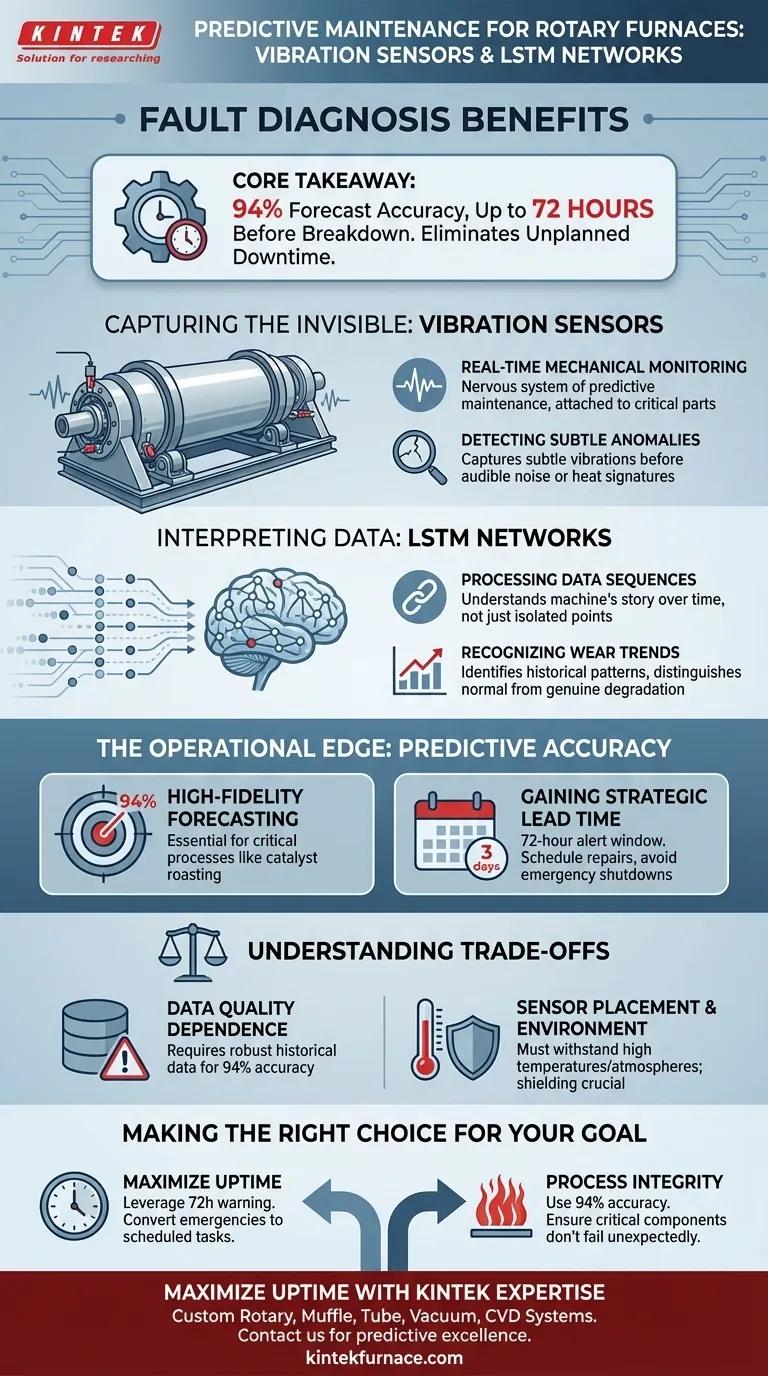
Visual Guide
Related Products
- Vacuum Sealed Continuous Working Rotary Tube Furnace Rotating Tube Furnace
- Electric Rotary Kiln Small Rotary Furnace Biomass Pyrolysis Plant Rotating Furnace
- Electric Rotary Kiln Continuous Working Small Rotary Furnace Kiln for Pyrolysis Plant Heating
- Electric Rotary Kiln Small Rotary Furnace for Activated Carbon Regeneration
- Laboratory Vacuum Tilt Rotary Tube Furnace Rotating Tube Furnace
People Also Ask
- What is the purpose of rotary tube furnaces? Achieve Uniform Heat Treatment for Powders and Granules
- What are the key advantages of using a rotary tube furnace? Achieve Dynamic, Uniform Heating for Powders
- How does the amount of material processed vary between batch and continuous rotary tube furnaces? Scale Your Production Efficiently
- What are the advantages of rotary tube furnaces in fuel compatibility? Boost Efficiency and Cut Costs
- What is the temperature range of some rotary tube furnaces? Achieve Uniform Heating Up to 1200°C



















