
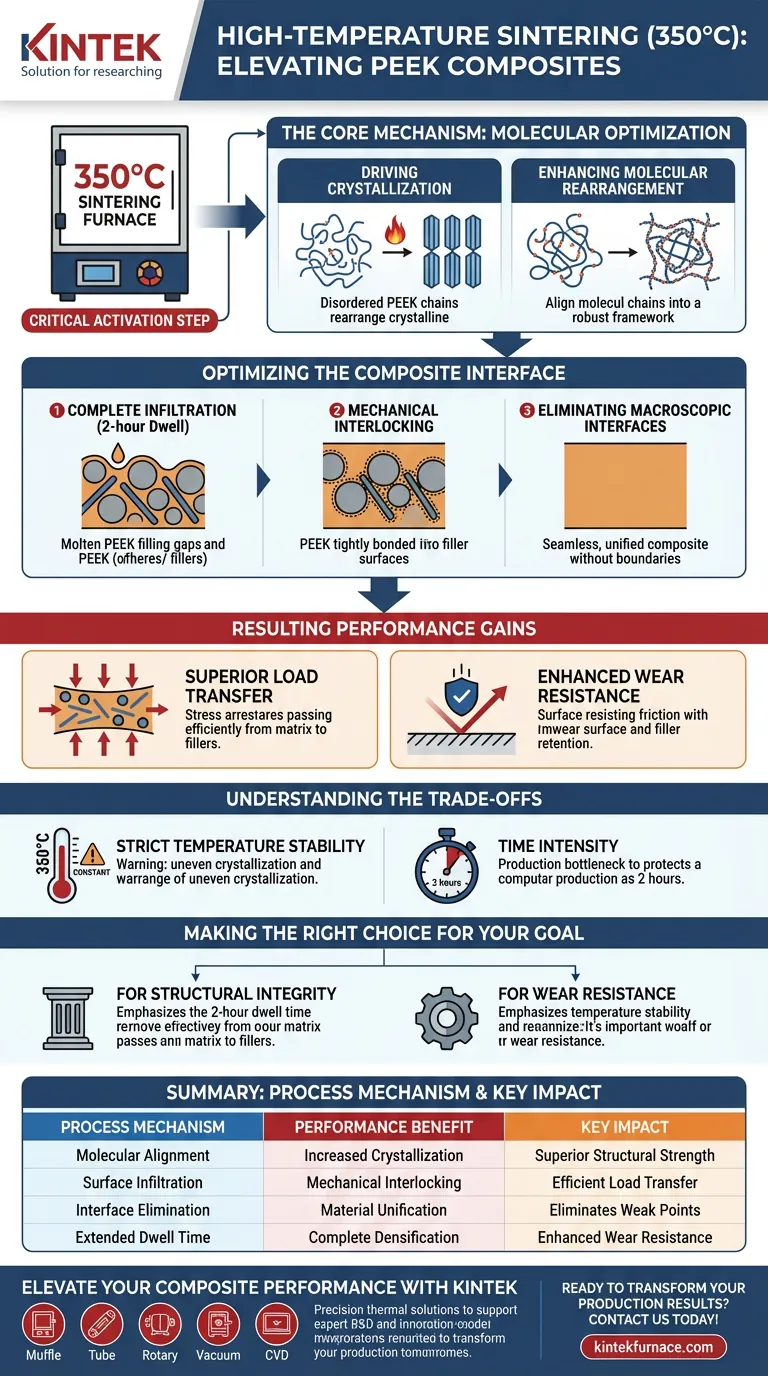
High-temperature sintering at 350°C acts as the critical activation step for maximizing the performance of Polyetheretherketone (PEEK) composites. By maintaining this constant temperature, the furnace provides the thermal energy required for PEEK molecular chains to rearrange and crystallize, rather than simply melting the material. This specific thermal environment enables the polymer to fully infiltrate multi-dimensional fillers, resulting in a cohesive structure with superior mechanical properties.
The core benefit of this process is the transition from a physical mixture to a chemically and mechanically unified composite. A constant 350°C environment drives the crystallization and interfacial adhesion necessary to eliminate macroscopic weak points, directly translating to enhanced load-bearing capacity and wear resistance.
The Mechanics of Molecular Optimization
Driving Crystallization
The primary function of the 350°C environment is to energize the polymer chains. At this temperature, the PEEK molecules gain sufficient mobility to align themselves into an ordered, crystalline structure.
Enhancing Molecular Rearrangement
This is not merely about melting; it is about reorganization. The constant heat allows the molecular chains to untangle and rearrange, establishing a robust internal framework that defines the material's final strength.
Optimizing the Composite Interface
Achieving Complete Infiltration
For a composite to perform well, the polymer must interact perfectly with its reinforcement. Maintaining the 350°C temperature for a duration of 2 hours ensures the PEEK melt has time to flow into every crevice.
Mechanical Interlocking
The extended dwell time allows the PEEK to fully infiltrate the surface of multi-dimensional fillers. This creates a tight "lock" between the matrix and the filler, establishing strong mechanical interlocking.
Eliminating Macroscopic Interfaces
A successful sintering cycle removes the distinct physical boundaries between the different materials. By eliminating these physical interfaces at a macroscopic level, the composite behaves as a single, unified material rather than a collection of separate parts.
Resulting Performance Gains
Superior Load Transfer
Because the physical interfaces are eliminated and adhesion is high, external stress is efficiently transferred from the softer PEEK matrix to the stronger fillers. This results in significantly improved load transfer capabilities.
Enhanced Wear Resistance
The strong interfacial adhesion prevents fillers from being dislodged under friction. This structural integrity directly contributes to superior wear resistance in the finished composite.
Understanding the Trade-offs
While 350°C sintering offers significant performance boosts, it requires precise process control.
strict Temperature Stability
The process relies on a constant 350°C environment. Fluctuations in temperature can lead to uneven crystallization, creating internal stresses or weak spots within the composite.
Time Intensity
The requirement for a 2-hour dwell time to ensure full infiltration introduces a bottleneck in production speed. Rushing this stage to save time will result in poor adhesion and incomplete densification.
Making the Right Choice for Your Goal
To maximize the utility of your PEEK composites, align your processing parameters with your specific performance targets.
- If your primary focus is Structural Integrity: Ensure the 2-hour dwell time is strictly observed to guarantee complete removal of macroscopic interfaces.
- If your primary focus is Wear Resistance: Prioritize the stability of the 350°C temperature to maximize crystallization and filler retention at the surface.
Control the temperature and time precisely, and you will transform raw PEEK into a high-performance engineering asset.
Summary Table:
| Process Mechanism | Performance Benefit | Key Impact |
|---|---|---|
| Molecular Alignment | Increased Crystallization | Superior structural strength and internal framework |
| Surface Infiltration | Mechanical Interlocking | Efficient load transfer from matrix to fillers |
| Interface Elimination | Material Unification | Eliminates weak points and macroscopic interfaces |
| Extended Dwell Time | Complete Densification | Enhanced wear resistance and long-term durability |
Elevate Your Composite Performance with KINTEK
Unlock the full potential of your PEEK materials with precision-engineered thermal solutions. Backed by expert R&D and manufacturing, KINTEK offers high-performance Muffle, Tube, Rotary, Vacuum, and CVD systems designed for the strict temperature stability required for advanced sintering.
Whether you need to maintain a constant 350°C for critical crystallization or require a fully customizable high-temperature furnace for unique R&D needs, our lab systems provide the accuracy your materials demand.
Ready to transform your production results? Contact us today to discuss your specific lab requirements with our specialists!
Visual Guide
References
- Zhengjia Ji, Chao Xu. Potassium Titanate Whisker/Graphene Multi-Dimensional Fillers to Improve the Wear Resistance of Poly(Ether Ether Ketone) Composite. DOI: 10.3390/lubricants13050211
This article is also based on technical information from Kintek Furnace Knowledge Base .
Related Products
- 2200 ℃ Tungsten Vacuum Heat Treat and Sintering Furnace
- High Temperature Muffle Oven Furnace for Laboratory Debinding and Pre Sintering
- 2200 ℃ Graphite Vacuum Heat Treat Furnace
- Vacuum Heat Treat Sintering Furnace Molybdenum Wire Vacuum Sintering Furnace
- 1400℃ High Temperature Laboratory Tube Furnace with Alumina Tube
People Also Ask
- How does a tungsten-heated vacuum sintering furnace prepare (TbxY1-x)2O3 ceramics? Achieve 99%+ Density & Purity
- How do compaction pressure and vacuum sintering optimize porous ceramics? Maximize Density & Toughness
- What wear-resistance enhancements are achieved by powder coating? The Role of Vacuum Sintering Furnaces
- What role does a high-temperature vacuum sintering furnace play in the densification of WC-10(Ni, Ni/Co) alloys?
- What core role does a high-temperature vacuum sintering furnace play in Sm:YAG ceramics? Mastering Optical Clarity



















