
Vacuum-based processing is the definitive method for preserving the delicate 3D architecture of Cobalt Oxide and Carbon Nanotube (Co3O4@CNT) composites. The primary advantage lies in utilizing the principle of sublimation or low-pressure evaporation to remove moisture and solvents, which effectively eliminates the liquid-gas interface tension inherent in traditional drying methods. This process prevents the destructive capillary forces that would otherwise cause the carbon nanotube network to collapse and shrink.
By eliminating the surface tension that occurs during standard evaporation, vacuum processing locks in a stable, high-porosity framework. This preservation of the 3D structure is critical for maximizing specific surface area and ensuring efficient electrolyte penetration in battery applications.
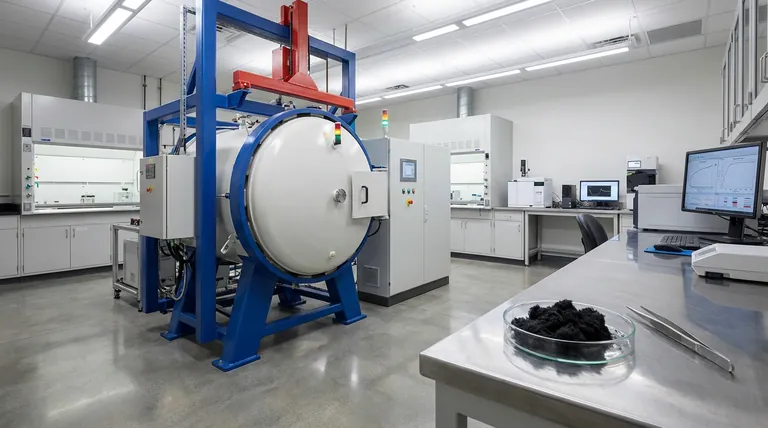
The Mechanics of Structural Preservation
Eliminating Liquid-Gas Tension
In traditional drying, as liquid evaporates, the surface tension at the liquid-gas interface exerts significant force on the solid structure. This force pulls the nanomaterials together, often leading to structural collapse.
Vacuum processing bypasses this issue. By operating under vacuum, the process utilizes sublimation (direct solid-to-gas transition) or low-pressure evaporation, removing the solvent without creating the surface tension that damages the composite.
Preventing Volume Shrinkage
Because the capillary forces are neutralized, the composite material does not undergo the volume shrinkage typical of air-dried samples.
This allows the carbon nanotube network to maintain its original, expanded dimensions. The result is a robust, stable composite that retains its intended geometric form rather than densifying into a less useful mass.
Impact on Material Performance
Maintaining High Specific Surface Area
The primary chemical advantage of Co3O4@CNT composites relies on exposing as much active material as possible. Vacuum processing ensures the lattice remains open and porous.
This preservation leads to a significantly higher specific surface area compared to traditional methods. A higher surface area translates directly to more active sites for electrochemical reactions.
Optimizing Electrolyte Channels
For these composites to function effectively in batteries, the electrolyte must be able to permeate the material deeply.
The stable, three-dimensional structure preserved by vacuum processing acts as an optimized network of channels. This facilitates rapid ion transport and electrolyte penetration, which is essential for high-performance energy storage.
Secondary Processing Benefits
Protection Against Oxidation
Beyond structural drying, vacuum environments are critical when high temperatures are required for sintering or annealing.
Vacuum furnaces prevent oxygen from interacting with the materials at high heat. This is vital for carbon nanotubes, which can degrade or burn off in oxygen-rich environments at elevated temperatures.
Controlled Atmosphere for Reactions
Vacuum processing equipment allows for precise regulation of the atmosphere, enabling complex chemical conversions without compromising structure.
For example, if the composite requires sulfidation, a vacuum furnace can facilitate the reaction between sublimated sulfur and the composite. This ensures complete chemical conversion while maintaining the integrity of the underlying Co3O4@CNT framework.
Understanding the Trade-offs
Equipment Complexity and Cost
Vacuum processing requires specialized hardware, including vacuum pumps, sealed chambers, and precise pressure controllers.
This represents a significantly higher capital investment and maintenance burden compared to standard convection ovens or air-drying setups.
Throughput Limitations
Vacuum processes are typically batch-oriented rather than continuous.
This can create bottlenecks in manufacturing throughput. The time required to pump down the chamber and control the sublimation rate often makes the cycle time longer than simple thermal drying.
Making the Right Choice for Your Goal
To determine if vacuum-based processing is necessary for your specific application, consider your performance targets:
- If your primary focus is Electrochemical Performance: Use vacuum processing to maximize porosity and specific surface area, ensuring the best possible electrolyte accessibility.
- If your primary focus is Material Purity: Rely on vacuum environments to prevent the oxidation of the carbon nanotube network during high-temperature treatment.
- If your primary focus is Low-Cost Mass Production: Evaluate if the performance loss from air-drying shrinkage is acceptable, as vacuum processing will increase unit cost and cycle time.
Vacuum processing transforms the Co3O4@CNT composite from a simple mixture into a highly engineered, 3D architecture optimized for advanced energy applications.
Summary Table:
| Feature | Vacuum-Based Processing | Traditional Air Drying |
|---|---|---|
| Structural Integrity | Preserves 3D architecture; no collapse | Significant shrinkage and densification |
| Surface Tension | Eliminated via sublimation/low pressure | High capillary forces at gas-liquid interface |
| Surface Area | High specific surface area (optimized) | Reduced active sites due to structural collapse |
| Oxidation Risk | Near zero; protected environment | High risk for CNT degradation at temperature |
| Electrolyte Access | Open channels for rapid ion transport | Restricted penetration due to dense structure |
| Cost & Throughput | Higher investment; batch processing | Lower cost; higher volume capacity |
Unlock High-Performance Energy Storage with Precision Vacuum Solutions
Maintaining the delicate 3D framework of Co3O4@CNT composites requires expert-level thermal and vacuum control. At KINTEK, we specialize in providing the advanced equipment necessary to prevent structural collapse and maximize material purity.
Backed by expert R&D and manufacturing, KINTEK offers Muffle, Tube, Rotary, Vacuum, and CVD systems, all fully customizable to meet your unique laboratory or production needs. Whether you are optimizing electrolyte penetration or preventing carbon oxidation, our systems deliver the stability and precision your research demands.
Ready to elevate your material performance? Contact our experts today to find the perfect vacuum furnace solution for your application.
References
- Changwei Shan, Liwei Mi. Co<sub>1−<i>x</i></sub>S@CNT composite with a three-dimensional skeleton for high-performance magnesium–lithium hybrid batteries. DOI: 10.1039/d3ma01089a
This article is also based on technical information from Kintek Furnace Knowledge Base .
Related Products
- Molybdenum Vacuum Heat Treat Furnace
- Vacuum Heat Treat Sintering Furnace with Pressure for Vacuum Sintering
- Split Chamber CVD Tube Furnace with Vacuum Station CVD Machine
- Vacuum Induction Melting Furnace
- High Pressure Laboratory Vacuum Tube Furnace
People Also Ask
- What is the primary application of vacuum heat treating furnaces in aerospace? Enhance Component Performance with Precision
- How does vacuum heat treating work in terms of temperature and time control? Master Precise Material Transformations
- How does a vacuum heat treating furnace improve the condition of metal alloys? Achieve Superior Metal Performance
- What is the process of vacuum heat treating? Achieve Superior Metallurgical Properties
- Why are vacuum heat treating furnaces essential for aerospace? Ensure Superior Material Integrity for High-Stakes Applications



















