Knowledge What is the significance of temperature control in the condenser during the magnesium distillation process?
Author avatar

Tech Team · Kintek Furnace

Updated 1 day ago

What is the significance of temperature control in the condenser during the magnesium distillation process?


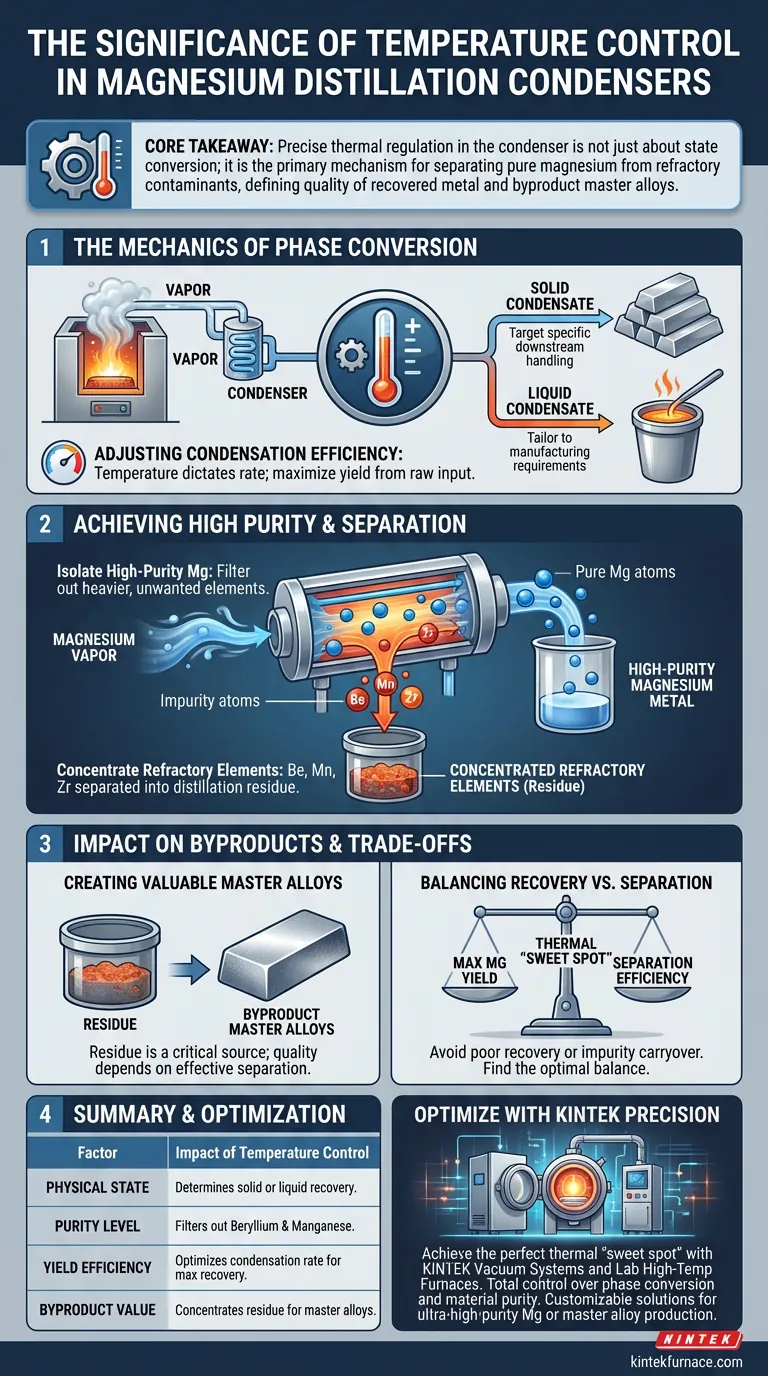
Temperature control in the condenser is the critical variable that determines both the physical state and the chemical purity of the recovered magnesium. By strictly regulating thermal conditions, operators manage the conversion of gaseous magnesium into specific solid or liquid forms, directly influencing the efficiency of the entire distillation process.

Core Takeaway: Precise thermal regulation in the condenser is not just about state conversion; it is the primary mechanism for separating pure magnesium from refractory contaminants, thereby defining the quality of both the recovered metal and the byproduct master alloys.
What is the significance of temperature control in the condenser during the magnesium distillation process?

The Mechanics of Phase Conversion

Determining the Condensate Form

The fundamental role of the condenser is to transition magnesium from a gaseous state back into a usable physical form.

Depending on the specific temperature settings applied, the system can target the production of either solid or liquid condensates. This flexibility allows the process to be tailored to specific downstream handling or manufacturing requirements.

Adjusting Condensation Efficiency

Temperature directly dictates the efficiency of the condensation process.

By manipulating the thermal gradient, operators can maximize the rate at which magnesium is captured from the vapor stream. This ensures the highest possible yield of the metal from the raw input.

Achieving High Purity and Separation

Isolating High-Purity Magnesium

The distillation process relies on temperature control to act as a filter.

When the condenser is operated at optimal temperatures, it facilitates the recovery of high-purity magnesium metal. This ensures that the final magnesium product is free from heavier, unwanted elements that do not vaporize or condense under the same conditions.

Concentrating Refractory Elements

A key function of the condenser temperature is to ensure that specific refractory elements do not contaminate the magnesium.

Elements such as beryllium, manganese, and zirconium are effectively separated during this stage. Because they are not collected in the condenser with the magnesium, they are concentrated in the distillation residue.

Impact on Byproducts

Creating Valuable Master Alloys

The residue left behind is not merely waste; it is a critical source for secondary products.

By ensuring refractory elements remain in the residue, the process creates a concentrated base for byproduct master alloys. The quality and chemical composition of these alloys are directly dependent on how effectively the magnesium was separated in the condenser.

Understanding the Operational Trade-offs

Balancing Recovery vs. Separation

There is often a delicate balance between maximizing magnesium yield and maintaining separation efficiency.

If the temperature profile is incorrect, you risk either poor magnesium recovery rates or the carryover of impurities. The goal is to find the thermal "sweet spot" that recovers the maximum amount of magnesium while keeping refractory elements strictly confined to the residue.

Making the Right Choice for Your Goal

To optimize the magnesium distillation process, you must adjust your thermal parameters based on your desired end-product.

  • If your primary focus is High-Purity Magnesium: Prioritize condenser temperatures that maximize condensation efficiency to capture the magnesium vapor while excluding heavier elements.
  • If your primary focus is Master Alloy Production: Ensure the separation process is rigorous enough to fully concentrate beryllium, manganese, and zirconium in the distillation residue.

Ultimately, the condenser temperature is the lever that controls the distribution of value between your purified metal and your alloy feedstock.

Summary Table:

Factor Impact of Temperature Control
Physical State Determines if magnesium recovers as a solid or liquid.
Purity Level Filters out refractory elements like Beryllium and Manganese.
Yield Efficiency Optimizes the condensation rate to maximize metal recovery.
Byproduct Value Concentrates refractory elements in residue for master alloys.

Optimize Your Metal Distillation with KINTEK Precision

Achieving the perfect thermal 'sweet spot' in magnesium distillation requires equipment that delivers uncompromising accuracy. KINTEK provides industry-leading Vacuum systems and Lab High-Temp Furnaces designed to give you total control over phase conversion and material purity.

Backed by expert R&D and manufacturing, our systems are fully customizable to meet the unique challenges of your refining process. Whether you are targeting ultra-high-purity magnesium or concentrated master alloy production, KINTEK has the solution.

Ready to elevate your lab's performance? Contact us today to discuss your custom high-temperature furnace needs with our engineering team!

Visual Guide
What is the significance of temperature control in the condenser during the magnesium distillation process? Visual Guide

References

  1. В. Н. Володин, Xeniya Linnik. Recycling of beryllium, manganese, and zirconium from secondary alloys by magnesium distillation in vacuum. DOI: 10.31643/2024/6445.42

This article is also based on technical information from Kintek Furnace Knowledge Base .

Related Products

People Also Ask

Related Products

1700℃ High Temperature Muffle Oven Furnace for Laboratory

1700℃ High Temperature Muffle Oven Furnace for Laboratory

KT-17M Muffle Furnace: High-precision 1700°C lab furnace with PID control, energy efficiency, and customizable sizes for industrial & research applications.

1800℃ High Temperature Muffle Oven Furnace for Laboratory

1800℃ High Temperature Muffle Oven Furnace for Laboratory

KINTEK Muffle Furnaces: Precision 1800°C heating for labs. Energy-efficient, customizable, with PID control. Ideal for sintering, annealing, and research.

High Temperature Muffle Oven Furnace for Laboratory Debinding and Pre Sintering

High Temperature Muffle Oven Furnace for Laboratory Debinding and Pre Sintering

KT-MD Debinding & Pre-Sintering Furnace for ceramics - precise temperature control, energy-efficient design, customizable sizes. Boost your lab efficiency today!

Laboratory Muffle Oven Furnace with Bottom Lifting

Laboratory Muffle Oven Furnace with Bottom Lifting

Boost lab efficiency with KT-BL Bottom Lifting Furnace: precise 1600℃ control, superior uniformity, and enhanced productivity for material science and R&D.

1400℃ Muffle Oven Furnace for Laboratory

1400℃ Muffle Oven Furnace for Laboratory

KT-14M Muffle Furnace: Precision 1400°C heating with SiC elements, PID control, and energy-efficient design. Ideal for labs.

1400℃ High Temperature Laboratory Tube Furnace with Quartz and Alumina Tube

1400℃ High Temperature Laboratory Tube Furnace with Quartz and Alumina Tube

KINTEK's Tube Furnace with Alumina Tube: Precision high-temperature processing up to 2000°C for labs. Ideal for material synthesis, CVD, and sintering. Customizable options available.

1700℃ High Temperature Laboratory Tube Furnace with Quartz or Alumina Tube

1700℃ High Temperature Laboratory Tube Furnace with Quartz or Alumina Tube

KINTEK's Tube Furnace with Alumina Tube: Precision heating up to 1700°C for material synthesis, CVD, and sintering. Compact, customizable, and vacuum-ready. Explore now!

1400℃ Controlled Inert Nitrogen Atmosphere Furnace

1400℃ Controlled Inert Nitrogen Atmosphere Furnace

KT-14A Controlled Atmosphere Furnace for labs & industry. 1400°C max temp, vacuum sealing, inert gas control. Customizable solutions available.

1200℃ Controlled Inert Nitrogen Atmosphere Furnace

1200℃ Controlled Inert Nitrogen Atmosphere Furnace

KINTEK 1200℃ Controlled Atmosphere Furnace: Precision heating with gas control for labs. Ideal for sintering, annealing, and material research. Customizable sizes available.

1200℃ Split Tube Furnace Laboratory Quartz Tube Furnace with Quartz Tube

1200℃ Split Tube Furnace Laboratory Quartz Tube Furnace with Quartz Tube

Discover KINTEK's 1200℃ Split Tube Furnace with quartz tube for precise high-temperature lab applications. Customizable, durable, and efficient. Get yours now!

1700℃ Controlled Inert Nitrogen Atmosphere Furnace

1700℃ Controlled Inert Nitrogen Atmosphere Furnace

KT-17A Controlled Atmosphere Furnace: Precise 1700°C heating with vacuum & gas control. Ideal for sintering, research & material processing. Explore now!

High Pressure Laboratory Vacuum Tube Furnace Quartz Tubular Furnace

High Pressure Laboratory Vacuum Tube Furnace Quartz Tubular Furnace

KINTEK High Pressure Tube Furnace: Precision heating up to 1100°C with 15Mpa pressure control. Ideal for sintering, crystal growth, and lab research. Customizable solutions available.

Vertical Laboratory Quartz Tube Furnace Tubular Furnace

Vertical Laboratory Quartz Tube Furnace Tubular Furnace

Precision KINTEK Vertical Tube Furnace: 1800℃ heating, PID control, customizable for labs. Ideal for CVD, crystal growth & materials testing.

Laboratory Quartz Tube Furnace RTP Heating Tubular Furnace

Laboratory Quartz Tube Furnace RTP Heating Tubular Furnace

KINTEK's RTP Rapid Heating Tube Furnace delivers precise temperature control, rapid heating up to 100°C/sec, and versatile atmosphere options for advanced lab applications.

Vacuum Heat Treat Sintering Furnace Molybdenum Wire Vacuum Sintering Furnace

Vacuum Heat Treat Sintering Furnace Molybdenum Wire Vacuum Sintering Furnace

KINTEK's Vacuum Molybdenum Wire Sintering Furnace excels in high-temperature, high-vacuum processes for sintering, annealing, and material research. Achieve precise 1700°C heating with uniform results. Custom solutions available.

Multi Zone Laboratory Quartz Tube Furnace Tubular Furnace

Multi Zone Laboratory Quartz Tube Furnace Tubular Furnace

KINTEK Multi-Zone Tube Furnace: Precise 1700℃ heating with 1-10 zones for advanced material research. Customizable, vacuum-ready, and safety-certified.

Mesh Belt Controlled Atmosphere Furnace Inert Nitrogen Atmosphere Furnace

Mesh Belt Controlled Atmosphere Furnace Inert Nitrogen Atmosphere Furnace

KINTEK Mesh Belt Furnace: High-performance controlled atmosphere furnace for sintering, hardening & heat treatment. Customizable, energy-efficient, precise temperature control. Get a quote now!

Vacuum Heat Treat Sintering Furnace with Pressure for Vacuum Sintering

Vacuum Heat Treat Sintering Furnace with Pressure for Vacuum Sintering

KINTEK's Vacuum Pressure Sintering Furnace offers 2100℃ precision for ceramics, metals, and composites. Customizable, high-performance, and contamination-free. Get a quote now!

600T Vacuum Induction Hot Press Vacuum Heat Treat and Sintering Furnace

600T Vacuum Induction Hot Press Vacuum Heat Treat and Sintering Furnace

600T Vacuum Induction Hot Press Furnace for precise sintering. Advanced 600T pressure, 2200°C heating, vacuum/atmosphere control. Ideal for research & production.

Vacuum Heat Treat Sintering and Brazing Furnace

Vacuum Heat Treat Sintering and Brazing Furnace

KINTEK Vacuum Brazing Furnaces deliver precision, clean joints with superior temperature control. Customizable for diverse metals, ideal for aerospace, medical, and thermal applications. Get a quote!


Leave Your Message
