
The primary advantage of using a vacuum drying oven for Co-Fe-ZIF particles is the preservation of chemical and structural integrity through low-temperature solvent removal. By lowering the ambient pressure, vacuum drying allows volatile solvents trapped deep within nanocantilevers or pores to evaporate thoroughly at just 60 °C. This significantly outperforms standard ovens by eliminating the high-temperature oxygen exposure that causes oxidation and structural degradation.
Core Takeaway Standard thermal drying poses a high risk of oxidizing precursors and collapsing delicate pore structures due to heat and air exposure. Vacuum drying mitigates this by lowering solvent boiling points, ensuring the retention of active sites and the authentic microscopic state of the material.
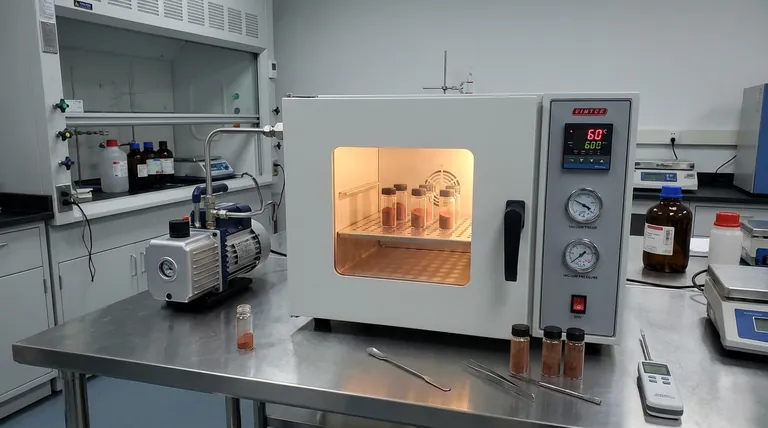
The Critical Role of Pressure and Temperature
Lowering Solvent Boiling Points
The fundamental mechanism of the vacuum drying oven is the reduction of internal pressure. This physical change drastically lowers the boiling point of residual solvents (such as ethanol or methanol).
Consequently, solvents adsorbed deep within the material can be removed rapidly without raising the temperature to destructive levels. This allows for effective processing at a relatively low temperature of 60 °C.
Prevention of Oxidation
A standard oven relies on convection, which continuously exposes materials to oxygen. When combined with heat, this environment accelerates oxidation reactions.
Vacuum drying operates in an oxygen-depleted, negative-pressure environment. This prevents the precursors from oxidizing, ensuring the chemical composition of the Co-Fe-ZIF particles remains stable and pure.
Preserving Structural Architecture
Protecting Deep Pore Structures
Co-Fe-ZIF particles rely on complex internal structures for their functionality. High-temperature drying in standard ovens can cause these delicate structures to collapse due to capillary forces or thermal stress.
Vacuum drying gently removes solvents from within the nanocantilevers and pores. This prevents pore closure and maintains the material's high specific surface area, which is critical for its eventual application.
Retaining Active Sites
The performance of Co-Fe-ZIF particles is directly tied to the availability of their active sites.
By avoiding thermal degradation and structural collapse, vacuum drying ensures these active sites remain intact. This maximizes the material's potential for catalytic activity or ion transport.
Facilitating Post-Processing
Beyond chemical stability, the physical state of the dried powder matters.
The vacuum suction effect promotes the formation of a looser internal structure compared to the dense caking often seen in standard drying. This makes the material significantly easier to grind and pulverize in subsequent processing stages.
Understanding the Risks of Standard Drying
While standard ovens are common, they introduce uncontrolled variables that are detrimental to nanomaterials.
Thermal Oxidation: In a standard air environment, heat acts as a catalyst for unwanted chemical changes. This degrades the purity of the metal-organic framework.
Structural Collapse: The rapid evaporation of solvents at high atmospheric pressure creates stress on the material. This often leads to the destruction of the porous morphology, rendering the ZIF particles less effective for their intended purpose.
Making the Right Choice for Your Goal
To maximize the quality of your Co-Fe-ZIF synthesis, align your drying method with your specific material requirements.
- If your primary focus is Chemical Purity: Use vacuum drying to eliminate oxygen exposure, preventing the oxidation of precursors and preserving the intended stoichiometry.
- If your primary focus is Structural Performance: Rely on vacuum drying to prevent pore collapse and maintain the high surface area required for effective catalysis or adsorption.
Vacuum drying is not just a drying step; it is a preservation technique essential for maintaining the functional potential of advanced porous materials.
Summary Table:
| Feature | Vacuum Drying Oven (60 °C) | Standard Convection Oven |
|---|---|---|
| Mechanism | Low pressure / Low-temp evaporation | Atmospheric pressure / Convection |
| Oxidation Risk | Negligible (Oxygen-depleted) | High (Heat + Air exposure) |
| Pore Structure | Preserved (Low thermal stress) | High risk of collapse/caking |
| Solvent Removal | Deep extraction from nanocantilevers | Surface-level focus |
| Material State | Loose powder, easy to grind | Dense, oxidized, or degraded |
Precision is non-negotiable when processing advanced nanomaterials like Co-Fe-ZIF. Backed by expert R&D and manufacturing, KINTEK offers high-performance Vacuum, Muffle, Tube, and CVD systems designed to preserve your material's delicate chemical and structural integrity. Whether you need a standard solution or a system fully customizable for unique laboratory needs, our technology ensures your active sites remain intact and your results remain consistent. Contact KINTEK today to optimize your thermal processing and safeguard your research outcomes.
References
- Dhayanantha Prabu Jaihindh, Chun-Yi Chen. Bimetallic and Magnetic CoFe-/Nitrogen-Doped Carbon Nanocomposites as Catalysts for the Degradation of Rhodamine B. DOI: 10.1021/acsanm.5c02849
This article is also based on technical information from Kintek Furnace Knowledge Base .
Related Products
- Vacuum Heat Treat Sintering and Brazing Furnace
- Vacuum Heat Treat Sintering Furnace Molybdenum Wire Vacuum Sintering Furnace
- Dental Porcelain Zirconia Sintering Ceramic Vacuum Press Furnace
- Molybdenum Vacuum Heat Treat Furnace
- Vacuum Hot Press Furnace Machine Heated Vacuum Press
People Also Ask
- What is one of the most important uses of vacuum heat treating furnaces in aerospace? Achieve Superior Strength in Aircraft Alloys
- How does vacuum heat treating affect the grain structure of metal alloys? Achieve Precise Microstructure Control
- What are the benefits of using vacuum heat treating furnaces for metal alloys? Achieve Superior Metal Properties and Performance
- What is the temperature of a vacuum furnace brazing? Optimize Your Joint Strength and Cleanliness
- What are the steps involved in a typical vacuum brazing treatment? Master the Process for Strong, Clean Joints












