
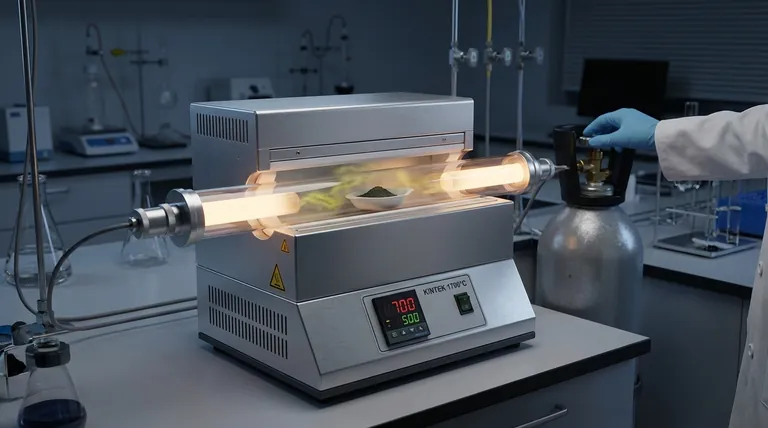
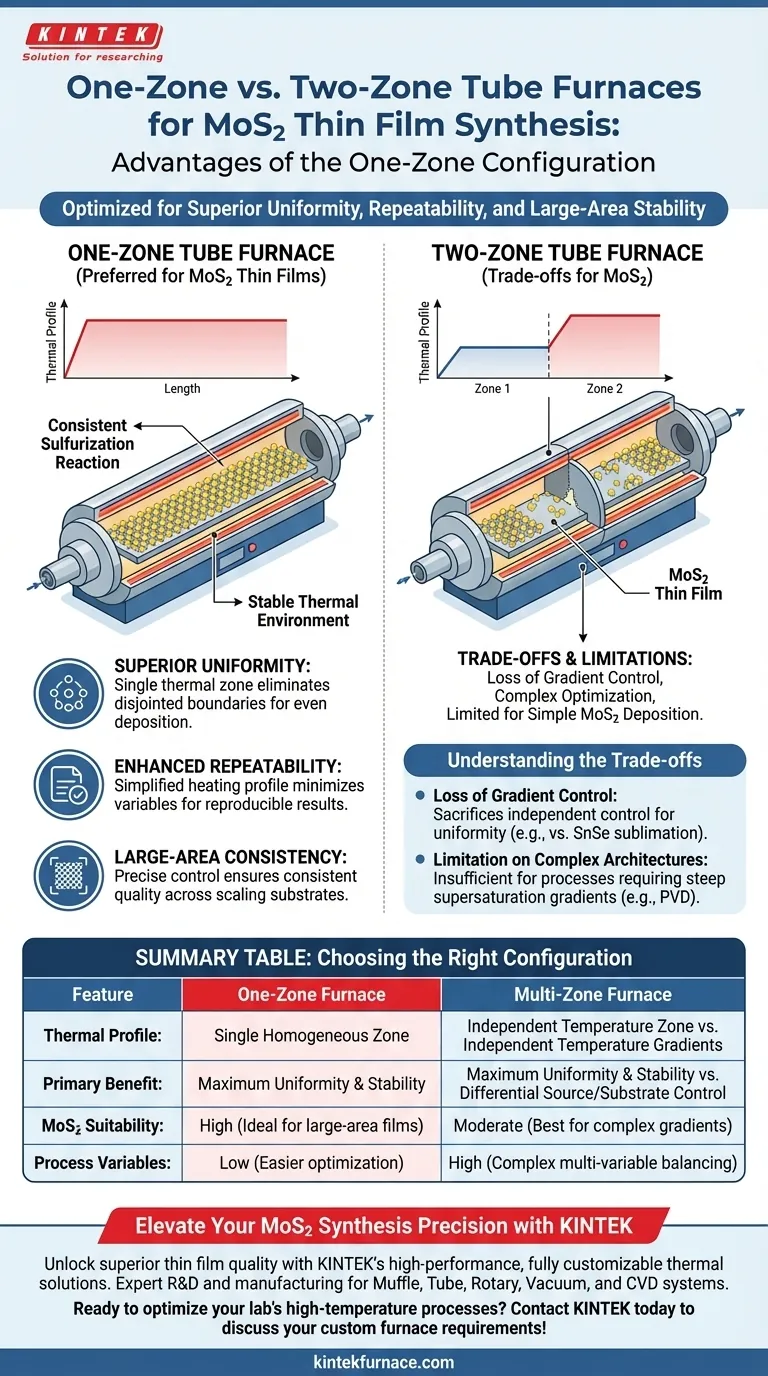
For the synthesis of molybdenum disulfide (MoS2) thin films, the primary advantage of a one-zone tube furnace is its ability to deliver superior uniformity and repeatability. While multi-zone configurations offer gradient control, the one-zone setup creates a more stable thermal environment that is specifically optimized for controlling the stability of the sulfurization reaction across large areas.
Core Takeaway Achieving high-quality MoS2 thin films often relies less on complex temperature gradients and more on reaction stability. A one-zone furnace excels here by eliminating thermal boundaries, ensuring consistent sulfurization and repeatable film quality across the entire substrate.
The Impact on Film Quality
Superior Uniformity
The most critical challenge in thin film synthesis is ensuring the material is deposited evenly. A one-zone furnace maintains a single, homogeneous thermal profile. This eliminates the risk of disjointed thermal zones that can lead to uneven growth rates across the substrate.
Enhanced Repeatability
In experimental and production environments, the ability to reproduce results is paramount. By reducing the complexity of the heating profile, the one-zone configuration minimizes process variables. This ensures that optimized process conditions yield the same high-quality results in subsequent runs.
Large-Area Consistency
When synthesizing films over larger substrates, thermal consistency becomes difficult to maintain. The one-zone configuration allows for precise control over the reaction environment. This ensures consistent results even when scaling up to larger-area thin films.
Process Control and Stability
Stabilizing the Sulfurization Reaction
The chemical reaction between the molybdenum precursor and sulfur is sensitive. The one-zone furnace allows for precise control over the stability of this sulfurization reaction. By keeping the entire reaction chamber at a unified temperature, the process avoids the instability that can occur at the interface of different temperature zones.
Optimization Simplicity
Optimizing a process in a one-zone furnace focuses on a single thermal variable. This allows researchers to fine-tune the environment more effectively than trying to balance the interaction between two or three independent zones.
Understanding the Trade-offs
Loss of Gradient Control
It is important to recognize what you sacrifice when choosing a one-zone setup. As noted in processes for other materials like Tin Selenide (SnSe), multi-zone furnaces (two-zone or three-zone) provide independent control over sublimation and deposition zones.
Limitation on Complex Architectures
If your specific synthesis method requires a steep temperature gradient to regulate supersaturation levels—common in Physical Vapor Deposition (PVD) or bulk crystal growth—a one-zone furnace will be insufficient. The one-zone system is specialized for uniformity, not for separating source and substrate temperatures.
Making the Right Choice for Your Goal
To select the correct furnace configuration, you must prioritize your specific processing needs:
- If your primary focus is MoS2 Thin Film Uniformity: Choose the one-zone furnace to maximize large-area consistency and reaction stability.
- If your primary focus is Complex Crystal Growth (e.g., SnSe): Choose a multi-zone furnace to leverage independent temperature gradients for controlling supersaturation.
By aligning your equipment choice with the specific chemical needs of MoS2, you ensure a robust and repeatable synthesis process.
Summary Table:
| Feature | One-Zone Furnace | Multi-Zone Furnace |
|---|---|---|
| Thermal Profile | Single Homogeneous Zone | Independent Temperature Gradients |
| Primary Benefit | Maximum Uniformity & Stability | Differential Source/Substrate Control |
| MoS2 Suitability | High (Ideal for large-area films) | Moderate (Best for complex gradients) |
| Process Variables | Low (Easier optimization) | High (Complex multi-variable balancing) |
Elevate Your MoS2 Synthesis Precision with KINTEK
Unlock superior thin film quality with KINTEK’s industry-leading thermal solutions. Backed by expert R&D and manufacturing, KINTEK offers high-performance Muffle, Tube, Rotary, Vacuum, and CVD systems—all fully customizable to meet your specific research or production needs. Whether you require the stable uniformity of a one-zone furnace for consistent sulfurization or a complex multi-zone system, our engineering team ensures you have the right tools for breakthrough results.
Ready to optimize your lab's high-temperature processes? Contact KINTEK today to discuss your custom furnace requirements!
Visual Guide
References
- Saiful Islam, Nowshad Amin. Modulating Molybdenum Disulfide (MoS <sub>2</sub> ) Thin Films Formation via Vapor-Phase Synthesis: Time Variation. DOI: 10.1088/1755-1315/1560/1/012038
This article is also based on technical information from Kintek Furnace Knowledge Base .
Related Products
- Split Multi Heating Zone Rotary Tube Furnace Rotating Tube Furnace
- Multi Zone Laboratory Quartz Tube Furnace Tubular Furnace
- Multi Heating Zones CVD Tube Furnace Machine for Chemical Vapor Deposition Equipment
- Magnesium Extraction and Purification Condensing Tube Furnace
- Vacuum Sealed Continuous Working Rotary Tube Furnace Rotating Tube Furnace
People Also Ask
- What are the main applications of multi zone tube furnaces in university laboratories? Unlock Precision in Material Science and Energy Research
- How are multi zone tube furnaces used in ceramics, metallurgy and glass research? Unlock Precise Thermal Control for Advanced Materials
- What role do multi zone tube furnaces play in new energy research? Unlock Precise Thermal Control for Innovation
- What environmental protection applications utilize multi zone tube furnaces? Unlock Precision in Waste Treatment and Green Tech
- What temperature-related capabilities make multi zone tube furnaces valuable for research? Unlock Precision Thermal Control



















