
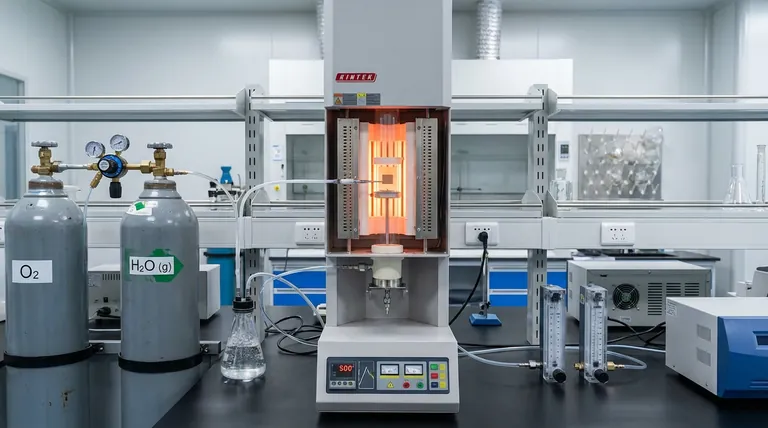
A laboratory tube furnace acts as a precision reactor utilized to convert metal-organic precursors into inorganic carbonate thin films through a process called pyrolysis. By maintaining a controlled environment—specifically 500°C in a wet oxygen atmosphere—the furnace facilitates the complete thermal decomposition of organic functional groups, transforming precursors like propionates into pure inorganic phases.
The core function of the tube furnace in this application is to drive chemical transformation through heat and atmosphere control. It effectively strips away organic components via pyrolysis to yield stable inorganic carbonates, such as calcium or barium carbonate, without destroying the film's physical structure.
The Mechanism of Thermal Decomposition
Achieving Complete Pyrolysis
The primary role of the furnace is to provide the thermal energy required to break chemical bonds.
For metal-organic precursors, specifically propionates, the furnace is set to approximately 500°C.
At this temperature, the organic functional groups within the precursor become unstable and decompose, a process known as pyrolysis.
The Role of Atmosphere
Temperature alone is often insufficient for high-purity conversion; the chemical environment is equally critical.
The tube furnace allows for the introduction of specific gases, in this case, a wet oxygen atmosphere.
This oxygen-rich environment accelerates the oxidation of the carbon-based components, ensuring they are removed effectively rather than becoming trapped as impurities.
Phase Transformation and Integrity
Creating Specific Inorganic Phases
The goal of this process is a distinct phase change from organic to inorganic.
Under these precise thermal conditions, metal-organic propionates transform into crystalline inorganic carbonates.
Common resulting phases include calcite-type calcium carbonate (CaCO3) or orthorhombic barium carbonate (BaCO3).
Preserving Morphological Integrity
A major challenge in thin film processing is preventing the film from cracking or peeling during chemical conversion.
The tube furnace provides a uniform heat distribution that helps maintain the morphological integrity of the thin films.
This controlled heating prevents the structural degradation that often occurs during rapid or uneven volume changes associated with decomposition.
Understanding the Trade-offs
Temperature Precision vs. Decomposition Rates
While high temperatures are necessary for decomposition, excessive heat can damage the substrate or alter the film's stoichiometry.
Conversely, if the temperature drops below the optimal 500°C range, the decomposition of organic groups may be incomplete.
This results in residual carbon contamination, which degrades the electronic or optical properties of the film.
Stress Management
Thermal processing inevitably introduces stress into thin films.
While the primary goal here is chemical conversion, the cooling phase of the tube furnace must be managed carefully.
Improper cooling can re-introduce internal stresses, negating the benefits of the controlled heating environment.
Making the Right Choice for Your Goal
To achieve high-quality inorganic carbonate films, you must balance thermal energy with atmospheric control.
- If your primary focus is Chemical Purity: Ensure the furnace maintains a consistent 500°C in a wet oxygen atmosphere to guarantee the complete removal of organic functional groups.
- If your primary focus is Structural Stability: Utilize the furnace's precise temperature ramping to mitigate thermal shock and preserve the morphological integrity of the calcite or orthorhombic phases.
By strictly controlling the pyrolysis environment, you transform volatile organic precursors into robust, crystalline inorganic materials.
Summary Table:
| Parameter | Specification / Detail | Impact on Thin Film Quality |
|---|---|---|
| Processing Temp | ~500°C | Ensures complete pyrolysis of organic groups |
| Atmosphere | Wet Oxygen | Accelerates oxidation and removes carbon impurities |
| Precursor Type | Metal-Organic (e.g., Propionates) | Serves as the base for inorganic phase transformation |
| Resulting Phases | CaCO3 (Calcite), BaCO3 (Orthorhombic) | Creates stable, crystalline inorganic structures |
| Key Outcome | Morphological Integrity | Prevents cracking/peeling via uniform heat distribution |
Elevate Your Thin Film Research with KINTEK Precision
Achieving high-purity phase transformations requires absolute control over thermal and atmospheric variables. KINTEK provides industry-leading Tube, Muffle, Vacuum, and CVD systems, specifically engineered to handle complex pyrolysis and chemical vapor deposition processes.
Backed by expert R&D and advanced manufacturing, our laboratory high-temperature furnaces are fully customizable to meet your unique thin-film synthesis needs—ensuring uniform heat distribution and precise gas flow control for superior morphological integrity.
Ready to optimize your material conversion? Contact KINTEK experts today to find the perfect thermal solution for your lab.
References
- Daniel Sánchez‐Rodríguez, Jordi Farjas. Kinetic analysis of reversible solid-gas reactions in films: application to the decomposition of CaCO$$_3$$ and BaCO$$_3$$ carbonates. DOI: 10.1007/s10973-024-13318-x
This article is also based on technical information from Kintek Furnace Knowledge Base .
Related Products
- 1400℃ High Temperature Laboratory Tube Furnace with Alumina Tube
- Laboratory Quartz Tube Furnace RTP Heating Tubular Furnace
- Laboratory Vacuum Tilt Rotary Tube Furnace Rotating Tube Furnace
- 1700℃ High Temperature Laboratory Tube Furnace with Alumina Tube
- Vertical Laboratory Quartz Tube Furnace Tubular Furnace
People Also Ask
- How does zone-melting in tube furnaces synthesize bismuth micro-wires? Master Single-Crystal Thermoelectric Growth
- How do high-temperature laboratory tube furnaces ensure environmental stability? Precision Thermal Reduction Tips
- How are high-temperature laboratory tube furnaces applied in long-term vacuum homogenization heat treatments for intermetallic samples?
- How are high-temp tube furnaces used to measure diffusion coefficients per Fick's law? Master Precision Annealing
- How are high-temperature tube furnaces applied in testing ceramic-supported alloy membranes? Insights



















