
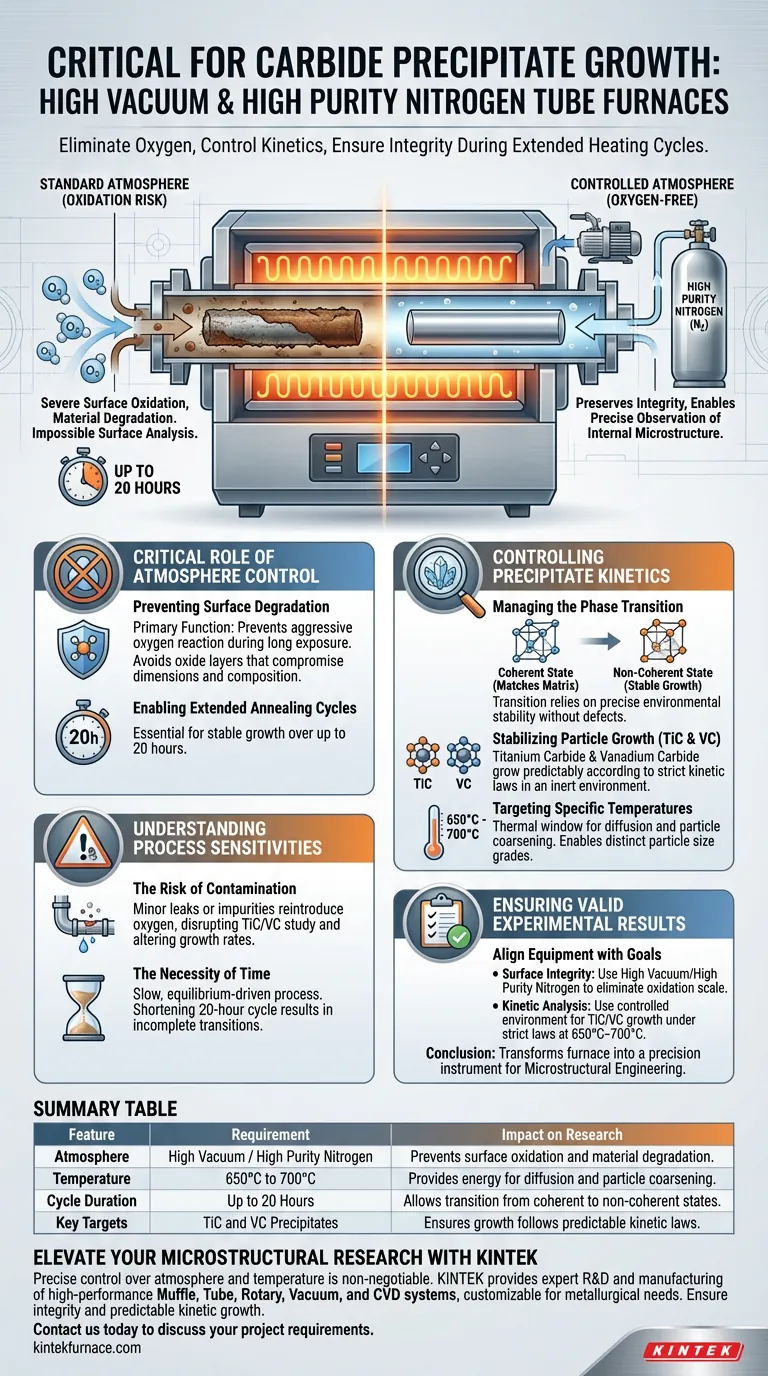
The necessity of a High Vacuum or High Purity Nitrogen Tube Furnace lies in its ability to eliminate oxygen during the extended heating cycles required for steel alloy research. When annealing alloys for durations up to 20 hours, standard atmospheric conditions would cause immediate and severe surface oxidation. By maintaining an extremely low oxygen environment, these furnaces preserve the integrity of the sample, allowing for the precise observation of internal microstructural changes without external interference.
Core Takeaway To successfully transition precipitates from coherent to non-coherent states, you must isolate the material from environmental contaminants. A high vacuum or high-purity nitrogen atmosphere is the only way to ensure that particle growth is driven solely by kinetic laws and temperature, rather than by surface degradation or oxidation.
The Critical Role of Atmosphere Control
Preventing Surface Degradation
The primary function of using High Vacuum or High Purity Nitrogen is to prevent surface oxidation.
When steel alloys are exposed to high temperatures for long periods, oxygen reacts aggressively with the metal surface.
This reaction creates oxide layers that can compromise the material's dimensions and chemical composition, rendering surface analysis impossible.
Enabling Extended Annealing Cycles
The growth of carbide precipitates is not an instantaneous process; it requires significant time.
Specific annealing protocols often demand durations of up to 20 hours.
Maintaining a pure, oxygen-free environment for this length of time is essential to ensure the material remains stable throughout the entire treatment.
Controlling Precipitate Kinetics
Managing the Phase Transition
The goal of this specific heat treatment is to control the transition of precipitates.
You are moving particles from a coherent state (where their crystal lattice matches the metal matrix) to a non-coherent state.
This delicate transition relies on precise environmental stability to proceed without defects.
Stabilizing Particle Growth
The furnace allows for the stable growth of specific carbide particles, specifically Titanium Carbide (TiC) and Vanadium Carbide (VC).
These particles grow according to strict kinetic laws.
An inert or vacuum environment ensures that this growth is predictable and repeatable.
Targeting Specific Temperatures
To facilitate this growth, the furnace must maintain a temperature range between 650°C and 700°C.
This thermal window provides the necessary energy for diffusion and particle coarsening.
Precise temperature control, combined with atmosphere control, enables the production of distinct particle size grades for comparative analysis.
Understanding the Process Sensitivities
The Risk of Contamination
While these furnaces are powerful, the process is highly sensitive to the purity of the environment.
Even a minor leak in a vacuum system or impurities in the nitrogen supply can reintroduce oxygen.
This would immediately disrupt the study of TiC or VC particles, potentially altering their growth rates or surface characteristics.
The Necessity of Time
It is important to recognize that this is a slow, equilibrium-driven process.
Shortening the 20-hour cycle to save time will likely result in incomplete phase transitions.
You must be prepared to commit to the full duration to achieve a true non-coherent state in the precipitates.
Ensuring Valid Experimental Results
If you are aiming to produce reliable data on precipitate growth, you must align your equipment choice with your specific analytical goals.
- If your primary focus is Surface Integrity: You must use High Vacuum or High Purity Nitrogen to completely eliminate the risk of oxidation scale forming during long heat treatments.
- If your primary focus is Kinetic Analysis: You need the controlled environment to ensure TiC and VC particles grow strictly according to kinetic laws at 650°C–700°C without external chemical interference.
By eliminating oxygen and precisely controlling temperature over extended periods, you transform your furnace from a simple heater into a precision instrument for microstructural engineering.
Summary Table:
| Feature | Requirement | Impact on Research |
|---|---|---|
| Atmosphere | High Vacuum / High Purity Nitrogen | Prevents surface oxidation and material degradation. |
| Temperature | 650°C to 700°C | Provides energy for diffusion and particle coarsening. |
| Cycle Duration | Up to 20 Hours | Allows transition from coherent to non-coherent states. |
| Key Targets | TiC and VC Precipitates | Ensures growth follows predictable kinetic laws. |
Elevate Your Microstructural Research with KINTEK
Precise control over atmosphere and temperature is non-negotiable for the growth of carbide precipitates. KINTEK provides expert R&D and manufacturing of high-performance Muffle, Tube, Rotary, Vacuum, and CVD systems, all customizable to meet your unique metallurgical research needs.
Ensure the integrity of your steel alloys and achieve predictable kinetic growth with our industry-leading high-temperature furnaces. Contact us today to discuss your project requirements and see how our tailored heating solutions can enhance your lab's efficiency.
Visual Guide
References
- Tim Boot, Vera Popovich. Hydrogen trapping and embrittlement of titanium- and vanadium carbide-containing steels after high-temperature hydrogen charging. DOI: 10.1007/s10853-024-09611-7
This article is also based on technical information from Kintek Furnace Knowledge Base .
Related Products
- High Pressure Laboratory Vacuum Tube Furnace
- Vacuum Induction Melting Furnace
- 1400℃ Controlled Inert Nitrogen Atmosphere Furnace
- Magnesium Extraction and Purification Condensing Tube Furnace
- 1200℃ Controlled Inert Nitrogen Atmosphere Furnace
People Also Ask
- What role does a high vacuum tube furnace play in Co-Al sintering? Master High-Purity Porous Material Synthesis
- What are the different types of tube furnaces available? Find the Perfect Fit for Your Lab's Needs
- What are the main advantages of vacuum tube furnaces in the market? Achieve Purity and Precision in Material Processing
- What is the role of a vacuum tube furnace during the final thermal treatment stage of Fe3O4@CSAC catalysts?
- What conditions do tube furnaces provide for Au-Seeded TiO2 nanowires? Master Precision Thermal Synthesis



















