
Hot Isostatic Pressing (HIP) provides superior densification and structural integrity compared to conventional sintering. By creating an environment of simultaneous high temperature and high-pressure inert gas, HIP exerts isotropic force on Bismuth Telluride composites. This process actively eliminates internal defects and enhances material properties in ways that standard pressure-less thermal sintering cannot achieve.
Core Takeaway While conventional sintering relies on time and temperature to bond particles, often leaving residual porosity, HIP introduces isotropic pressure to force densification. This creates a Bismuth Telluride composite with densities exceeding 93%, free of microscopic voids, and with preserved grain structures that ensure optimal electrical and mechanical performance.
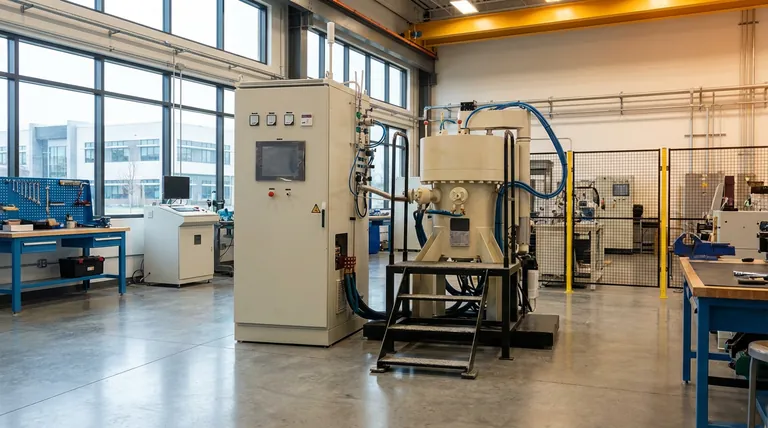
Mechanisms of Material Enhancement
Application of Isotropic Pressure
Unlike conventional sintering or uniaxial hot pressing, a HIP system utilizes an inert gas, such as argon, to apply pressure.
Because this pressure is applied via gas, it is isotropic, meaning it acts equally from all directions. This uniformity ensures that the material consolidates evenly, preventing the directional deformities sometimes seen in mechanical pressing methods.
Elimination of Microscopic Defects
The primary limitation of conventional sintering is the persistence of pores within the finished material.
The high-pressure environment of the HIP system effectively crushes and eliminates these microscopic pores and voids. This results in a much more continuous material structure compared to the porous nature of conventionally sintered ceramics.
Achieving Superior Density
Due to the elimination of voids, HIP significantly increases the final density of the composite.
Bismuth Telluride processed via HIP achieves a material density of over 93%. High density is critical for maximizing the active volume of the material available for electron transport.
Preserving Microstructural Properties
Dense Bonding Without Excessive Grain Growth
In conventional sintering, which can take one to two hours, prolonged exposure to heat often causes grains to merge and grow excessively.
HIP promotes dense particle bonding without triggering this excessive grain growth. By applying pressure, the system achieves consolidation without requiring the extended thermal dwell times that degrade the microstructure.
Optimized Electrical and Mechanical Performance
The reduction in porosity and the preservation of grain structure directly translate to performance.
The HIP process significantly improves mechanical integrity, making the composite less brittle and more durable. Simultaneously, the dense, void-free structure enhances electrical performance by providing an uninterrupted path for charge carriers.
The Limitations of Conventional Sintering
The Speed and Phase Change Trade-off
Conventional sintering is a slower process, typically requiring one to two hours to complete phase changes and alloy formation.
Pressure-assisted methods, which include activated sintering processes like hot pressing, can reduce the time required for densification to a matter of minutes. Relying solely on conventional sintering sacrifices this efficiency and increases the window for unwanted microstructural changes.
Vulnerability to Defects
The absence of external pressure in conventional sintering relies entirely on diffusion to remove pores.
This often fails to remove all microscopic voids, leading to lower density. These remaining voids act as weak points for mechanical failure and scatterers for electrical current, limiting the ultimate efficiency of the Bismuth Telluride device.
Making the Right Choice for Your Goal
To optimize your Bismuth Telluride composite manufacturing, consider the specific requirements of your application:
- If your primary focus is Maximum Density and Strength: Utilize the HIP system to achieve >93% density and eliminate the microscopic voids that compromise mechanical integrity.
- If your primary focus is Electrical Efficiency: Choose HIP to ensure dense particle bonding and uniform structure, which optimizes electrical performance by removing porous interruptions.
- If your primary focus is Microstructural Control: Leverage pressure-assisted sintering to achieve densification without the excessive grain growth associated with the long duration of conventional sintering.
By adding isotropic pressure to the sintering equation, HIP transforms a porous ceramic into a robust, high-performance composite.
Summary Table:
| Feature | Conventional Sintering | Hot Isostatic Pressing (HIP) |
|---|---|---|
| Pressure Type | None (Ambient) | Isotropic (Gas Pressure) |
| Material Density | Lower / Porous | > 93% Theoretical Density |
| Microstructure | Excessive Grain Growth | Preserved Grain Structure |
| Defect Rate | High Residual Porosity | Eliminates Micro-voids |
| Processing Time | 1–2 Hours | Minutes (Pressure Assisted) |
| Mechanical Strength | Brittle / Vulnerable | High Structural Integrity |
Elevate Your Material Performance with KINTEK Precision
Don't let residual porosity compromise your Bismuth Telluride research. Backed by expert R&D and manufacturing, KINTEK offers advanced Hot Isostatic Pressing (HIP), Muffle, Tube, Rotary, and Vacuum systems to ensure your composites reach maximum density and electrical efficiency.
Whether you need standard lab high-temp furnaces or fully customizable solutions for unique material challenges, our engineering team is ready to help. Contact KINTEK today to optimize your sintering process and achieve the structural integrity your application demands.
References
- Mohamed Abdelnaser Mansour, Ahmed Abdelmoneim. Enhancing the thermoelectric properties for hot-isostatic-pressed Bi2Te3 nano-powder using graphite nanoparticles. DOI: 10.1007/s10854-024-12389-8
This article is also based on technical information from Kintek Furnace Knowledge Base .
Related Products
- 600T Vacuum Induction Hot Press Vacuum Heat Treat and Sintering Furnace
- Vacuum Heat Treat Sintering Furnace with Pressure for Vacuum Sintering
- 9MPa Air Pressure Vacuum Heat Treat and Sintering Furnace
- Vacuum Hot Press Furnace Machine Heated Vacuum Press Tube Furnace
- High Temperature Muffle Oven Furnace for Laboratory Debinding and Pre Sintering
People Also Ask
- Why use Vacuum Hot Press (VHP) for ZnS Ceramics? Achieve Superior IR Transparency and Mechanical Strength
- How does a vacuum hot press sintering furnace mitigate copper sintering swelling? Solve Fe-Cu Expansion Issues
- What are the benefits of using a vacuum hot press sintering furnace for the preparation of SiCw/2024 aluminum matrix composites? Achieve High-Performance Aerospace Materials
- How does the vacuum environment in a vacuum hot press sintering furnace protect chromium-containing ceramics? Find out.
- What is the core function of a vacuum hot press sintering furnace in the preparation of high-density RuTi alloys? Achieve Maximum Density and Purity






