
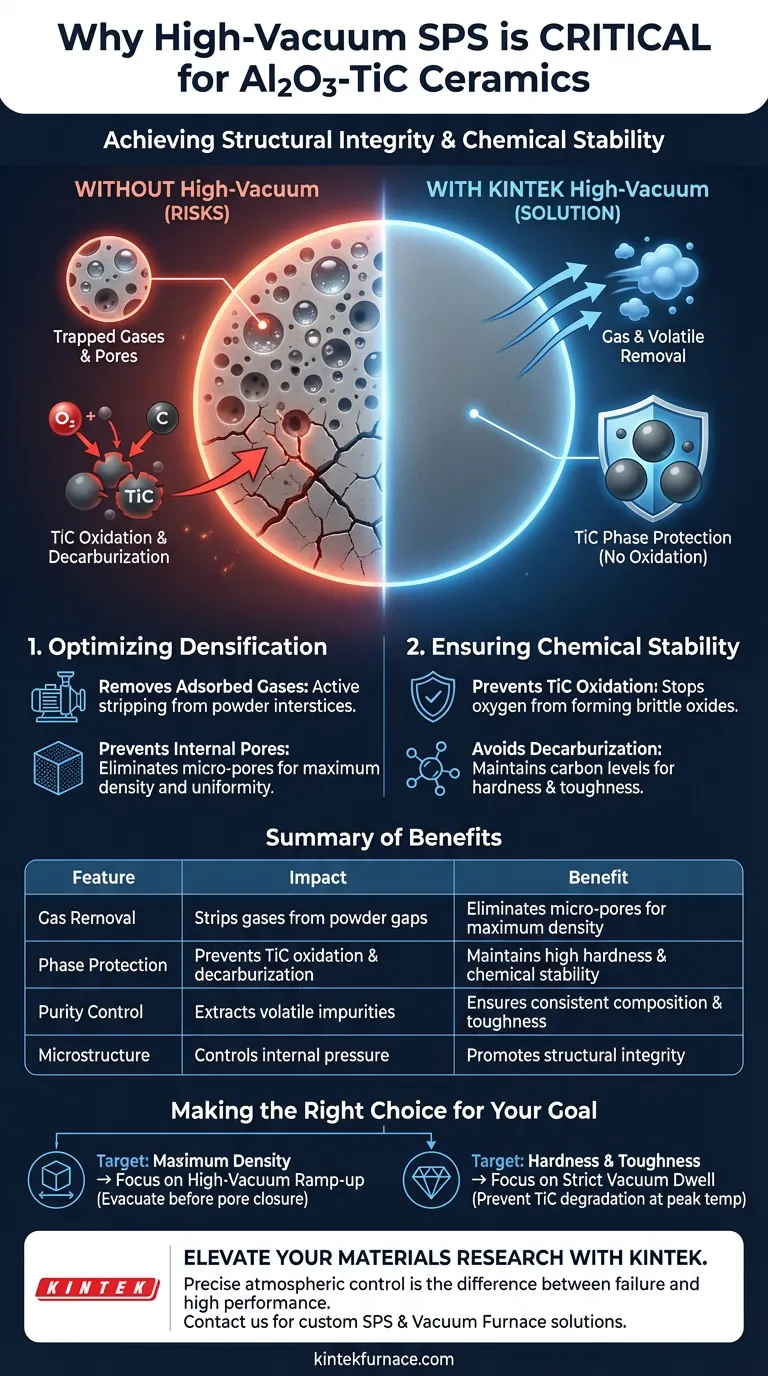
Achieving structural integrity in Al2O3-TiC ceramics requires a high-vacuum sintering system. This environment is critical for extracting adsorbed gases and volatile impurities from the powder interstices, which is necessary to prevent internal pore formation. Additionally, the vacuum protects the Titanium Carbide (TiC) phase from oxidation and decarburization, preserving the composite's chemical stability and mechanical performance.
The vacuum environment serves a dual purpose: it acts as a purification mechanism by removing trapped gases to minimize porosity, and as a protective shield that preserves the chemical integrity of the titanium carbide phase against high-temperature degradation.
Optimizing Densification and Microstructure
To achieve a dense ceramic body, you must address the physical barriers inherent in the powder compact.
Removing Adsorbed Gases
Raw ceramic powders naturally hold adsorbed gases on their surfaces. A high-vacuum environment actively strips these gases from the powder gaps before and during the heating process. Failure to remove these gases would result in trapped pockets of air within the material.
Preventing Internal Pores
The presence of volatile impurities creates internal pressure that opposes densification. By maintaining a low-pressure environment, you facilitate the extraction of these volatiles. This results in a significant reduction of micro-pores, ensuring the final product achieves high density and structural uniformity.
Ensuring Chemical Stability
While Aluminum Oxide (Al2O3) is relatively stable, the Titanium Carbide (TiC) component introduces specific chemical vulnerabilities at sintering temperatures.
Preventing TiC Oxidation
Titanium Carbide is highly susceptible to oxidation when exposed to high temperatures. Even trace amounts of residual oxygen can react with TiC to form titanium oxides. The vacuum system eliminates oxygen from the chamber, ensuring the TiC remains in its hard, non-oxide phase.
Avoiding Decarburization
High temperatures can lead to the loss of carbon from the TiC structure, a process known as decarburization. This reaction alters the stoichiometry of the ceramic, weakening its mechanical properties. A controlled vacuum environment suppresses this reaction, maintaining the hardness and toughness required for high-performance applications.
The Risks of Inadequate Vacuum Control
While a vacuum system adds complexity, operating without one or with insufficient vacuum levels introduces severe performance penalties.
Compromised Mechanical Properties
If oxidation occurs, the formation of oxide impurities will degrade the material's hardness. Instead of a robust Al2O3-TiC composite, you risk creating a material with brittle oxide inclusions that act as failure points.
Inconsistent Phase Composition
Without precise atmospheric control, chemical reactions become unpredictable. The final sintered body may not match the intended phase composition. This leads to variability in performance, making the ceramic unsuitable for precision tooling or structural applications.
Making the Right Choice for Your Goal
The level of vacuum control you implement should align with the specific properties you need to maximize in your final product.
- If your primary focus is Maximum Density: Prioritize a high-vacuum ramp-up stage to ensure all adsorbed gases are evacuated from powder gaps before pore closure occurs.
- If your primary focus is Hardness and Toughness: Maintain a strict high-vacuum or oxygen-free environment throughout the peak temperature dwell to prevent the degradation of the TiC phase.
Success in SPS processing relies on viewing the vacuum not just as an absence of air, but as an active tool for chemical and structural control.
Summary Table:
| Feature | Impact of High Vacuum | Benefit to Al2O3-TiC Composite |
|---|---|---|
| Gas Removal | Strips adsorbed gases from powder gaps | Eliminates micro-pores for maximum density |
| Phase Protection | Prevents TiC oxidation & decarburization | Maintains high hardness and chemical stability |
| Purity Control | Facilitates extraction of volatile impurities | Ensures consistent phase composition and toughness |
| Microstructure | Controls internal pressure during heating | Promotes structural integrity and uniform densification |
Elevate Your Materials Research with KINTEK
Precise atmospheric control is the difference between a brittle failure and a high-performance ceramic. Backed by expert R&D and manufacturing, KINTEK offers specialized Spark Plasma Sintering (SPS) support and high-temperature vacuum systems, including Muffle, Tube, Rotary, and CVD furnaces—all fully customizable to your unique sintering requirements.
Don't let oxidation or porosity compromise your results. Partner with KINTEK to achieve the structural integrity and mechanical excellence your Al2O3-TiC composites demand.
Contact our technical experts today to find your custom sintering solution.
Visual Guide
References
- Huda F. Khalil, Mervette El-Batouti. Zn-Al Ferrite/Polypyrrole Nanocomposites: Structure and Dielectric and Magnetic Properties for Microwave Applications. DOI: 10.3390/polym16172432
This article is also based on technical information from Kintek Furnace Knowledge Base .
Related Products
- Spark Plasma Sintering SPS Furnace
- Vacuum Dental Porcelain Sintering Furnace for Dental Laboratories
- 9MPa Air Pressure Vacuum Heat Treat and Sintering Furnace
- Dental Porcelain Zirconia Sintering Ceramic Vacuum Press Furnace
- Vacuum Heat Treat Sintering Furnace with Pressure for Vacuum Sintering
People Also Ask
- How does the heating mechanism of Spark Plasma Sintering (SPS) function? Enhance TiC/SiC Composite Fabrication
- Why is it necessary to maintain a high vacuum environment during the SPS of SiC? Key to High-Density Ceramics
- What are the technical advantages of using an SPS sintering furnace? Elevate Al2O3-TiC Material Performance
- What are the steps in the discharge plasma sintering process? Master Fast, High-Density Material Consolidation
- What are the advantages of spark plasma sintering (SPS) over traditional forging? Precision Microstructural Control

















