
The primary advantage of Flash Lamp Annealing (FLA) is the ability to decouple film crystallization from substrate heating. While traditional muffle furnaces heat the entire assembly uniformly—often warping or melting sensitive substrates—FLA utilizes sub-millisecond, high-energy pulses to rapidly heat the thin film to 600–800°C. This process occurs so quickly that thermal conduction is delayed, keeping the substrate temperature safely below 400°C.
Core Takeaway FLA solves the thermal incompatibility between high-performance films and low-temperature substrates. By delivering instantaneous, selective energy, it enables the growth of piezoceramic films on low-melting-point glass without causing the deformation associated with the prolonged heating of traditional furnaces.
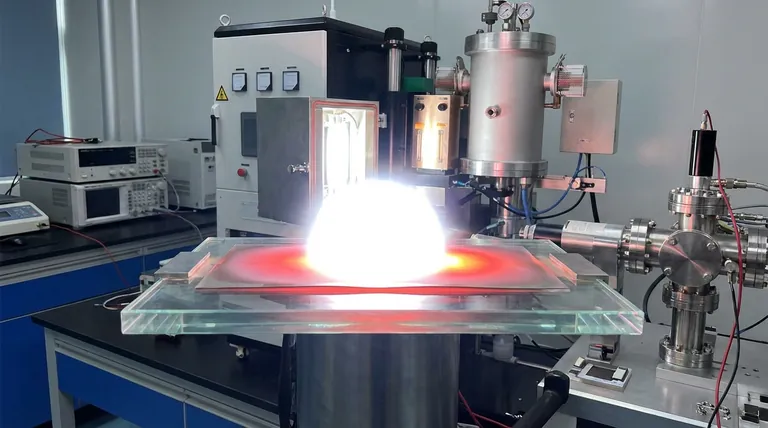
The Mechanics of Rapid Crystallization
Sub-Millisecond Energy Pulses
FLA equipment uses xenon lamps to generate extremely short pulses of energy. These pulses last less than a millisecond, delivering a concentrated burst of heat.
Selective Absorption
Unlike a furnace that heats the air and chamber walls, FLA relies on selective light absorption. The thin film absorbs the photonic energy directly, converting it into heat instantly.
Achieving High Peak Temperatures
This method allows the film to reach crystallization temperatures of approximately 600–800°C. This is sufficient to induce the necessary phase changes for high-performance piezoelectric properties.
Solving the Substrate Constraint
Overcoming the "Glass Ceiling"
Traditional muffle furnaces require prolonged heating to achieve crystallization. If you attempt to reach 600°C in a standard furnace, a glass substrate will likely deform or melt due to the sustained thermal load.
Utilizing Thermal Delay
FLA exploits the principle of thermal conduction delay. Because the heating duration is so short, the heat generated in the film does not have time to conduct fully into the substrate.
Preserving Substrate Integrity
Consequently, the substrate remains below 400°C. This capability is critical for in-situ growth on cost-effective or functional low-melting-point glass substrates that cannot survive traditional annealing.
Understanding the Trade-offs
The Value of Slow Annealing
While FLA excels at speed and substrate protection, the traditional programmable muffle furnace offers different benefits. It provides precise temperature cycle control, typically operating effectively between 200°C and 300°C for specific applications.
Managing Internal Stress
The slow, controlled nature of a muffle furnace allows for gradual atomic migration. This can help minimize internal thermal stress and eliminate structural defects, resulting in a dense and uniform film surface.
Crystallinity and Phase Transition
For substrates that can withstand the heat, or for processes requiring lower temperatures, muffle furnaces significantly promote the phase transition from an amorphous state to a crystalline phase. They ensure consistent grain size through steady thermal application.
Making the Right Choice for Your Goal
To select the correct annealing method, you must prioritize either substrate protection or stress minimization.
- If your primary focus is Substrate Compatibility: Choose Flash Lamp Annealing (FLA) to grow high-temperature films on heat-sensitive materials like glass without deformation.
- If your primary focus is Film Density and Stress Reduction: Choose a Programmable Muffle Furnace (if substrate permits) to minimize defects through precise, slow-cycle thermal control.
Ultimately, FLA is the enabling technology for combining high-performance ceramics with low-cost, low-temperature substrates.
Summary Table:
| Feature | Flash Lamp Annealing (FLA) | Traditional Muffle Furnace |
|---|---|---|
| Heating Speed | Sub-millisecond pulses | Slow, gradual cycles |
| Substrate Impact | Minimal (stays < 400°C) | High (heats entire assembly) |
| Target Temp | 600–800°C (film selective) | Uniform chamber temperature |
| Key Benefit | Use with low-temp substrates | Stress reduction & film density |
| Best For | Glass/flexible substrates | High-density crystallization |
Revolutionize Your Material Processing with KINTEK
Whether you need the rapid, selective energy of advanced annealing or the precision of controlled thermal cycles, KINTEK provides the expertise to elevate your lab's capabilities. Backed by expert R&D and world-class manufacturing, we offer a comprehensive range of Muffle, Tube, Rotary, Vacuum, and CVD systems, all fully customizable to meet your unique thin-film and ceramic research requirements.
Ready to overcome thermal constraints? Contact KINTEK today to find the perfect high-temperature solution for your lab!
References
- Longfei Song, Sebastjan Glinšek. Crystallization of piezoceramic films on glass via flash lamp annealing. DOI: 10.1038/s41467-024-46257-0
This article is also based on technical information from Kintek Furnace Knowledge Base .
Related Products
- High Temperature Muffle Oven Furnace for Laboratory Debinding and Pre Sintering
- Multi Heating Zones CVD Tube Furnace Machine for Chemical Vapor Deposition Equipment
- Controlled Inert Nitrogen Hydrogen Atmosphere Furnace
- 1200℃ Controlled Inert Nitrogen Atmosphere Furnace
- Electric Rotary Kiln Pyrolysis Furnace Plant Machine Small Rotary Kiln Calciner
People Also Ask
- What thermal phenomena occur during polymer binder burnout in ceramic green bodies? Lab Furnace Guide
- What role does a high-temperature muffle furnace play in STFO synthesis? Achieve Pure Perovskite Results
- Why is controlled heat treatment in a muffle furnace necessary for calcined clay? Achieve Optimal Pozzolanic Activity
- How does a high-temperature muffle furnace facilitate the formation of LaNbxAl1−xO3+δ perovskite structures? Key Roles
- What role does a high-temperature muffle furnace play in the multi-stage synthesis of Li0.5MnFe1.5O4? Key to Pure Spinel



















