
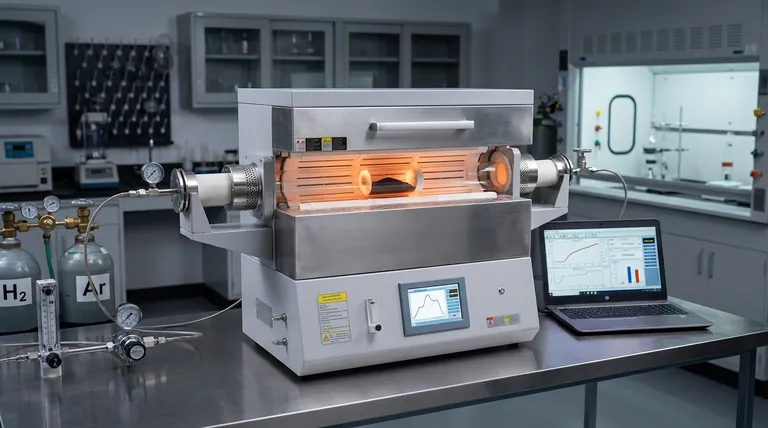
The tube high-temperature furnace functions as the primary reactor for the critical carbonization and reduction phases required to synthesize NiSA-O/Mo2C catalysts. It utilizes programmed temperature ramping and precise atmosphere switching to facilitate the in situ transformation of precursors into molybdenum-based carbides featuring unique double-shelled hollow structures.
The tube furnace provides the essential combination of thermal energy and environmental stability needed to regulate the material's phase composition and pore structure, turning raw precursors into a highly active catalytic architecture.
Driving the Chemical Transformation
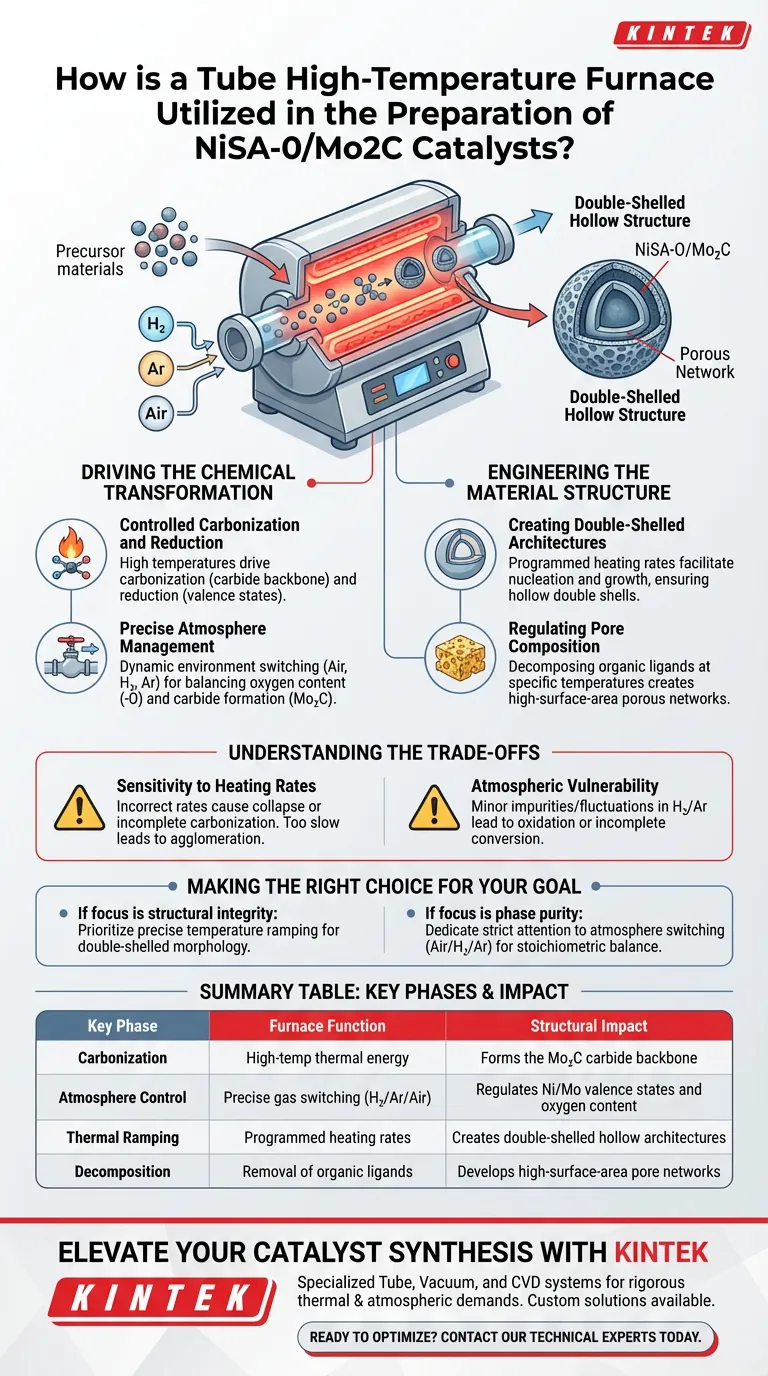
Controlled Carbonization and Reduction
The central role of the furnace is to drive the chemical conversion of precursor materials. By subjecting the material to high temperatures, the furnace initiates the carbonization process, which forms the carbide backbone of the catalyst. Simultaneously, it manages reduction tasks to ensure the correct valence states of the metal components.
Precise Atmosphere Management
The synthesis of NiSA-O/Mo2C requires a dynamic environment. The tube furnace allows operators to switch seamlessly between different gas atmospheres, such as air, hydrogen, and argon. This control is vital for defining the chemical nature of the catalyst, specifically balancing the oxygen content (the "-O" component) and the carbide formation (Mo2C).
Engineering the Material Structure
Creating Double-Shelled Architectures
The primary reference highlights that this specific catalyst possesses a "double-shelled hollow structure." The tube furnace facilitates this morphology through carefully programmed heating rates. The thermal treatment dictates how the material nucleates and grows, preventing collapse and ensuring the formation of these complex shells.
Regulating Pore Composition
Beyond the macro-shape, the furnace determines the internal porosity of the material. By decomposing organic ligands within the precursors at specific temperatures, the furnace creates a porous network. This high surface area is critical for exposing the active sites of the catalyst to reactants during its final application.
Understanding the Trade-offs
Sensitivity to Heating Rates
While the furnace allows for programmed ramping, incorrect heating rates can be detrimental. Rapid heating may cause structural collapse or incomplete carbonization, destroying the desired double-shelled morphology. Conversely, heating that is too slow may lead to excessive particle agglomeration, reducing catalytic surface area.
Atmospheric Vulnerability
The quality of the final Mo2C phase is strictly dependent on the purity and flow of the reduction gases. Even minor fluctuations in the hydrogen or argon atmosphere during the reduction phase can lead to unwanted oxidation or incomplete conversion, rendering the catalyst less effective.
Making the Right Choice for Your Goal
To optimize the preparation of NiSA-O/Mo2C catalysts using a tube furnace:
- If your primary focus is structural integrity: Prioritize the precision of your temperature ramping program to preserve the double-shelled hollow morphology.
- If your primary focus is phase purity: Dedicate strict attention to the atmosphere switching protocols (Air/H2/Ar) to ensure the correct stoichiometric balance of the carbide and oxide components.
Success in synthesizing this catalyst relies not just on reaching high temperatures, but on the precise orchestration of thermal and atmospheric cycles.
Summary Table:
| Key Phase | Furnace Function | Structural Impact |
|---|---|---|
| Carbonization | High-temp thermal energy | Forms the Mo2C carbide backbone |
| Atmosphere Control | Precise gas switching (H2/Ar/Air) | Regulates Ni/Mo valence states and oxygen content |
| Thermal Ramping | Programmed heating rates | Creates double-shelled hollow architectures |
| Decomposition | Removal of organic ligands | Develops high-surface-area pore networks |
Elevate Your Catalyst Synthesis with KINTEK
Precision is the difference between a collapsed structure and a high-performance NiSA-O/Mo2C catalyst. Backed by expert R&D and world-class manufacturing, KINTEK offers specialized Tube, Vacuum, and CVD systems designed for the rigorous thermal and atmospheric demands of modern material science.
Our lab high-temp furnaces provide the advanced temperature ramping and gas management systems essential for engineering complex double-shelled architectures. Whether you need a standard setup or a fully customizable solution tailored to your unique research needs, KINTEK delivers the reliability your lab deserves.
Ready to optimize your catalytic architecture? Contact our technical experts today and let us help you build the perfect furnace for your application.
Visual Guide
References
- Mengyun Hou, Chen Chen. Microenvironment reconstitution of highly active Ni single atoms on oxygen-incorporated Mo2C for water splitting. DOI: 10.1038/s41467-024-45533-3
This article is also based on technical information from Kintek Furnace Knowledge Base .
Related Products
- 1400℃ High Temperature Laboratory Tube Furnace with Alumina Tube
- 1700℃ High Temperature Laboratory Tube Furnace with Alumina Tube
- 1200℃ Split Tube Furnace Laboratory Quartz Tube Furnace with Quartz Tube
- Vertical Laboratory Quartz Tube Furnace Tubular Furnace
- High Pressure Laboratory Vacuum Tube Furnace
People Also Ask
- How does zone-melting in tube furnaces synthesize bismuth micro-wires? Master Single-Crystal Thermoelectric Growth
- How are high-temperature laboratory tube furnaces applied in long-term vacuum homogenization heat treatments for intermetallic samples?
- How do high-temperature laboratory tube furnaces ensure environmental stability? Precision Thermal Reduction Tips
- How are high-temp tube furnaces used to measure diffusion coefficients per Fick's law? Master Precision Annealing
- How are high-temperature tube furnaces applied in testing ceramic-supported alloy membranes? Insights



















