
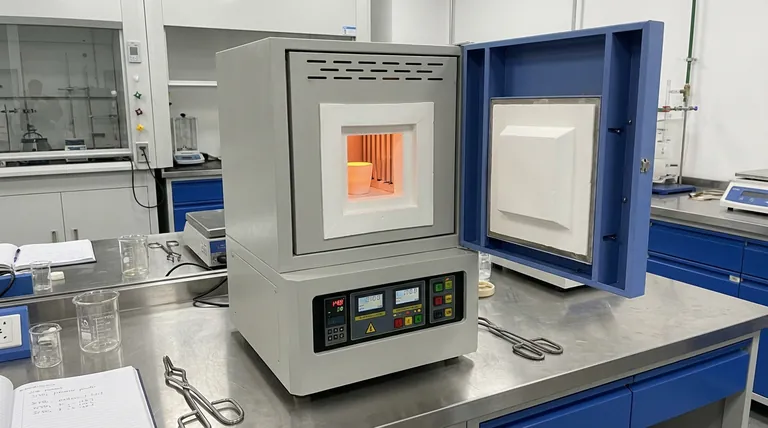
A high-temperature box furnace functions as a critical purification tool for SrVO3 precursors. It is primarily utilized to establish a contaminant-free foundation by removing moisture at 120 °C and burning off organic components, such as citrates, in an air environment at 600 °C. This thermal pretreatment is essential to prepare the powder for subsequent high-temperature reduction and phase transformation.
Core Takeaway The success of SrVO3 synthesis relies on a clean "blank slate" before final sintering. The high-temperature box furnace provides the controlled oxidative environment necessary to fully eliminate volatile impurities and organic binders, preventing structural defects during the final crystallization stages.
The Two-Stage Pretreatment Process
For SrVO3 precursors, the high-temperature box furnace is not just a heater; it is a chemical purification chamber. It executes a specific two-step thermal profile designed to stabilize the raw material.
Stage 1: Moisture Elimination
The first function of the furnace is to hold the precursors at approximately 120 °C.
At this temperature, absorbed water and surface moisture are evaporated from the powder. This prevents the rapid expansion of steam during higher-temperature stages, which could otherwise lead to cracks or structural inconsistencies in the material.
Stage 2: Organic Decomposition
Following drying, the temperature is raised to 600 °C in an air environment.
This stage is critical for burning off organic components, specifically citrates used during the precursor synthesis. The aerobic (air) environment allows these organics to oxidize and exit the material as gas.
Creating the Foundation
The primary output of this furnace process is not the final sintered ceramic, but a highly purified powder.
By ensuring all citrates and moisture are removed, the furnace creates a "clean foundation." This purity is required for the subsequent steps—high-temperature reduction and phase transformation—to proceed without interference from residual carbon or contaminants.
Mechanics of Decontamination
Thermal Oxidation
The box furnace leverages a stable thermal field to facilitate solid-state reactions.
In the context of SrVO3 precursors, the 600 °C stage breaks down the organic polymer networks. This effectively "resets" the chemical structure, leaving behind only the inorganic elements required for the final crystal lattice.
Gas Discharge
A critical function of the furnace is to ensure volatile components are fully discharged.
During the decomposition of organics, gases such as carbon dioxide are generated. The box furnace design allows these gases to escape the powder bed, preventing them from being trapped within the densifying material later in the process.
Understanding the Trade-offs
While the high-temperature box furnace is essential for purity, improper operation can compromise the sample.
Risk of Incomplete Oxidation
If the dwell time at 600 °C is insufficient, organic residues (carbon) may remain in the powder.
These residues can act as impurities during the final phase transformation, potentially disrupting the formation of the desired perovskite structure or altering the electronic properties of the SrVO3.
Thermal Shock and Airflow
Ramping temperatures too aggressively can be detrimental.
Although the primary goal is burning off organics, rapid heating can generate violent gas flows from decomposing materials. In some contexts, this can displace the powder or cause physical defects. A controlled, gradual ramp is often necessary to maintain sample integrity.
Making the Right Choice for Your Goal
To maximize the utility of a high-temperature box furnace for SrVO3 precursors, align your thermal profile with your specific purity requirements.
- If your primary focus is Purity: Ensure the hold time at 600 °C is generous to guarantee the complete oxidation of all citrate binders before moving to reduction steps.
- If your primary focus is Structural Integrity: Utilize a conservative heating ramp between 120 °C and 600 °C to allow gases to escape slowly without disrupting the powder bed.
The box furnace is the gatekeeper of quality, ensuring that only chemically pure material proceeds to the final, critical stages of synthesis.
Summary Table:
| Stage | Temperature | Environment | Primary Objective |
|---|---|---|---|
| Moisture Elimination | 120 °C | Air | Evaporate absorbed water and prevent steam-induced cracks |
| Organic Decomposition | 600 °C | Air | Burn off citrates and oxidize organic polymer networks |
| Thermal Oxidation | Up to 600 °C | Controlled | Reset chemical structure and ensure gas discharge (CO2) |
| Powder Preparation | Final Phase | Oxidative | Create a purified foundation for final phase transformation |
Elevate Your Materials Research with KINTEK
Precision in the calcination and sintering of SrVO3 precursors requires more than just heat—it requires the absolute thermal stability and controlled environments found in KINTEK high-temperature box furnaces.
Backed by expert R&D and manufacturing, KINTEK offers a comprehensive range of Muffle, Tube, Rotary, Vacuum, and CVD systems. Whether you are removing organic binders or conducting complex phase transformations, our lab high-temp furnaces are fully customizable to meet your unique research needs.
Ready to ensure the purity of your synthesis? Contact KINTEK today to discuss your furnace requirements!
References
- Md Sariful Sheikh, John H. Booske. Time dependence of SrVO3 thermionic electron emission properties. DOI: 10.1063/5.0186012
This article is also based on technical information from Kintek Furnace Knowledge Base .
Related Products
- 1400℃ High Temperature Laboratory Tube Furnace with Alumina Tube
- 1700℃ High Temperature Laboratory Tube Furnace with Alumina Tube
- 1800℃ High Temperature Muffle Oven Furnace for Laboratory
- 1700℃ High Temperature Muffle Oven Furnace for Laboratory
- 1200℃ Muffle Oven Furnace for Laboratory
People Also Ask
- How does zone-melting in tube furnaces synthesize bismuth micro-wires? Master Single-Crystal Thermoelectric Growth
- How are high-temp tube furnaces used to measure diffusion coefficients per Fick's law? Master Precision Annealing
- How do high-temperature laboratory tube furnaces ensure environmental stability? Precision Thermal Reduction Tips
- How are high-temperature laboratory tube furnaces applied in long-term vacuum homogenization heat treatments for intermetallic samples?
- How are high-temperature tube furnaces applied in testing ceramic-supported alloy membranes? Insights



















