
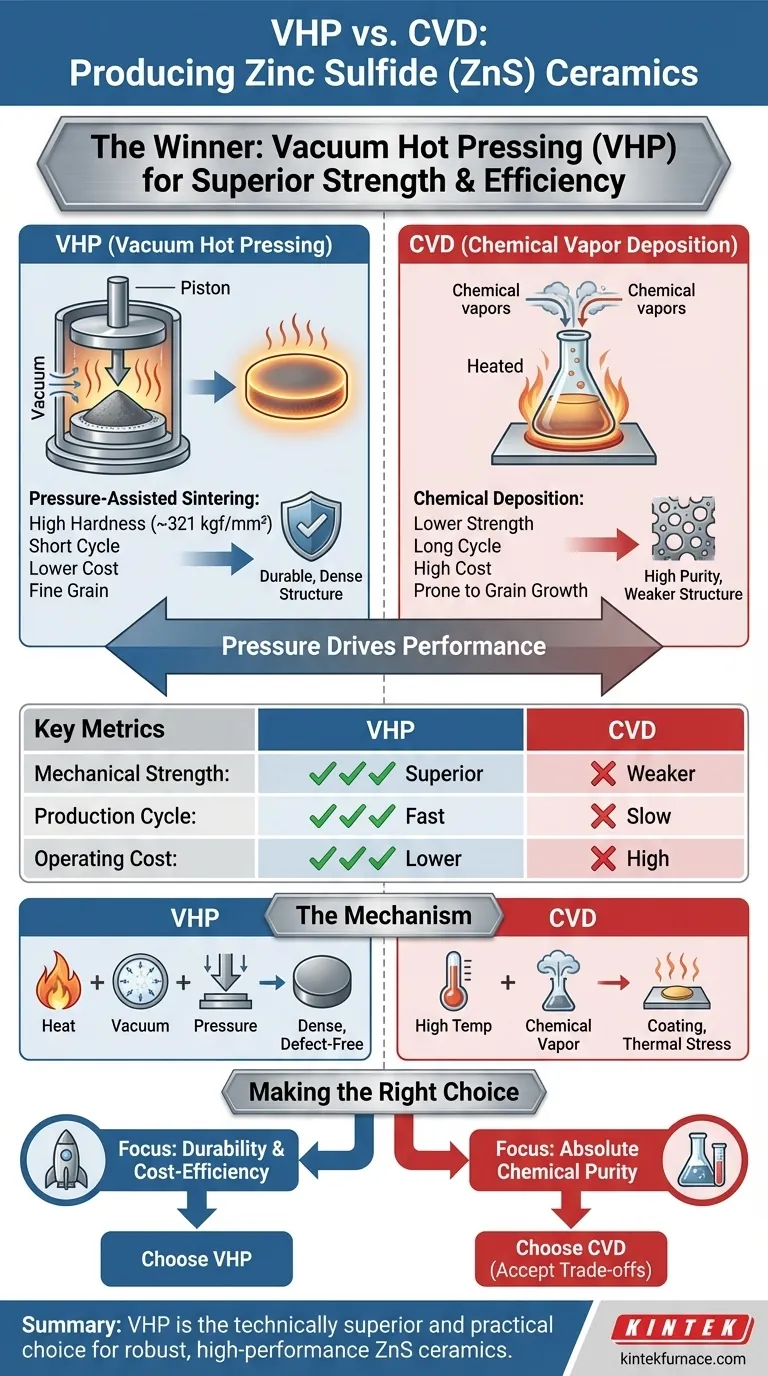
Vacuum Hot Pressing (VHP) significantly outperforms Chemical Vapor Deposition (CVD) when prioritizing mechanical strength and production efficiency for Zinc Sulfide (ZnS) ceramics.
While CVD is capable of producing high-purity material, it suffers from long production cycles, high costs, and results in mechanically weaker components. Conversely, VHP utilizes pressure-assisted sintering to produce ceramics with superior hardness and optimized microstructures, making them the standard for harsh environments like missile domes.
Core Takeaway For applications requiring structural durability and cost-effective manufacturing, VHP is the decisive winner over CVD. VHP overcomes the mechanical limitations of CVD by achieving near-theoretical density and higher hardness through a faster, pressure-driven process.
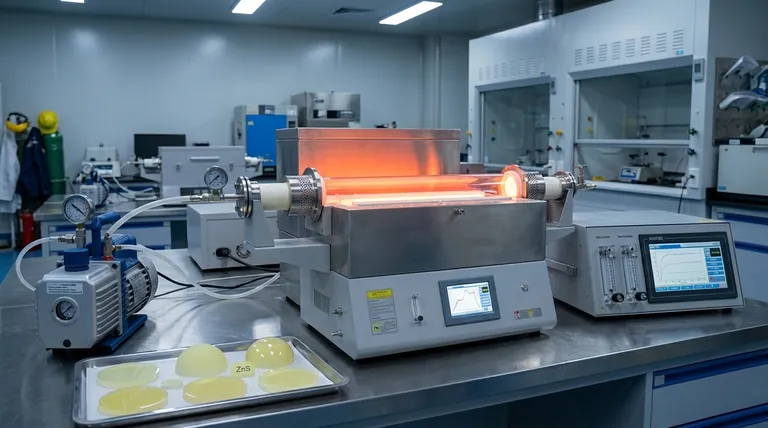
Mechanical Properties: Why VHP Yields Stronger Ceramics
Superior Hardness and Microstructure
VHP produces ZnS ceramics with significantly higher mechanical strength than those produced by CVD.
The process yields an optimized microstructure with elevated hardness values, such as 321 kgf/mm², which is critical for components that must withstand physical stress.
The Detriment of High CVD Temperatures
CVD processes often require extreme deposition temperatures ranging from 900°C to 2000°C.
These high temperatures can cause structural changes and deformation in the substrate material. This thermal stress frequently leads to a reduction in the overall mechanical properties of the body and weakens the bond between the coating and the substrate.
Grain Growth Suppression
VHP applies mechanical pressure (typically around 15–20 MPa) during heating.
This pressure allows for densification at lower temperatures, which suppresses excessive grain growth. Finer grain structures correlate directly to improved mechanical strength and toughness in the final ceramic.
Efficiency and Cost: The VHP Advantage
Reduced Production Cycle
The VHP process offers a significantly shorter production cycle compared to the slow deposition rates of CVD.
By simultaneously applying heat and pressure, VHP achieves densification much faster than the chemical growth process required by CVD.
Lower Equipment Costs
CVD involves complex, expensive equipment to manage volatile chemical precursors and high-temperature environments.
In contrast, VHP furnaces are generally simpler and lower in cost to operate. This makes VHP a more economically viable option for industrial-scale production of ZnS ceramics.
The Mechanism: How VHP Achieves Density
Simultaneous Vacuum, Heat, and Pressure
The success of VHP lies in the simultaneous application of high temperature (approx. 1020°C), high vacuum (10^-3 to 10^-5 mtorr), and mechanical pressure.
This combination creates a "pressure-assisted sintering" mechanism. It forces particle rearrangement and plastic flow that CVD simply cannot replicate.
Elimination of Defects
The high vacuum environment is essential for extracting volatile impurities and trapped gases from the powder interstices.
By forcibly removing these micro-pores, VHP creates a dense structure close to theoretical density. This not only improves strength but also ensures excellent infrared transmittance by minimizing light scattering.
Understanding the Trade-offs
Purity vs. Strength
While the primary reference notes that CVD produces high-purity ZnS, this purity comes at the cost of mechanical integrity.
If absolute chemical purity is the sole metric, CVD has merit; however, for any application involving physical stress or impact, the structural weakness of CVD is a major liability.
Thermal Constraints
CVD's high-temperature requirement restricts the choice of suitable substrate materials.
VHP operates at relatively lower temperatures (960°C–1040°C) due to the assistance of physical pressure, allowing for a wider range of processing options without deforming the component.
Making the Right Choice for Your Project
When selecting a manufacturing method for Zinc Sulfide ceramics, align your choice with your specific environmental requirements.
- If your primary focus is Durability and Impact Resistance: Choose Vacuum Hot Pressing (VHP) for its superior hardness and optimized microstructure, essential for missile domes and protective windows.
- If your primary focus is Cost and Speed: Choose Vacuum Hot Pressing (VHP) to leverage its shorter production cycles, lower equipment costs, and operational simplicity.
- If your primary focus is Absolute Chemical Purity: Acknowledge that CVD offers high purity, but be prepared to accept higher costs, longer lead times, and reduced mechanical strength.
Summary: For robust, high-performance ZnS ceramics delivered efficiently, Vacuum Hot Pressing is the technically superior and most practical manufacturing route.
Summary Table:
| Feature | Vacuum Hot Pressing (VHP) | Chemical Vapor Deposition (CVD) |
|---|---|---|
| Mechanical Strength | Superior (Hardness ~321 kgf/mm²) | Lower (Structural weakness) |
| Production Cycle | Short (Fast densification) | Long (Slow deposition rates) |
| Operating Cost | Lower (Simpler equipment) | High (Complex precursor management) |
| Microstructure | Fine grain; near-theoretical density | Prone to grain growth & thermal stress |
| Typical Use Case | Durable missile domes & windows | High-purity specialized coatings |
Optimize Your Ceramic Production with KINTEK
Are you looking to achieve maximum durability and cost-efficiency for your Zinc Sulfide (ZnS) components? Backed by expert R&D and manufacturing, KINTEK offers high-performance Vacuum Hot Pressing systems, Muffle, Tube, Rotary, and CVD systems—all fully customizable to meet your unique lab and industrial needs.
Our advanced high-temperature furnaces empower you to produce near-theoretical density materials with superior mechanical integrity and faster turnaround times. Don't settle for less—partner with KINTEK to elevate your material science capabilities.
Contact Our Experts Today to Find Your Custom Solution
Visual Guide
Related Products
- Dental Porcelain Zirconia Sintering Ceramic Vacuum Press Furnace
- Vacuum Hot Press Furnace Machine for Lamination and Heating
- Vacuum Hot Press Furnace Machine Heated Vacuum Press
- Vacuum Hot Press Furnace Machine Heated Vacuum Press Tube Furnace
- 600T Vacuum Induction Hot Press Vacuum Heat Treat and Sintering Furnace
People Also Ask
- What factors determine the quality of sintered zirconia restorations? Master Material, Equipment, and Technique
- How do conventional vs rapid sintering in dental furnaces affect zirconia? Optimize Efficiency Without Sacrificing Strength
- What is the purpose of dental sintering furnaces? Transform Zirconia into Durable, High-Quality Dental Restorations
- What precautions should be taken when sintering zirconia in the Fast Slow Dental Sintering Furnace? Master Key Steps for Perfect Results
- What temperature range is used for sintering zirconia ceramics? Achieve Optimal Strength and Translucency









